Label Printing Machine Selection by Production Scenario: Matching Press Type to Real Needs
Label Printing Machine Selection by Production Scenario: Matching Press Type to Real Needs
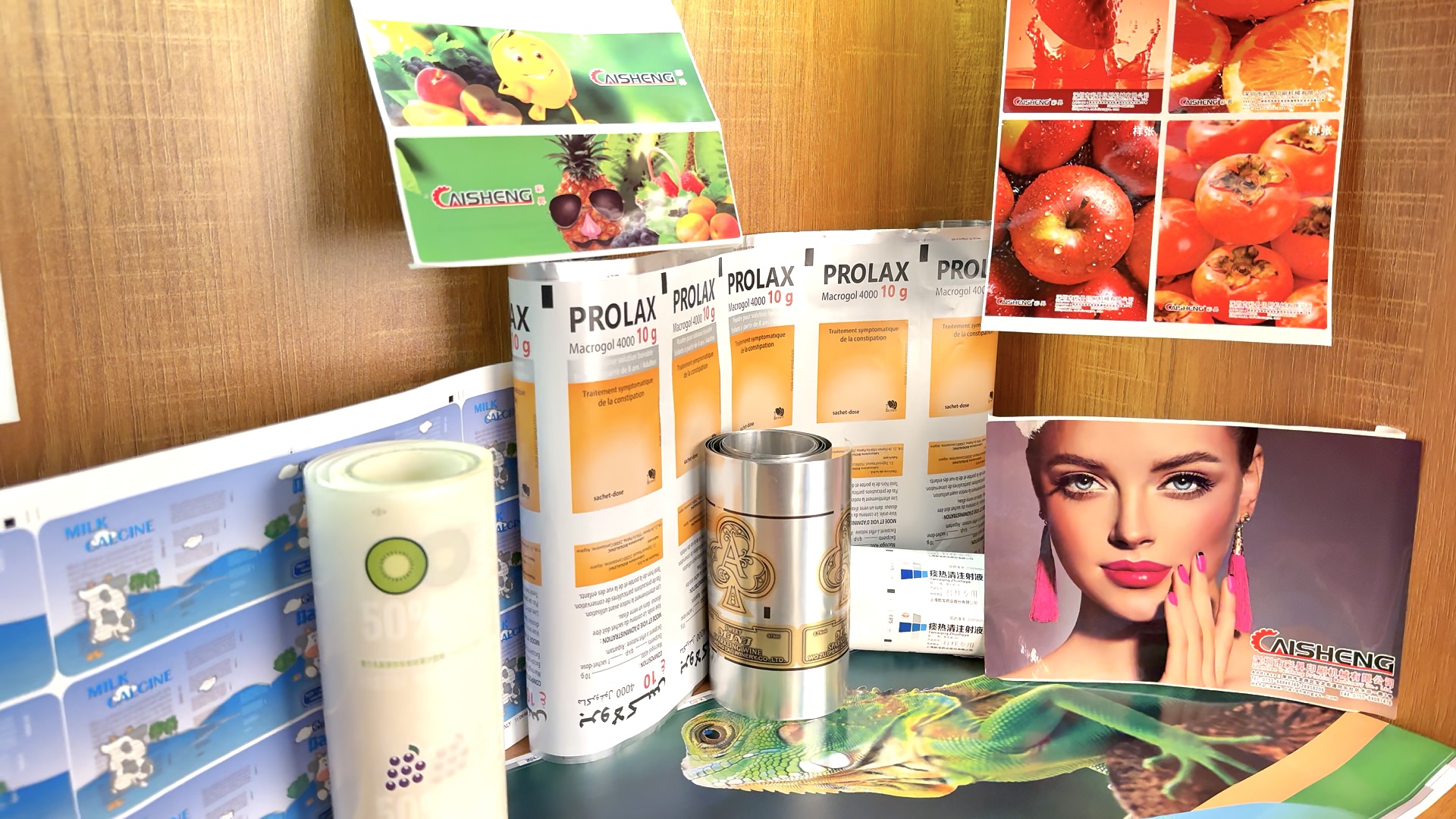
CAISHENG label printing machines support self-adhesive labels for daily chemicals, wine, food, cosmetics, pharmaceuticals, and wristbands.
Choosing a label printing machine is essentially a scenario-matching exercise. A converter who prints short-run cosmetic labels has different production constraints from a converter running long-run food labels. This guide helps buyers match press architecture, finishing modules, and speed to their actual label portfolio. The focus is on self-adhesive label production and the type of integrated systems that allow one machine to complete multiple processes in a single pass.
Problem Definition: Why a Generic Press Often Fails
Label converters often begin with a simple request — a label printing machine — but the real requirement is usually a Label Printing Solution System. Labels for daily chemicals, wine, food, cosmetics, pharmaceuticals, and wristbands share a need for registration accuracy, consistent color, and clean die-cutting, but they differ in run length, material, and finishing. Many facilities also need to change from short-run intermittent printing to high-volume full-rotary printing without buying a second press. A press with the wrong web width, insufficient color units, or no inline finishing creates bottlenecks and increases operating cost. The core challenge is to define the production scenario first, then select the machine that fits it.
Industry Background: Market Growth and Compliance Pressure
Market data helps explain why machine selection is becoming more complex. The global label printing machines market was valued at USD 8.58 billion in 2025 and is projected to reach USD 14.36 billion by 2034, according to The Insight Partners. Smithers reports that flexographic printing remains the most commonly used process for labels, valued at approximately USD 13.3 billion in output value. Grand View Research estimates the global flexographic printing machine market at USD 17.57 billion in 2024, with a projected 9.7% CAGR through 2030. Data Bridge Market Research states that Asia-Pacific dominated the label printing machines market with a 41.8% revenue share in 2025. For narrow web label presses specifically, Spherical Insights projects growth from USD 1.43 billion in 2024 to USD 3.21 billion by 2035.
Compliance is also part of the project requirement. Machinery sold in the EU must comply with the Machinery Directive 2006/42/EC and carry CE marking, with safety signs following EN ISO 7010. For graphic technology equipment including label presses, ISO 12643-2:2023 is the relevant international safety standard. Buyers should use these requirements as a filter when comparing suppliers and machine configurations.
Detailed Solution: CAISHENG Label Printing Machine Platforms
Shenzhen Caisheng Printing Machinery Co., Ltd. (CAISHENG) is a Shenzhen-based manufacturer of label printing equipment. Founded in 2011, CAISHENG operates a 6,000 m² factory with 65 employees, including 8 R&D engineers, and produces about 200 units per year. Around 50% of its output is exported to Southeast Asia, Europe, the Middle East, and the United States. The company specializes in intermittent letterpress and high-speed full-rotary letterpress label printing machines, flexographic printing machines, and screen printing machines, plus die-cutting and varnishing finishing equipment.
CAISHENG's guiding philosophy is 'One Machine, Multiple Functions, Caisheng Manufacturing.' Instead of offering only a basic press, CAISHENG provides ODM and one-to-one customized design, size, process, and function options. Available process modules include color stamping, glue-side printing frame, cold foil stamping, lamination, offline/online UV varnishing, flatbed die-cutting, rotary die-cutting, sheet cutting, slitting, corona treater, dust cleaner, static eliminator, full-rotary screen printing, hot foil stamping, and embossing. Supporting equipment can include a servo system, air cooling system, water cooling system, and UV drying lamp. The system is designed to work in normal room temperature and does not require a constant-temperature production workshop.
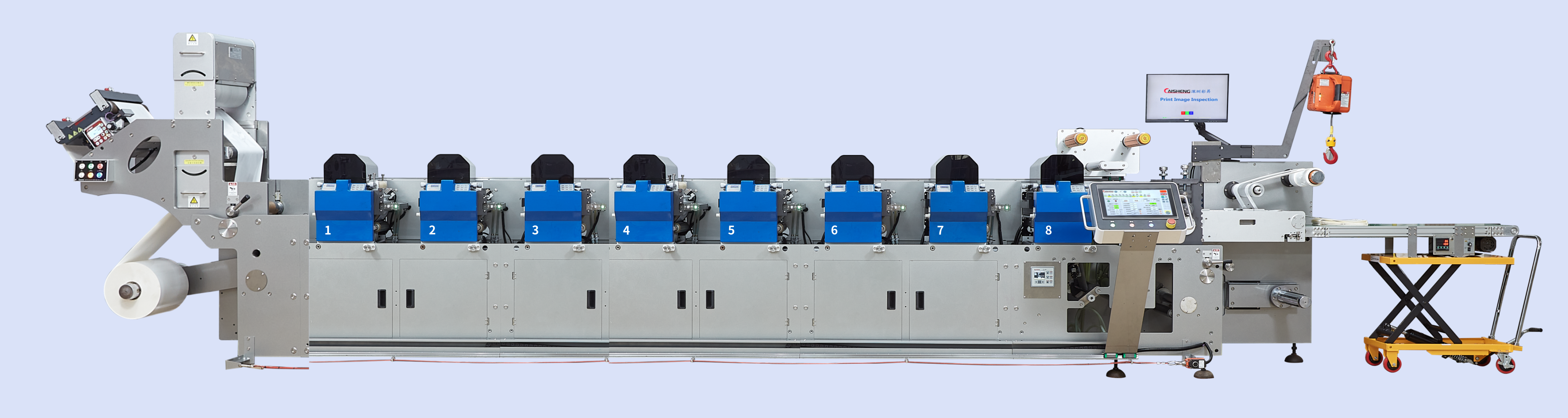
CS-370F-8C full-rotary flexo printing machine: a high-speed full rotation flexo press for label production.
CAISHENG's product range covers several project profiles:
- Intermittent letterpress label printing machines: CS-220-4C, CS-220-5C, CS-300-5C, CS-300-6C, CS-320-6C, and CS-320-7C. These models are often used as stickers printing machines, self-adhesive label presses, or semi-rotary label printing machines for short-to-medium runs at up to 40 m/min.
- Intermittent and full-rotary high-speed label printing machines: CS-JQ350-7C, CS-JQ350G-6C, and CS-JQ350G-10C. These combine intermittent label press flexibility with full-rotary label press speed: 60 m/min in intermittent mode and 158 m/min in full-rotary mode.
- Flexo label printing machines: CS-J380F-4C, CS-J380F-7C, CS-Q370F-6C, and CS-370F-8C. The semi-rotary flexo models are flexible flexographic presses; the full rotary flexo models reach 150 m/min and suit high-volume flexo label printing.
- Finishing and multifunctional equipment: CS-350 high speed die-cutting machine, CS-Q380V high-speed corona oil integrated machine, and VS-250W full rotation screen printing multifunctional machine.
Step-by-Step Breakdown: From Label Portfolio to Machine Specification
The following workflow can be used by engineering and purchasing teams to translate production scenarios into a machine configuration.
- Map your label portfolio and run lengths. List label types by industry: daily chemicals, cosmetics, food, wine, pharmaceuticals, wristbands, or industrial chemical labels. Note typical run length, number of SKUs, and label dimensions.
- Choose the printing technology. Flexographic printing is the most commonly used label process globally; it offers broad material compatibility. Letterpress is a common choice for labels requiring sharp solids and clean text. Screen printing adds opaque or high-opacity effects and is often used for specialty labels.
- Define the number of colors and special processes. For wine labels, cold foil stamping or glue-side printing may be needed. For cosmetics, hot foil stamping, embossing, or full-rotary screen printing may be required. For chemical labels, varnishing or lamination can improve resistance.
- Select web width and print area. A compact CS-220-4C or CS-220-5C covers web widths from 30 to 240 mm. The CS-300 series covers 30 to 300 mm. The CS-320 series covers 30 to 320 mm. The CS-JQ350 series and CS-Q370F series support 350 mm or 370 mm printing widths for larger labels.
- Decide between intermittent, full-rotary, or combined operation. Intermittent presses such as the CS-320-6C or CS-J380F-4C are economical for variable repeat lengths and short runs. Full-rotary presses such as the CS-Q370F-6C are designed for long runs at high speed. Combined machines like the CS-JQ350G-6C allow both modes in one label printing machine.
- Add inline finishing modules. A one-stop solution should reduce offline work. Typical modules include rotary die-cutting, flatbed die-cutting, UV varnishing, corona treatment, slitting, and sheet cutting. The CS-350 high speed die-cutting machine can be used for dedicated finishing, while the CS-Q380V provides inline varnishing for digital print finishing.
- Verify compliance and safety documentation. For EU-bound equipment, confirm that the full machine and its safety components are designed to meet the Machinery Directive 2006/42/EC and EN ISO 7010 requirements. ISO 12643-2:2023 is also relevant for graphic technology equipment.
- Confirm supplier capability and lead time. CAISHENG supports ODM, has a monthly production capacity of 18 units, an MOQ of 1 unit, and a normal lead time of 45 to 60 days. Quality control includes 100% testing before shipment, remote support, and a one-year warranty for major components.
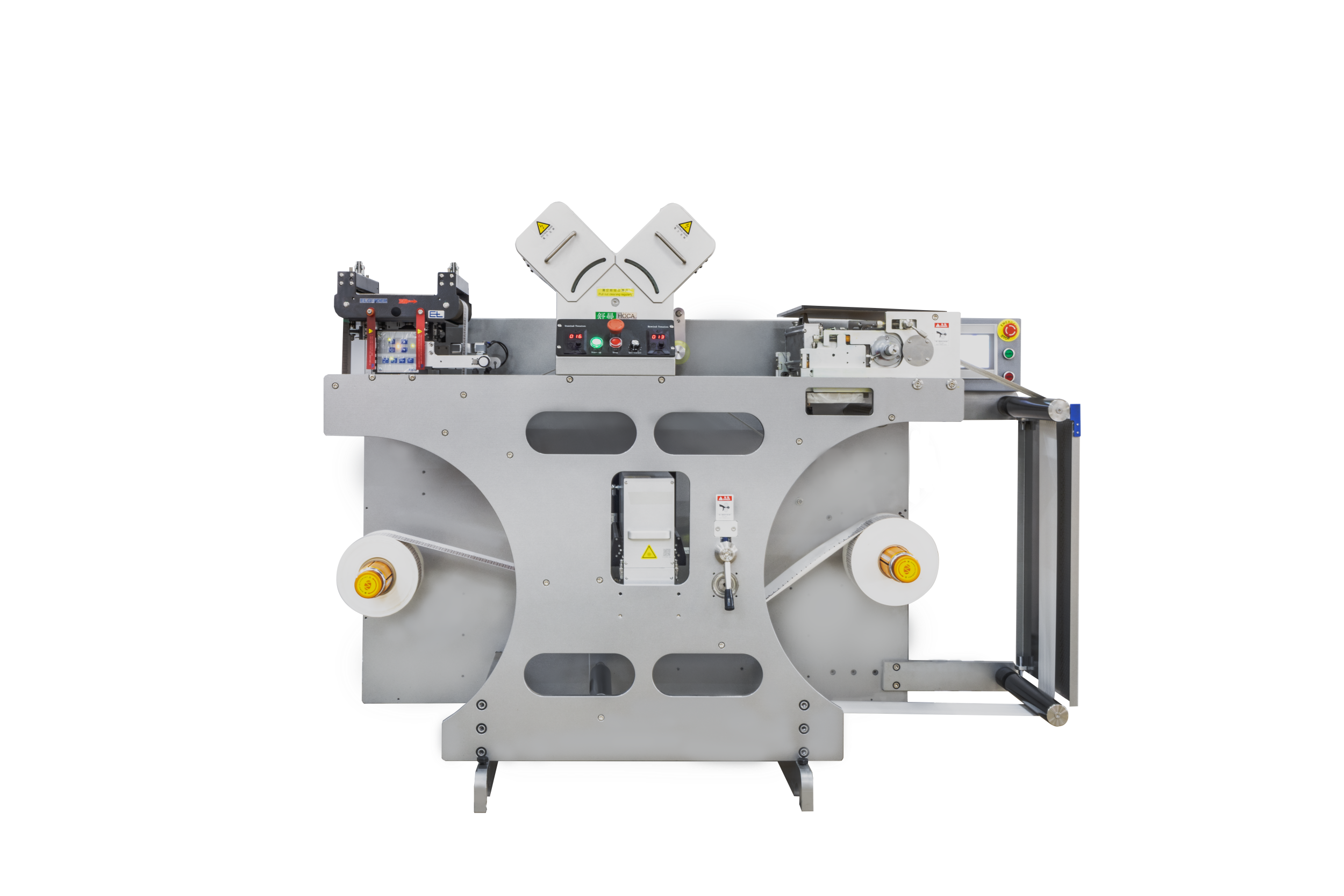
CS-Q380V high-speed corona oil integrated machine: a varnishing solution designed for digital print finishing.
Use Cases: Matching Machine Configurations to Real Projects
CAISHENG's application scenario unit lists self-adhesive labels for daily chemicals, chemicals, wristbands, wine labels, food, cosmetics, and pharmaceuticals. Below are practical machine matches for these project types.
Daily Chemical and Household Care Labels
Daily chemical labels often need strong color, chemical-resistant coating, and clean rotary die-cutting. The CS-300-6C or CS-320-6C intermittent letterpress machines are practical choices. They support web widths up to 300 mm or 320 mm, a maximum full-rotary printing area of 280x326 mm or 320x326 mm, and 40 m/min intermittent speed. This class of rotation label machine can be configured with glue-side printing, cold foil, flatbed die-cutting, and rotary die-cutting to finish labels in one pass.
Food and Beverage Labels
Food labels and wine labels often require short-to-medium runs with frequent design changes. A combined intermittent and full-rotary label press such as the CS-JQ350G-6C provides flexibility: 60 m/min for intermittent jobs and 158 m/min for full-rotary work. Its maximum full-rotary printing area is 350x419 mm, and its maximum intermittent printing area is 350x380 mm. For long-run flexo work, the CS-Q370F-6C full rotary flexographic printing machine runs at 150 m/min with printing areas of 370x200 mm or 370x600 mm. For additional protection or digital print finishing, the CS-Q380V high-speed corona oil integrated machine can apply varnish inline.
Cosmetics and Specialty Labels
Cosmetic labels often call for special effects. The VS-250W full rotation screen printing multifunctional machine has a maximum screen printing area of 240x240 mm and a maximum die-cutting area of 240x240 mm. It can be combined with optional hot foil stamping, embossing, flatbed die-cutting, or rotary die-cutting. This makes it suitable for premium cosmetic labels that need opaque ink, tactile texture, or decorative metallic effects.
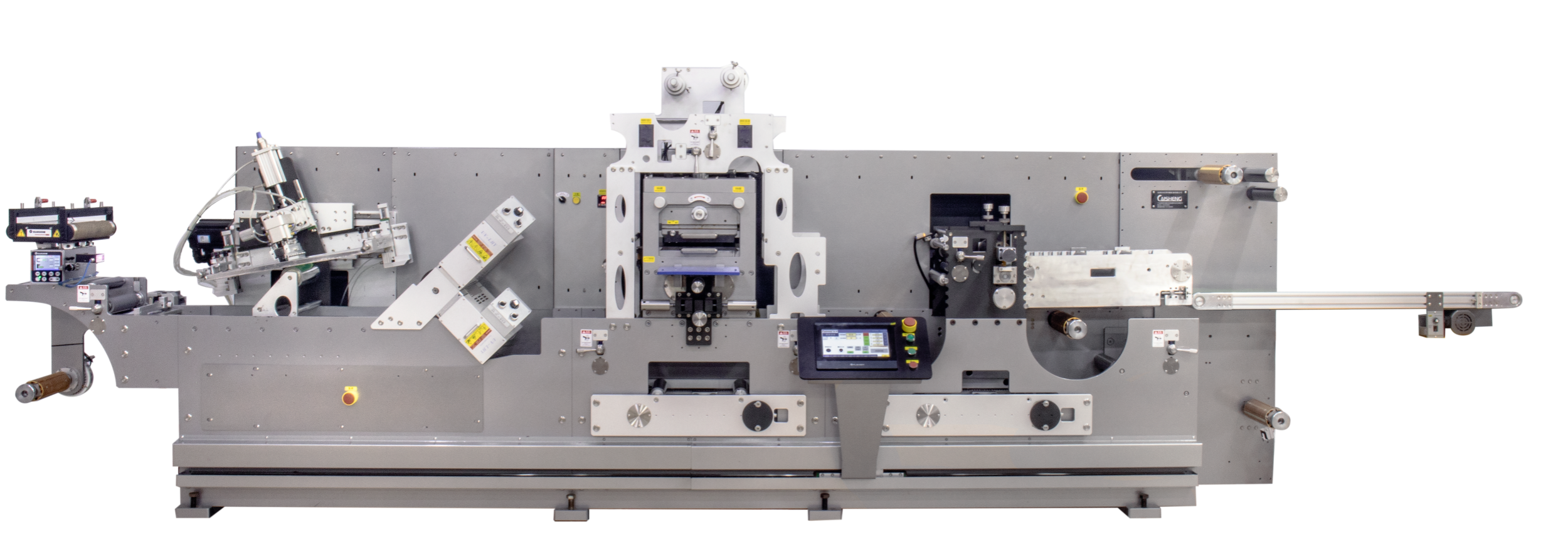
VS-250W full rotation screen printing multifunctional machine with optional hot foil stamping, embossing, or flatbed and rotary die-cutting.
Pharmaceutical and Wristband Labels
Pharmaceutical labels and wristbands need precise registration and flexible volumes. The CS-JQ350-7C combines intermittent and full-rotary letterpress printing in one machine. It has a 350 mm web, a maximum full-rotary printing area of 350x419 mm, a maximum intermittent printing area of 350x380 mm, and speeds of 60 m/min and 158 m/min. For smaller formats, the CS-220-5C stickers printing machine supports a web width of 30 to 240 mm and a maximum full-rotary printing area of 220x245 mm, making it an option for compact label and wristband production with flatbed die-cutting.
High-Volume Industrial and Chemical Labels
Industrial chemical labels are often produced in higher volumes on flexo or full-rotary presses. The CS-370F-8C full rotation flexo press prints at 150 m/min and is designed for long-run flexographic label printing. Finishing can be handled by the CS-350 high speed die-cutting machine, which runs at 60 m/min in intermittent mode and 160 m/min in full-rotary mode, with maximum die-cutting areas of 350x460 mm and 350x420 mm respectively.
Case Evidence
CAISHENG has documented project results. A renowned Asian trademark design and printing company used CS-320 series label presses for high-quality label printing. After two years, the client recognized the machines' printing precision, stable production performance, and flexible process expansion capabilities. In another case, Donnelley & Sons (RRD), a global provider of commercial printing, packaging, and multichannel marketing communication solutions, used a CS-300 as label printing production equipment. Over three years, the CS-300 gained high recognition for stable registration accuracy, print quality, and reliable equipment performance, and the equipment helped improve production efficiency and product quality.
Comparison Table: CAISHENG Label Printing Machine Series by Project Fit
The table below compares representative CAISHENG models by drive type, print area, maximum speed, and typical project fit. All data is based on published CAISHENG product specifications.
| Series / Model | Machine Type | Max Printing Area | Max Speed | Typical Project Fit |
|---|---|---|---|---|
| CS-220-4C / CS-220-5C | Intermittent letterpress label printing machine | Full rotary: 220x245 mm; intermittent: 220x200 mm | 40 m/min | Compact stickers printing, small self-adhesive labels, wristbands |
| CS-300-5C / CS-300-6C | Intermittent letterpress label printing machine | Full rotary: 280x326 mm; intermittent: 280x300 mm | 40 m/min | Daily chemical, food, and self-adhesive label projects with glue-side or die-cutting options |
| CS-320-6C / CS-320-7C | Intermittent letterpress label printing machine / rotary label press | Full rotary: 320x326 mm; intermittent: 320x300 mm | 40 m/min | Cosmetics, chemicals, pharmaceutical labels with cold foil, embossing, or rotary die-cutting |
| CS-JQ350-7C | Intermittent & full-rotary label press machine | Full rotary: 350x419 mm; intermittent: 350x380 mm | 60 / 158 m/min | Mixed short-run and long-run multi-process label printing |
| CS-JQ350G-6C | High-speed label printing machine | Full rotary: 350x419 mm; intermittent: 350x380 mm | 60 / 158 m/min | High-speed food, beverage, and daily chemical label production |
| CS-JQ350G-10C | Full-rotary label press with LED UV | Full rotary: 350x419 mm; intermittent: 350x380 mm | 60 / 158 m/min | High color count and complex integrated label projects |
| CS-J380F-4C / CS-J380F-7C | Semi-rotary flexo / flexographic press | Full rotary: 360x419 mm; intermittent: 360x380 mm | 60 m/min | Flexible flexo label printing for shorter runs and frequent changeovers |
| CS-Q370F-6C / CS-370F-8C | Full rotary flexographic printing machine | 370x200 mm / 370x600 mm | 150 m/min | High-volume flexo label printing, long-run industrial labels |
| VS-250W | Full rotation screen printing multifunctional machine | Screen printing: 240x240 mm; die-cutting: 240x240 mm | Not specified | Screen effects, hot foil stamping, embossing, flatbed and rotary die-cutting |
| CS-350 | High speed die-cutting machine | Full rotary: 350x460 mm; semi-rotary: 350x420 mm | 60 / 160 m/min | Dedicated high-speed rotary die-cutting and finishing |
| CS-Q380V | High-speed corona oil integrated machine | Max web width: 360 mm | 100 m/min | Varnishing and digital print finishing |
FAQ: Common Project-Level Questions
What compliance standards apply to label printing machines?
For graphic technology equipment including label presses, ISO 12643-2:2023 is the relevant international safety standard. Machinery sold in the EU must comply with the Machinery Directive 2006/42/EC and carry CE marking, with safety signs following EN ISO 7010. Buyers should request a compliance declaration from the supplier for the specific machine model and destination market.
Can one label printing machine handle multiple processes such as printing, die-cutting, and varnishing?
Yes. CAISHENG machines are designed around 'One Machine, Multiple Functions.' Depending on the model, configurations can include glue-side printing, cold foil stamping, lamination, offline/online UV varnishing, flatbed die-cutting, rotary die-cutting, sheet cutting, slitting, corona treater, dust cleaner, static eliminator, full-rotary screen printing, hot foil stamping, and embossing. This enables printing factories to complete multi-process printing on a single machine as a one-stop solution for adhesive label printing technology issues.
What factors affect the budget for a label printing machine?
Budget depends on web width, number of color units, printing technology (letterpress, flexo, or screen), whether the press is intermittent, full-rotary, or combined, the selected finishing modules, UV drying system, and the level of customization. A compact stickers printing machine like the CS-220-4C or CS-220-5C represents a different investment than a high-speed full-rotary label press like the CS-JQ350G-10C. Define your label portfolio and required processes before requesting price quotations.
Can I get samples or a test run before ordering?
CAISHENG supports ODM and customized machine design and performs 100% testing before delivery. For project-specific sample evaluation, contact CAISHENG with your substrates, label sizes, and finishing requirements so the engineering team can recommend a configuration and discuss a test plan. The company also provides remote support after delivery and a one-year warranty for major components.
What is the lead time for a customized label press?
For CAISHENG, the MOQ is 1 unit, monthly production capacity is 18 units, and normal lead time is 45 to 60 days depending on configuration. After-sales support includes remote support and a one-year warranty for major components. For a project-specific lead time and configuration, send an inquiry to CAISHENG.
Conclusion
Matching a label printing machine to a production scenario means aligning label type, run length, colors, finishing processes, compliance, and lead time. CAISHENG offers letterpress, flexo, screen, and finishing equipment — from compact 220 mm stickers printing machines to 350 mm and 370 mm high-speed presses — with ODM customization and documented project cases. Start with your scenario, not with a product name, and use the parameter table as a decision filter.
Need help selecting a label printing machine for your next project? Download the CAISHENG brochure or contact the CAISHENG team for a project-specific configuration, quotation, or sample discussion.
CAISHENG project inquiries: contact the team for a label printing machine configuration matched to your scenario.
Have Questions or Need More Details?
Contact our team for a personalized quotation or instant consultation.
Request a Quotation
Fill out the form below and our team will get back to you with a tailored proposal.
WhatsApp Direct Chat
Prefer to chat in real-time? Message us on WhatsApp for instant assistance & quick answers.
- Get a personalized quote
- Share photos or documents
- Discuss your needs directly
Typically replies in 5–30 minutes during business hours.