Flatbed vs Rotary Die-Cutting: A Model-by-Model Technical Guide for Label Printing Machines
Die-cutting mode is not a finishing detail bolted onto a label printing machine after the press has been chosen — it is part of the platform architecture, and on the CAISHENG range it decides which models can even quote your job. The family splits into three die-cutting groups: the CS-220 series carries flatbed die-cutting only; the CS-300 and CS-320 series are flatbed plus rotary die-cutting combination machines; the CS-350, CS-370 and CS-380 series are rotary die-cutting combination machines. Fix the label geometry, the material and the run length first, and the platform shortlist narrows on its own.
Shenzhen Caisheng Printing Machinery Co., Ltd. (CAISHENG) is a Shenzhen-based manufacturer, founded in 2011, of intermittent and high-speed full-rotary letterpress printing machines, flexographic printing machines, screen printing machines, and customized multi-functional label finishing solutions. Its equipment is specified for labels, adhesive stickers, PVC stickers and tags, and is exported to Southeast Asia, the European Union, the Middle East and the United States.
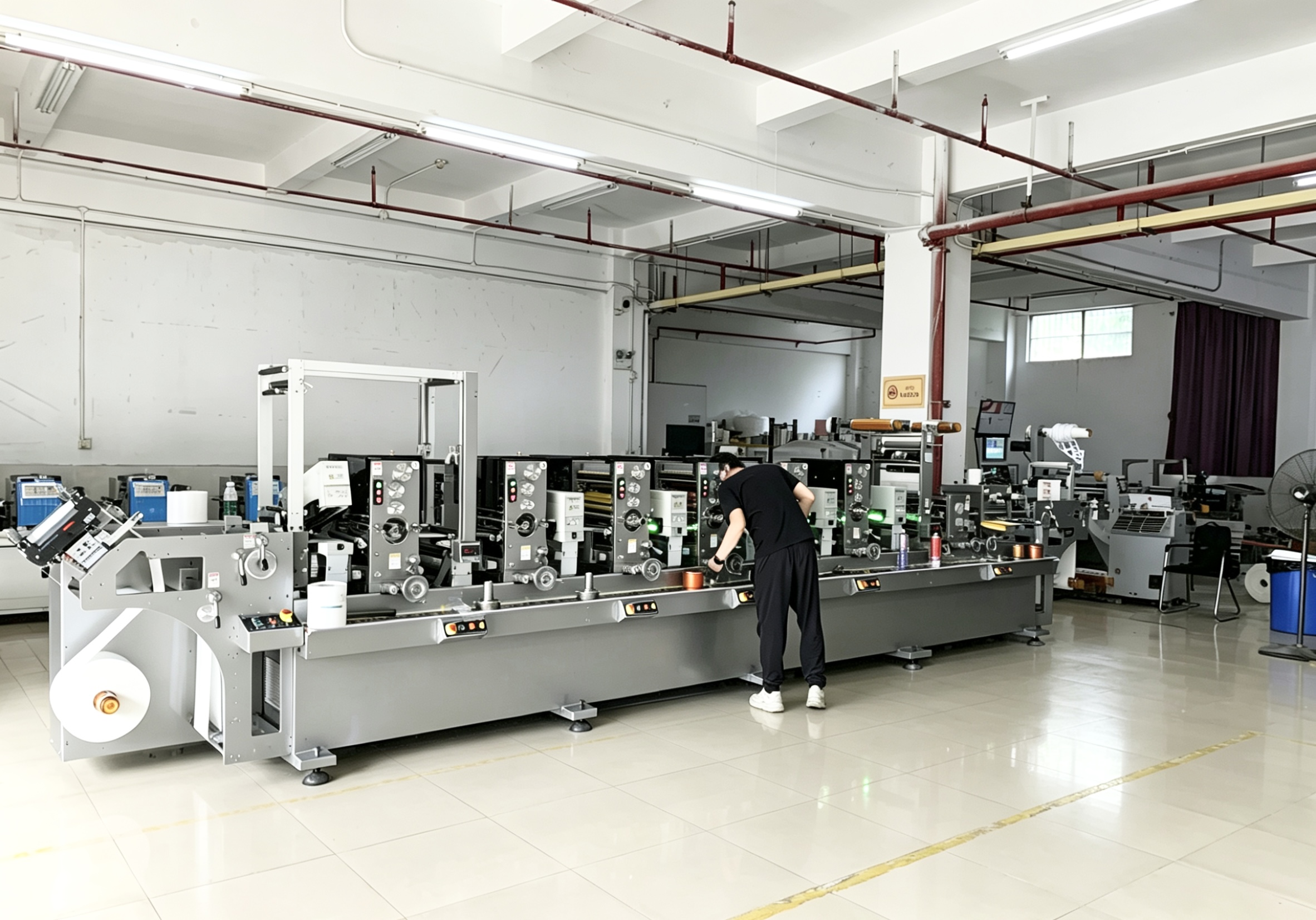
A CS-300 configuration carrying both rotary and flatbed die-cutting stations, plus glue-side printing, a multi-functional frame and slitting.
Why die-cutting architecture should be decided before the press specification
The most common sequencing error in label press procurement is to shortlist by colour count, web width and running speed, then treat die-cutting as a downstream question. That order of work produces two predictable failure modes.
- A flatbed-only platform is asked to carry long-run volume. A flat die has to meet the web at a defined stop. The cutting cycle is therefore cyclical rather than continuous, which is fine for jobbing work and not fine for a job that should run for days without a tooling change.
- A rotary platform is asked to cut a contour that really needs a flat tool. A cylindrical die rolls against an anvil and cuts at production speed, but the geometry it can hold economically is bounded by that cylinder. Complex or irregular contours belong on a flat die.
The practical definitions are worth stating plainly, because the two modes are often discussed as if they were quality levels rather than different mechanical systems. Flatbed die-cutting presses a flat die against a platen while the web is registered and momentarily stationary; the die is a planar tool, so intricate outlines, small radii and irregular shapes are straightforward to produce. Rotary die-cutting uses a cylindrical die rotating against an anvil roll, cutting continuously as the web passes; it suits stable repeat lengths and sustained production runs.
Neither is superior. They fail in different places. The question at the decision and execution stage is not "which is better" but "which combination does this label book actually need, and is that combination physically available on the platform I am about to order".
Industry background: why one die-cutting mode is no longer enough
Mordor Intelligence reports the global print label market at USD 57.05 billion in 2026, growing at a CAGR of 3.28% to reach USD 67.02 billion by 2031. That figure measures printed label output, not label machinery, so it should be read as a demand environment rather than an equipment market size — but the direction is useful context for equipment planning.
Moderate overall growth hides a harder reality for converters: the same market keeps splitting into two working patterns at once. Short, frequently changed runs keep multiplying as brands manage more SKUs and shorter promotional cycles, while volume work in beverages, food and household products still rewards continuous high-speed production. A converter serving both patterns with one die-cutting architecture is always compromising one of them.
That is why the CAISHENG portfolio is structured as three architectures rather than one general-purpose platform. The die-cutting choice is exposed at the model-family level, so a buyer can align tooling with geometry and run length instead of buying a single compromise machine and adapting the job book to it.
The three die-cutting architectures, model by model
CS-220 series — flatbed die-cutting only
The CS-220 family is built around a single die-cutting method. Models such as the CS-220-4C and CS-220-5C are letterpress platforms specified with flatbed die-cutting, and flatbed is the only die-cutting configuration available in this series.
What that delivers is tooling freedom. A flat die can carry the awkward contour — the tight corner, the deep notch, the irregular outline that would be impractical to wrap around a cylinder. Because the die is planar and the cutting action is a single press-and-release, changing between shapes is a tooling swap rather than a cylinder change, which suits converters whose work changes frequently and whose runs are short or intermittent.
The limit is equally clear. Flatbed cutting is cyclical, so sustained high-speed output over a long uninterrupted run is not what this architecture is built for. Buyers who select a CS-220 and then push it into multi-day volume production will find the die-cutting station setting the pace for the whole line. The CS-220 series is the right answer when contour complexity and changeover frequency matter more than continuous throughput.
CS-300 and CS-320 series — flatbed plus rotary die-cutting combination
The CS-300 and CS-320 families are combination machines: both a flatbed die-cutting station and a rotary die-cutting station are present on the same platform. Models in these families include the CS-300-5C, the CS-300-6C and the CS-320-6C.
The operational value is that one pass can do two different cutting jobs. A job with one awkward contour and a high-volume repeat shape no longer needs to be split across two machines, or run entirely on the slower of the two methods. Rotary handles what rotary handles well at line speed; flatbed picks up the shape no cylinder will hold. Because both stations sit on the same web path, the job is registered once rather than twice.
These platforms are also where configuration depth becomes a real selection variable. A CS-300-6C, for example, can be specified as a letterpress platform with glue-side printing, a multi-functional frame, rotary die-cutting, flatbed die-cutting and slitting in one line. That flexibility is valuable, but it has a cost in execution: more stations mean more setup knowledge, more tooling inventory to manage and more parameters to validate at commissioning. A converter whose entire book is simple shapes at volume should not pay for a second cutting station it will never engage.
CS-350, CS-370 and CS-380 series — rotary die-cutting combination machines
The CS-350, CS-370 and CS-380 families are rotary die-cutting combination machines. The CS-JQ350G-6C, CS-Q370-8C and CS-JQ380F-7C sit on these platforms, and the model designations are a useful illustration of how printing mode and die-cutting mode are two separate decisions: the CS-JQ350G-6C is offered with both intermittent and full-rotary printing modes, while the CS-JQ380F-7C is designated as a semi-rotary flexographic machine paired with rotary die-cutting.
This is the architecture for long runs with stable repeat lengths. Rotary cutting happens continuously at production speed, so the die-cutting station stops being the throughput ceiling that a cyclical flatbed station would impose on a long job. The trade-off sits in tooling: cylindrical dies are shape-specific and their economics depend on how much footage that shape will cut, and the geometry range is narrower than a flat die allows.
A rotary-combination platform therefore rewards a converter who can point to a set of high-volume, repeatable shapes and say with confidence that those shapes will keep running. It punishes a converter who buys it for volume and then discovers that half the book is bespoke contours.
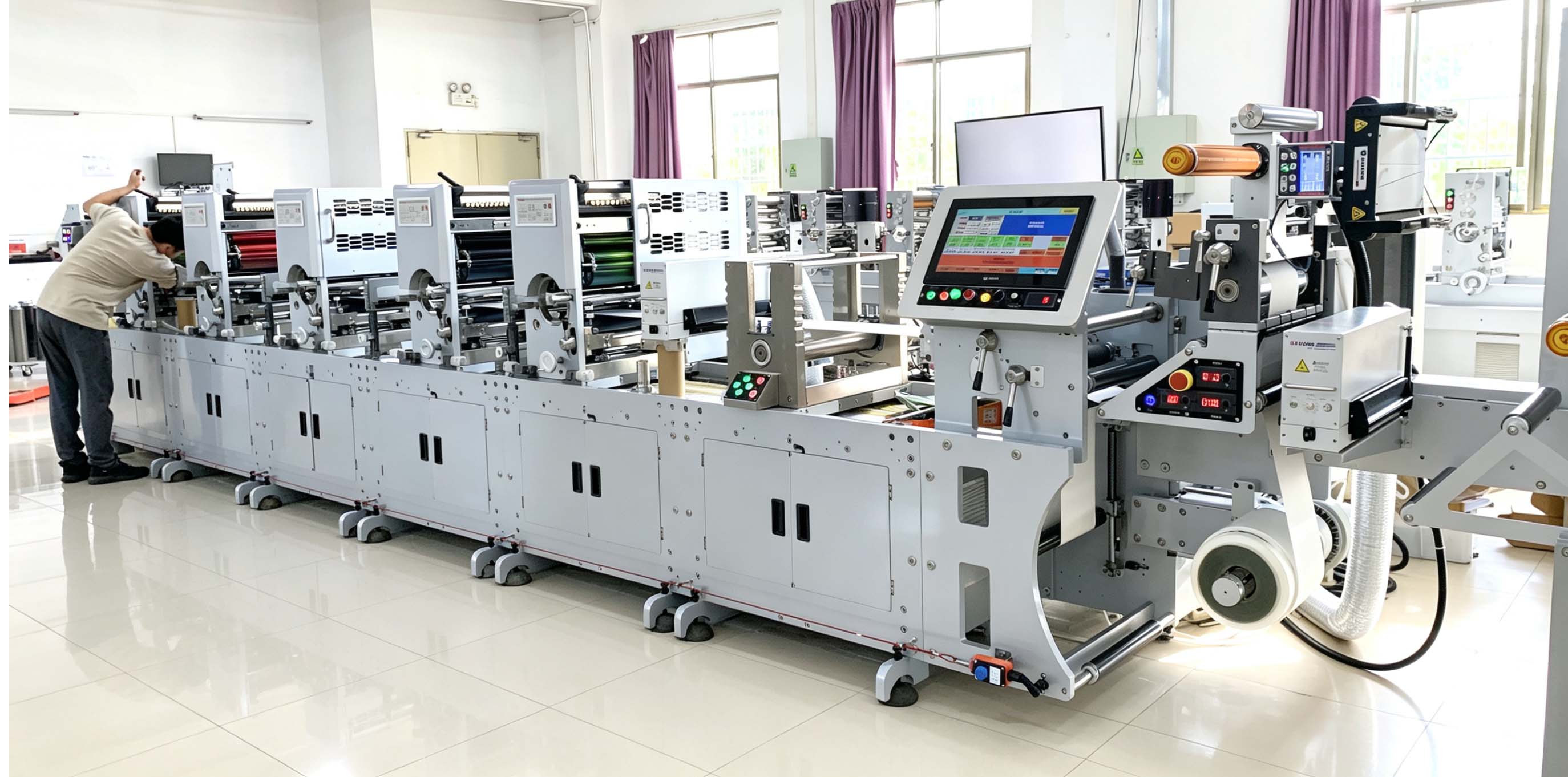
Commissioning a CS-JQ350G platform: printing mode and die-cutting set are both verified during installation and debugging, not assumed from the model code.
Where the CS-350 high-speed die-cutting machine fits
Not every die-cutting problem is a press problem. The CS-350 high-speed die-cutting machine is finishing equipment rather than a printing platform, and it belongs to the same part of the portfolio as CAISHENG's customized multi-functional label finishing solutions, which the company describes as including die-cutting systems and high-speed varnishing machines.
It becomes the right purchase when printing capacity is adequate and die-cutting is the bottleneck — the situation where a press with good output sits waiting on a cutting station that cannot keep pace. Because it is a separate line item, it should be specified with the same information you would give for a press: label geometry, repeat length, material and expected run length. Treating it as an accessory rather than a machine in its own right is the usual reason a finishing upgrade fails to move throughput.
How to specify printing mode and die-cutting mode on one order
The execution-stage discipline is to write both modes explicitly, on the same specification sheet, before the order is placed. Six steps keep the two decisions from being made independently of each other.
- Characterise the label geometry first. Separate the book into contours that need a flat die and shapes that a cylinder can hold. If you cannot make that split, no model selection is meaningful yet.
- Set the run-length bands and changeover frequency. Short and intermittent runs with frequent changes point to flatbed capability. Long, stable runs point to rotary. A book containing both points to a combination platform.
- Write the print mode explicitly. Intermittent and full-rotary printing are separate designations. The CS-JQ350G-6C is offered with both modes, and the CS-JQ380F-7C is a semi-rotary flexographic machine with rotary die-cutting — evidence that print mode and die-cutting mode are independent choices, not a package deal.
- Map the result to the die-cutting family. Flatbed only: CS-220. Flatbed plus rotary: CS-300 or CS-320. Rotary combination: CS-350, CS-370 or CS-380. If the book does not fit the family, the family is wrong — not the book.
- Write the module list, not just the model code. A CS-300-6C can be configured with glue-side printing, a multi-functional frame, rotary die-cutting, flatbed die-cutting and slitting together. Every module you add changes setup time, tooling inventory and commissioning scope, so each one should be justified by a job you can name.
- Close the loop before shipment. CAISHENG performs 100% testing of all units and invites customers to the factory for machine acceptance inspection, with machine-adjustment engineers running tests until finished products come off correctly. Use that acceptance visit to confirm die-cutting performance on your own material, not just general machine function.
Plan the commercial timeline alongside the technical specification. The minimum order quantity is 1 unit, typical production lead time is 45 to 60 days for export markets including Southeast Asia, the European Union, the Middle East and the United States, and monthly production capacity is 18 units. A die-cutting configuration that requires non-standard tooling should be raised early in the 45-to-60-day window rather than after the order is confirmed.
Use cases: which architecture fits which working pattern
A jobbing converter with many short SKUs. Cosmetics, promotional and private-label work where each shape changes often. The CS-220 series keeps tooling cheap to change and keeps complex contours achievable, and accepts that throughput per job will not be the line's selling point.
A mixed book spanning pharma, food and beverage. This is the combination scenario the CS-300 and CS-320 series exist for: rotary stations carry the repeat shapes at speed, the flatbed station absorbs the awkward contour without a second machine and a second registration.
A volume producer with a stable shape set. Beverage, household and long-run film work where the same die runs for extended periods. The CS-350, CS-370 and CS-380 families put rotary cutting in line with production speed, and the tooling investment is amortised over footage rather than over changeovers.
A converter whose printing is fine and whose die-cutting is not. The CS-350 high-speed die-cutting machine is the finishing-side answer, specified as its own equipment with its own geometry and run-length brief.
A selection rule worth keeping: if the label book contains both complex contours and long-run repeat shapes, do not try to solve it with a single die-cutting method. Either buy the combination platform, or plan to split the work — and price the second option honestly, because a split book means a second registration and a second handling step.
Comparison: flatbed versus rotary, and the family configuration table
The first table separates the two cutting methods on the criteria that actually change a purchase decision. The second maps those criteria onto the CAISHENG families so the model shortlist follows directly from the job book.
| Selection criterion | Flatbed die-cutting | Rotary die-cutting |
|---|---|---|
| Cutting action | Flat die pressed against a platen while the web is registered and stationary | Cylindrical die rotating against an anvil roll as the web passes |
| Geometry fit | Complex contours, tight corners, irregular outlines | Simple to moderate repeat shapes with a stable repeat length |
| Run-length fit | Short and intermittent runs, frequent job change | Long runs at sustained production speed |
| Where it appears in the CAISHENG range | Sole method on the CS-220 series; one station on CS-300 and CS-320 combination machines | One station on CS-300 and CS-320 combination machines; the die-cutting basis of the CS-350, CS-370 and CS-380 rotary combination machines |
| Main constraint to accept | Cyclical cutting limits sustained high-speed volume work | Shape-specific cylindrical tooling and a narrower geometry range |
| Series | Die-cutting configuration | Representative models | Best-fit work |
|---|---|---|---|
| CS-220 | Flatbed die-cutting only | CS-220-4C, CS-220-5C | Complex contours, short and intermittent runs, frequent changeover |
| CS-300 | Flatbed plus rotary die-cutting combination | CS-300-5C, CS-300-6C | Mixed books; configurations may add glue-side printing, multi-functional frame and slitting |
| CS-320 | Flatbed plus rotary die-cutting combination | CS-320-6C | Mid-volume work needing both cut types on one web path |
| CS-350 / 370 / 380 | Rotary die-cutting combination | CS-JQ350G-6C (intermittent and full-rotary printing), CS-Q370-8C, CS-JQ380F-7C | Long runs with stable repeat lengths at high speed |
| Finishing equipment | Standalone high-speed die-cutting unit | CS-350 high-speed die-cutting machine | Relieving die-cutting capacity when printing is already adequate |
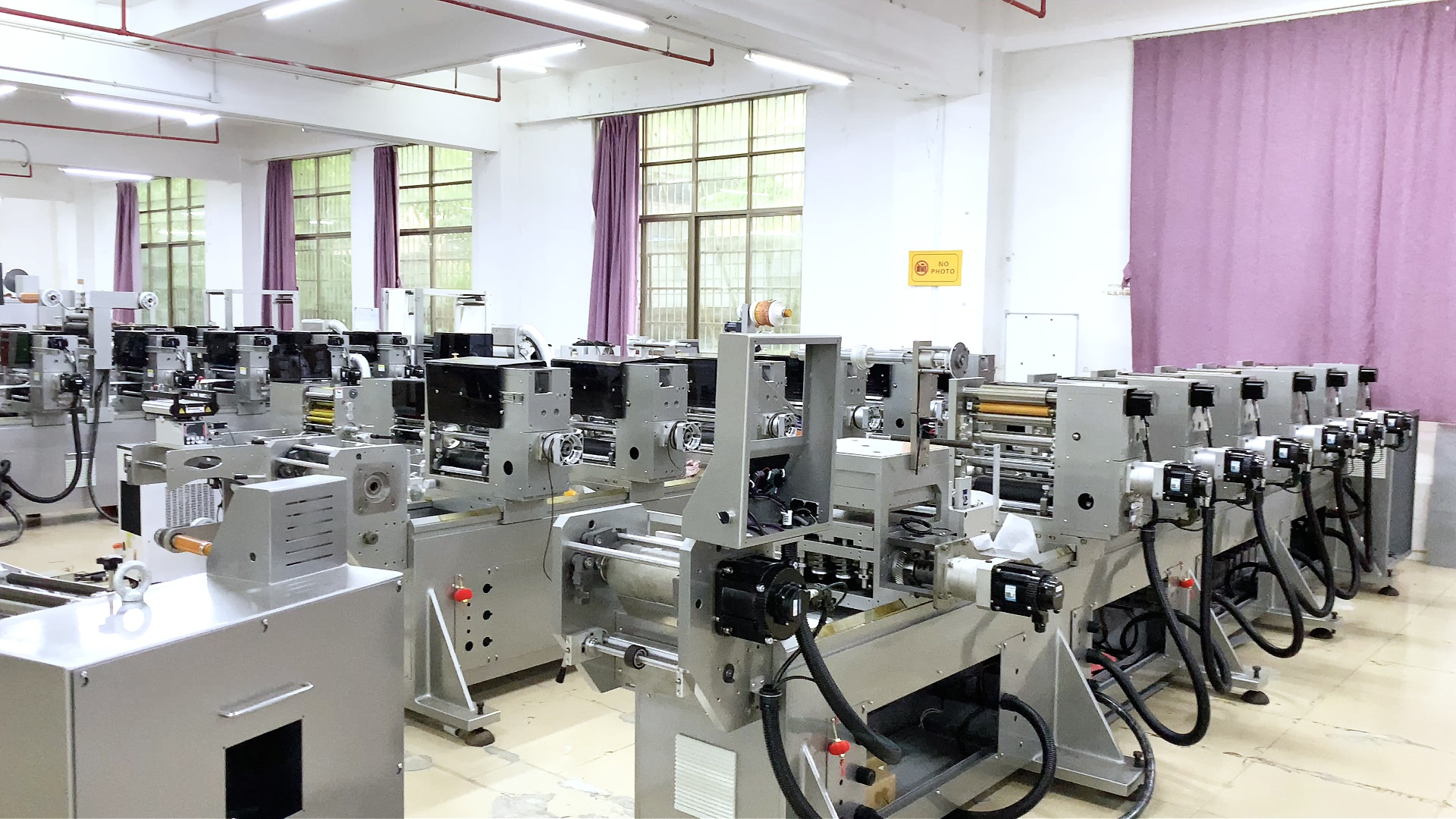
Every unit is 100% tested before shipment, and buyers can attend factory acceptance inspection to verify die-cutting performance on their own material.
Frequently asked questions
Are CAISHENG label printing machines certified for export markets?
Yes. CAISHENG holds ISO 9001, ISO 14001 and ISO 45001 certification, and its products meet CE standards. Machines are supplied to Southeast Asia, the European Union, the Middle East and the United States, and every unit is 100% tested before shipment.
Can one label printing machine run both flatbed and rotary die-cutting?
On the CAISHENG range, yes — but only on specific families. The CS-300 and CS-320 series are flatbed plus rotary die-cutting combination machines, so both cut types are available on one platform. The CS-220 series is flatbed die-cutting only, and the CS-350, CS-370 and CS-380 series are rotary die-cutting combination machines.
What are the ordering terms for a die-cutting configuration?
The minimum order quantity is 1 unit. Delivery terms are FOB and payment terms are 30/70, with a pre-shipment test used as the acceptance criterion.
How can I validate die-cutting on my own label before the machine ships?
Acceptance is based on a pre-shipment test. CAISHENG runs 100% testing of all units, and machine-adjustment engineers test machine performance until finished products come off correctly. Customers are invited to the factory for machine acceptance inspection, which is the point at which die-cutting results on your own material should be confirmed.
What is the lead time, and how do I start a specification?
Typical production lead time is 45 to 60 days for export markets including Southeast Asia, the European Union, the Middle East and the United States, with monthly production capacity of 18 units. Remote support and a one-year warranty on major components are provided. To start, send your label geometry, material and run-length data so the die-cutting architecture — and therefore the model family — can be fixed before the press specification is written.
Conclusion: the family already narrows the decision
Flatbed and rotary die-cutting are not competing quality tiers; they are two cutting mechanics with different geometry limits and different run-length economics. The CAISHENG range makes that choice explicit at the platform level: the CS-220 series is flatbed only, the CS-300 and CS-320 series combine flatbed with rotary, and the CS-350, CS-370 and CS-380 series are rotary combination machines. The CS-350 high-speed die-cutting machine sits outside the press families as finishing equipment for converters whose cutting capacity, not printing capacity, is the constraint.
The execution discipline is short: characterise the geometry, set the run-length band, write the print mode and the die-cutting mode on the same sheet — intermittent or full-rotary on one line, flatbed or rotary on the other — then confirm the module list and validate it at factory acceptance. Buyers who do that in this order rarely discover a die-cutting mismatch after installation.
Match die-cutting to your label book
CAISHENG builds intermittent and high-speed full-rotary label printing machines and customized multi-functional label finishing solutions in Shenzhen. Share your label geometry, material and run length, and the team will confirm which die-cutting architecture fits — flatbed, combination, or rotary — and issue a configuration and quote.
Browse the full model range and specifications: CAISHENG label printing machines | Download the product catalogue: CAISHENG catalogue (PDF)
Contact: Alice | Email: kanghong-1108@qq.com | Tel: +8613186283944 | WhatsApp: +86 133-1087-8219
Address: No.39, Shuitian Road, Tongle Community, Longgang District, Shenzhen, China
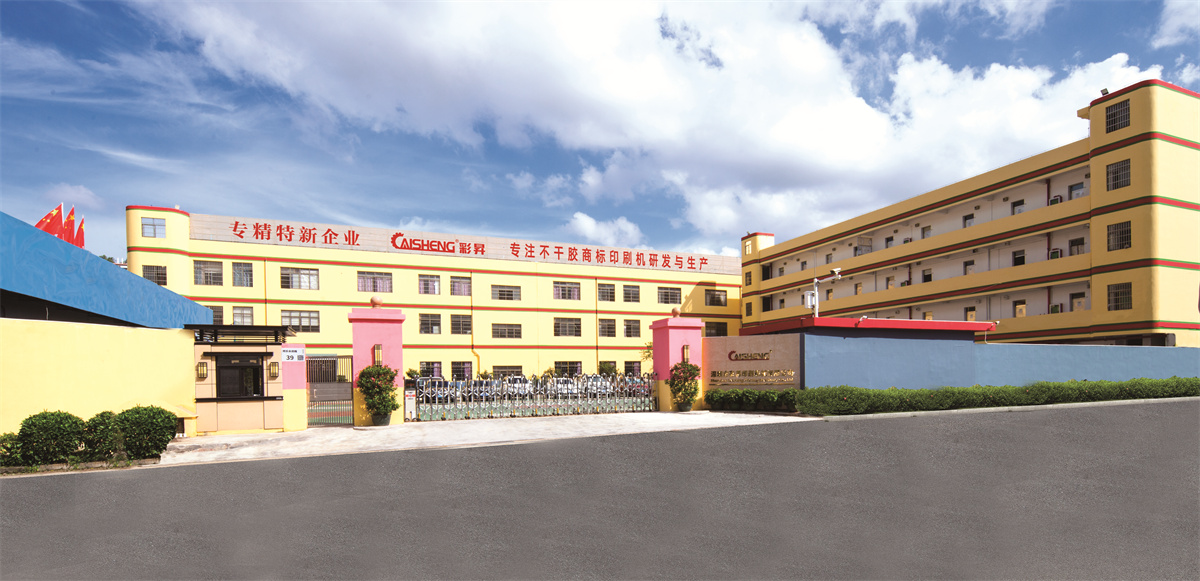
Buyers are invited to Shenzhen for machine acceptance inspection before shipment — the practical way to confirm die-cutting results on your own labels.
Have Questions or Need More Details?
Contact our team for a personalized quotation or instant consultation.
Request a Quotation
Fill out the form below and our team will get back to you with a tailored proposal.
WhatsApp Direct Chat
Prefer to chat in real-time? Message us on WhatsApp for instant assistance & quick answers.
- Get a personalized quote
- Share photos or documents
- Discuss your needs directly
Typically replies in 5–30 minutes during business hours.