How to Partner for the Long Haul: Label Press Maintenance and Technical Support After Delivery
The specification sheet closes the sale. What keeps a label printing machine productive years after commissioning is far less dramatic: a conformity file that survives an audit, a diagnostic route that does not begin with a flight from Shenzhen, a spare-part answer that arrives before the shift ends, and a manufacturer that still recognises your machine five years later.
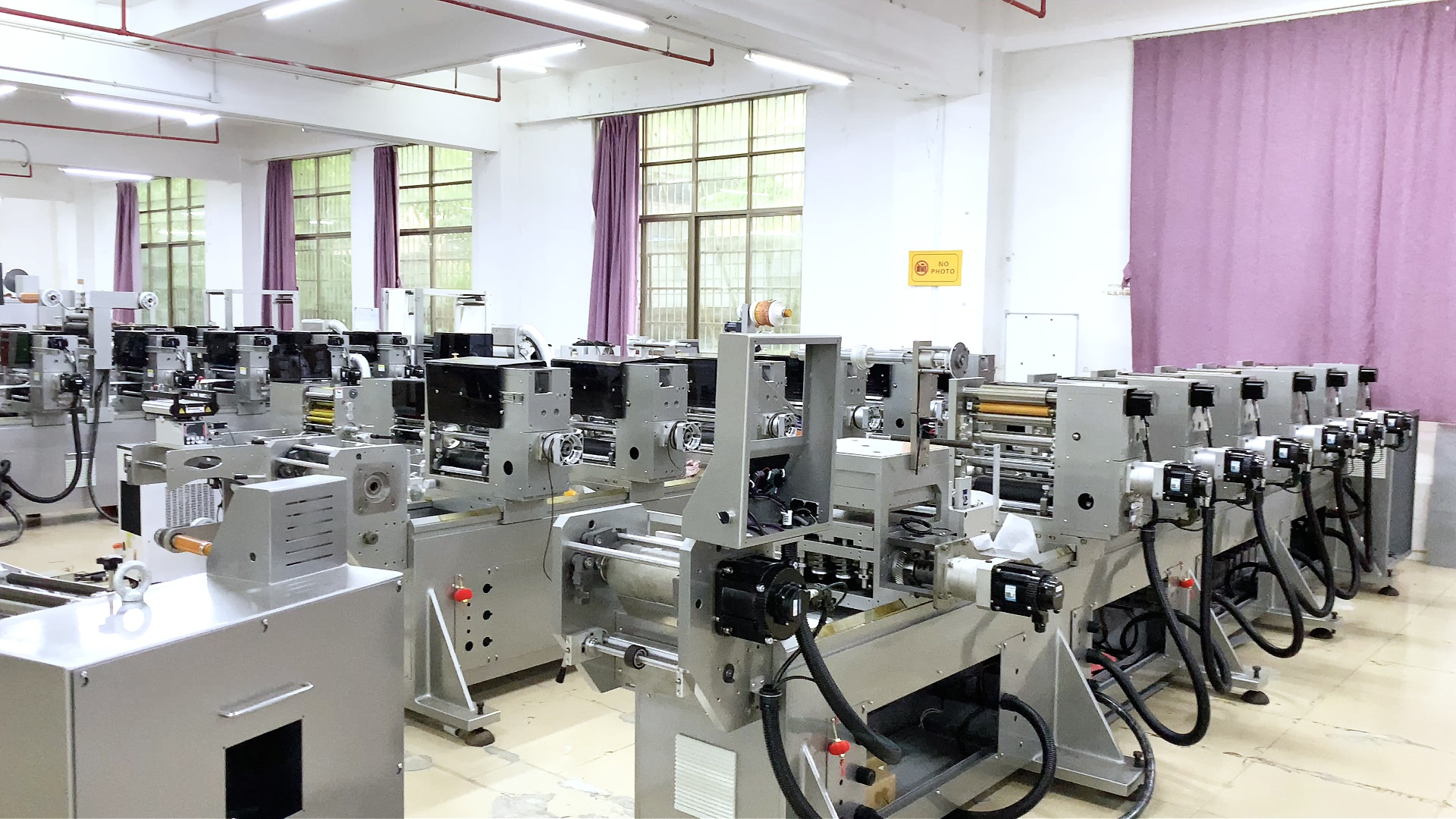
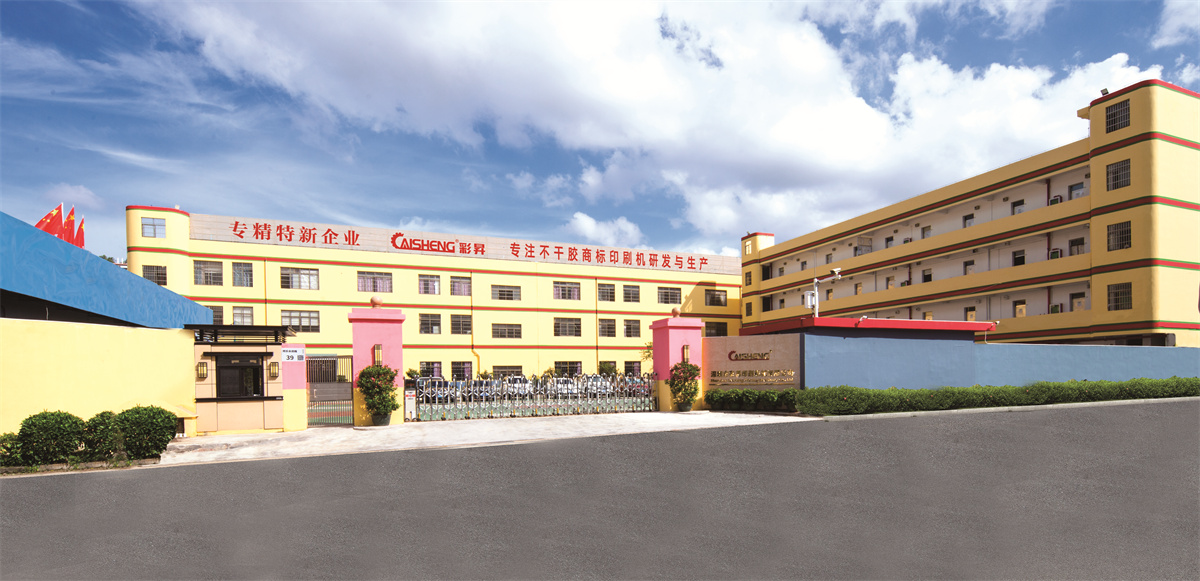
This guide is written for buyers in the evaluation stage — converters, distributors and brand owners comparing label printing machine suppliers — who want to know what happens after the crate is opened. Every answer below is limited to what Shenzhen Caisheng Printing Machinery Co., Ltd. (CAISHENG) documents about its own business. CAISHENG is a Chinese label printing equipment manufacturer founded in 2011, operating a 6,000 m² facility with 65 employees, an eight-engineer R&D team and an annual output of about 200 units, roughly 50% of which is exported to Southeast Asia, Europe, the Middle East and the United States.
Why Post-Delivery Support Is the Hardest Part of the Purchase
Almost all of the evaluation budget goes into the machine. Buyers compare web width, colour stations, die-cutting type and speed; they request videos; they negotiate on price. Very little of that scrutiny reaches the part of the relationship that determines whether the press is still earning in year four.
Three gaps make post-delivery support hard to judge objectively.
Information asymmetry. A service organisation is invisible until it is used. Buyers see a machine at a trade fair and a quotation in their inbox. They do not see how a fault is triaged at 22:00 in their own time zone, or who decides whether a problem is a settings issue or a hardware failure.
Geographic distance. Most label printing machine buyers import across borders. When the manufacturer sits in Shenzhen and the press runs in another hemisphere, the real question is not whether on-site help exists. It is what can be resolved before anybody books a flight.
Configuration drift. The moment a press is customised — a rotary die-cutting station, a corona treater, an extra screen unit — generic manuals stop matching the actual machine. Documentation that is not configuration-specific becomes useless precisely at the moment it is needed.
The cost of these gaps is rarely dramatic. It is small and cumulative: an operator guessing at a registration adjustment, a maintenance team improvising a bracket, an audit that stalls because the conformity file sits in a different folder from the machine record.
Why the Support Question Has Become More Important, Not Less
The label market is a mature, slowly growing base, and that changes how converters think about equipment. Mordor Intelligence estimates the global print label market at USD 57.05 billion in 2026, growing at a 3.28% CAGR to USD 67.02 billion by 2031. That figure measures printed label output rather than machinery, so it should not be read as a press-market number. What it does indicate is incremental rather than explosive growth — an environment where converters squeeze more output from existing assets instead of replacing them, which makes an idle press relatively more expensive.
Machine architecture has moved in the same direction. Modern presses are increasingly multi-functional: one platform can carry letterpress or flexo printing, rotary or flatbed die-cutting, varnishing, lamination, slitting and screen printing. Each added module is another subsystem with its own settings, wear points and adjustment logic. A five-module machine has a far larger support surface than a two-colour press, even when the footprint is similar.
Regulation has added a third layer. European buyers do not simply buy a machine; they document it. A CE attestation of conformity is a file that has to survive an audit years later, and its validity dates matter as much as its existence. Trade classification matters too, because flexographic printing machinery falls under HS code 844316, which determines how the shipment is declared at import. Buyers importing a press for the first time routinely meet this detail at the worst possible moment.
What CAISHENG Commits To After the Machine Leaves Shenzhen
Support claims only become useful when they can be checked. The commitments below are documented by the manufacturer and can be verified before an order is placed.
Conformity and technical documentation
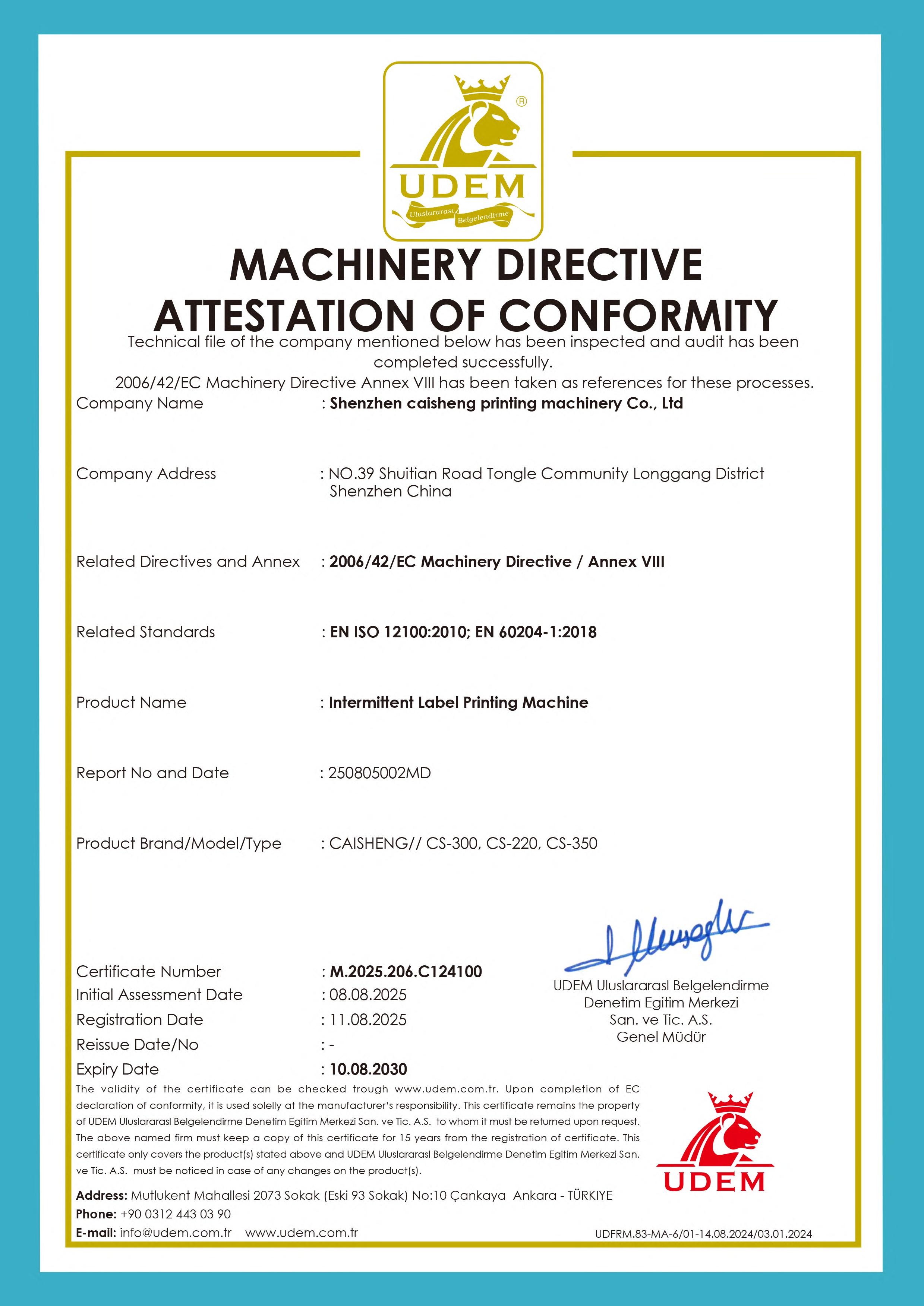
CAISHENG holds a CE Machinery Directive Attestation of Conformity numbered M.2025.206.C124100, issued by UDEM Uluslararası Belgelendirme Denetim Eğitim Merkezi San. ve Tic. A.S. The attestation covers the CS-300, CS-220 and CS-350 machine families, was issued on 8 November 2025 and remains valid until 8 October 2030. The harmonised standards cited are EN ISO 12100:2010 and EN 60204-1:2018 — the first covering general machinery risk assessment, the second the electrical equipment of machines.
That combination matters more than the certificate on its own. EN ISO 12100 requires a documented risk assessment, and EN 60204-1 governs emergency-stop architecture, protective bonding and control-circuit behaviour. A buyer who receives the attestation together with the declared standard set can hand the package to an internal EHS team or an external auditor and answer the first three questions they will ask.
Remote support and warranty scope
CAISHENG's stated after-sales scope is remote support plus a one-year warranty for major components. Read that sentence carefully during evaluation, because it leaves two things to be defined in writing: which components the manufacturer classifies as “major”, and what “remote” is expected to cover in practice. Neither question is answered by a quotation, and both are better settled before the purchase order than after the first breakdown.
Engineering capacity behind the support line
The company's R&D function is listed at eight engineers, and output at roughly 200 units a year. The relevant implication for a buyer is not the headcount itself but the shape of the organisation. A manufacturer building around 200 machines annually with a defined engineering group is small enough that configuration questions reach people who know the design, and structured enough to hold a build record for each unit.
Patented remote diagnostics
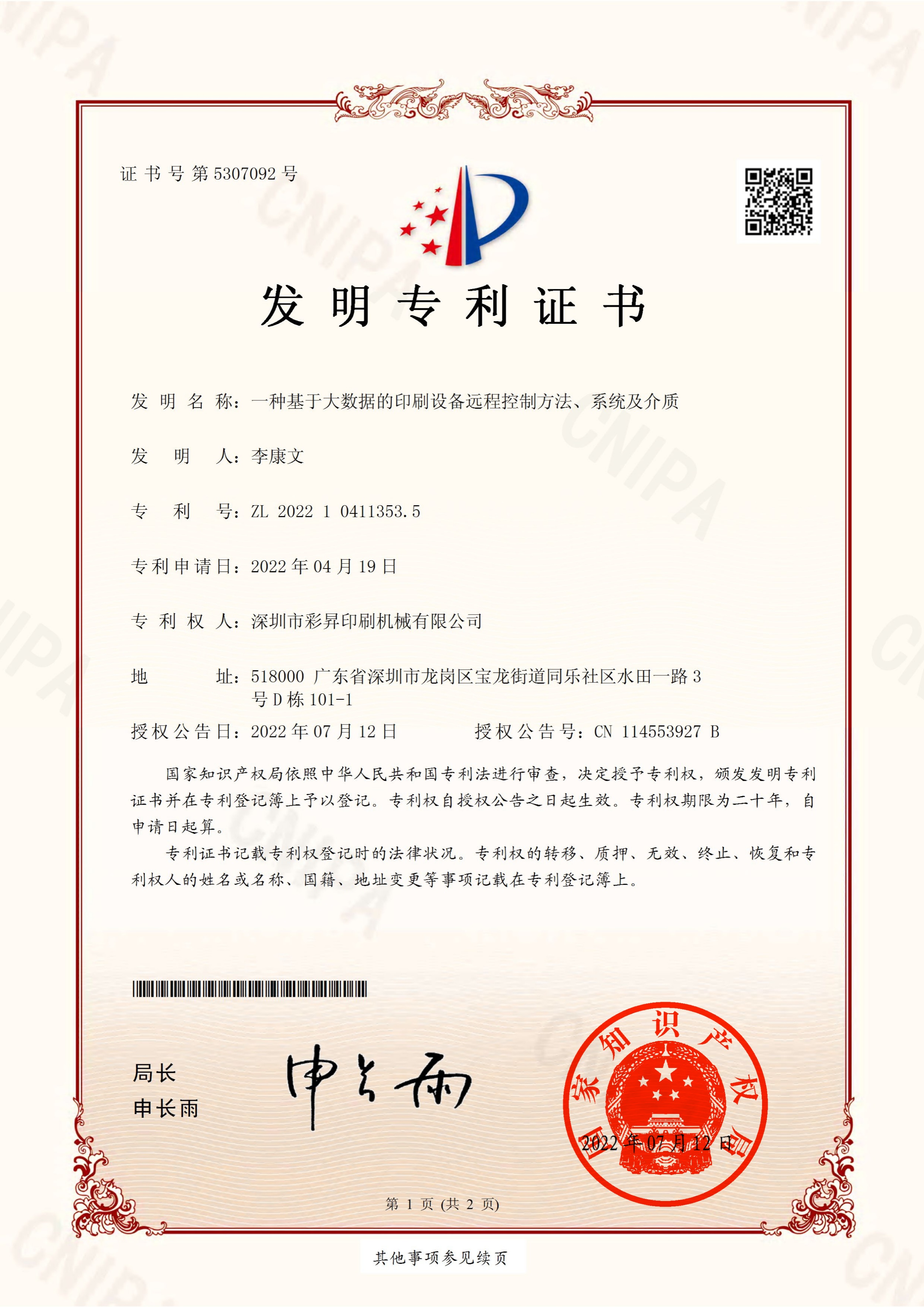
CAISHENG holds a Chinese invention patent, ZL 2022 1 0411353.5, granted on 12 July 2022 and running to 18 April 2042, titled “A method, system, and medium for remote control of printing equipment based on big data.” The protected scope covers remote data collection from printing equipment, cloud-based analysis, remote start-stop and parameter adjustment, and online fault diagnosis.
This belongs in a procurement conversation rather than a patent list because it describes a technical route for resolving faults without travel. A buyer evaluating a supplier in another hemisphere should ask whether such a capability exists and what it connects to. Here the answer is documented at the level of a granted patent rather than a marketing sentence.
Direct communication channels
Support is only as accessible as the channel behind it. CAISHENG publishes a named contact — Alice — with an email address at kanghong-1108@qq.com, a telephone number at +8613186283944, a WhatsApp line at +86 133-1087-8219, and a factory address at No.39, Shuitian Road, Tongle Community, Longgang District, Shenzhen, China. The company has been building label printing equipment since 2011.
For international buyers the test is simple. Are the channels published, named and reachable without an intermediary? A buyer who cannot reach a technical person on a published number before the sale has no reason to expect better access after it.
Customisation that stays documented
CAISHENG operates in ODM mode with a minimum order of one unit and a 45–60 day lead time, and lists an extensive customisation catalogue: cold foil stamping, hot foil stamping, embossing, glue-side printing frames, lamination, offline and online UV varnishing, flatbed die-cutting, rotary die-cutting, sheet cutting, slitting, corona treating, dust cleaning, static elimination and full-rotary screen printing.
Every item on that list changes the maintenance profile. A corona treater adds electrodes and a power supply; a rotary screen unit adds a screen cylinder and squeegee system; a slitting station adds blades and tension control. Buyers should insist that the configuration list attached to the order becomes the index of the documentation package, so that the spare-parts list, the warranty classification and the manual all refer to the same machine.
Six Steps That Turn a Delivery Into a Partnership
Step 1 — Freeze the configuration record before shipment
The build record should list every module, every option and every non-standard item on the machine. Treat it as the table of contents for manuals, spare parts and warranty classification. When a fault appears two years later, this document decides whether the conversation starts with “our machine” or with a specific configuration number.
Step 2 — Verify the conformity package at import
Check the attestation number, the machine family it covers, the issue and expiry dates, and the standards cited. For CAISHENG machines this means confirming M.2025.206.C124100 against the CS-300, CS-220 or CS-350 family actually shipped, and confirming that EN ISO 12100:2010 and EN 60204-1:2018 appear on the file. Separately, confirm the import classification with a customs broker — flexographic printing machinery is classified under HS 844316.
Step 3 — Commission against a written acceptance target
Installation and debugging should end with a measured result rather than a handshake. Agree in advance what “correct” means for registration, print density and die-cutting position, then record the values on the jobs the machine will actually run. Where the manufacturer publishes a tolerance for the model, use it as the anchor: the CS-220-4C intermittent rotary letterpress, for example, is specified at ±0.025 mm registration precision.
Step 4 — Build the escalation ladder before you need it
A workable ladder has four levels: the operator handles settings and consumables; the in-house technician handles mechanical adjustment; the manufacturer's remote channel handles diagnosis and parameter questions; engineering escalation handles the rest. Write the ladder down. Put the email address and telephone number next to the press, not in a filing cabinet, and record which issues were resolved at which level — that record is what makes a warranty claim or a parts negotiation credible later.
Step 5 — Cost the warranty year properly
The one-year warranty for major components is a window, not a plan. Use it to establish which parts wear, which adjustments drift and what consumption looks like at your own production mix. Buyers who leave the warranty year with a documented wear profile negotiate parts pricing from observed data; buyers who do not discover costs one breakdown at a time.
Step 6 — Review the relationship annually
A short annual review — uptime, response quality, documentation currency, configuration changes, parts consumption — converts a vague impression of the supplier into a set of trends. It also forces the documentation to stay current, which is the item most likely to decay silently between deliveries.
What Long-Term Support Looks Like in Practice
A three-year relationship in the United States. A global provider of commercial printing, packaging and marketing communication solutions installed one CS-300 series label printing machine for label production. After three years of operation, the equipment is reported to have delivered stable registration accuracy, excellent print quality and reliable performance, contributing to improved production efficiency and product quality. Customer feedback highlighted high recognition of these attributes, and the two parties established a long-term, stable cooperative relationship.
What makes this case relevant to a support evaluation is the time frame rather than the machine. Three years is long enough for commissioning support to be irrelevant and for the durability of the working relationship to be the only thing left holding the outcome.
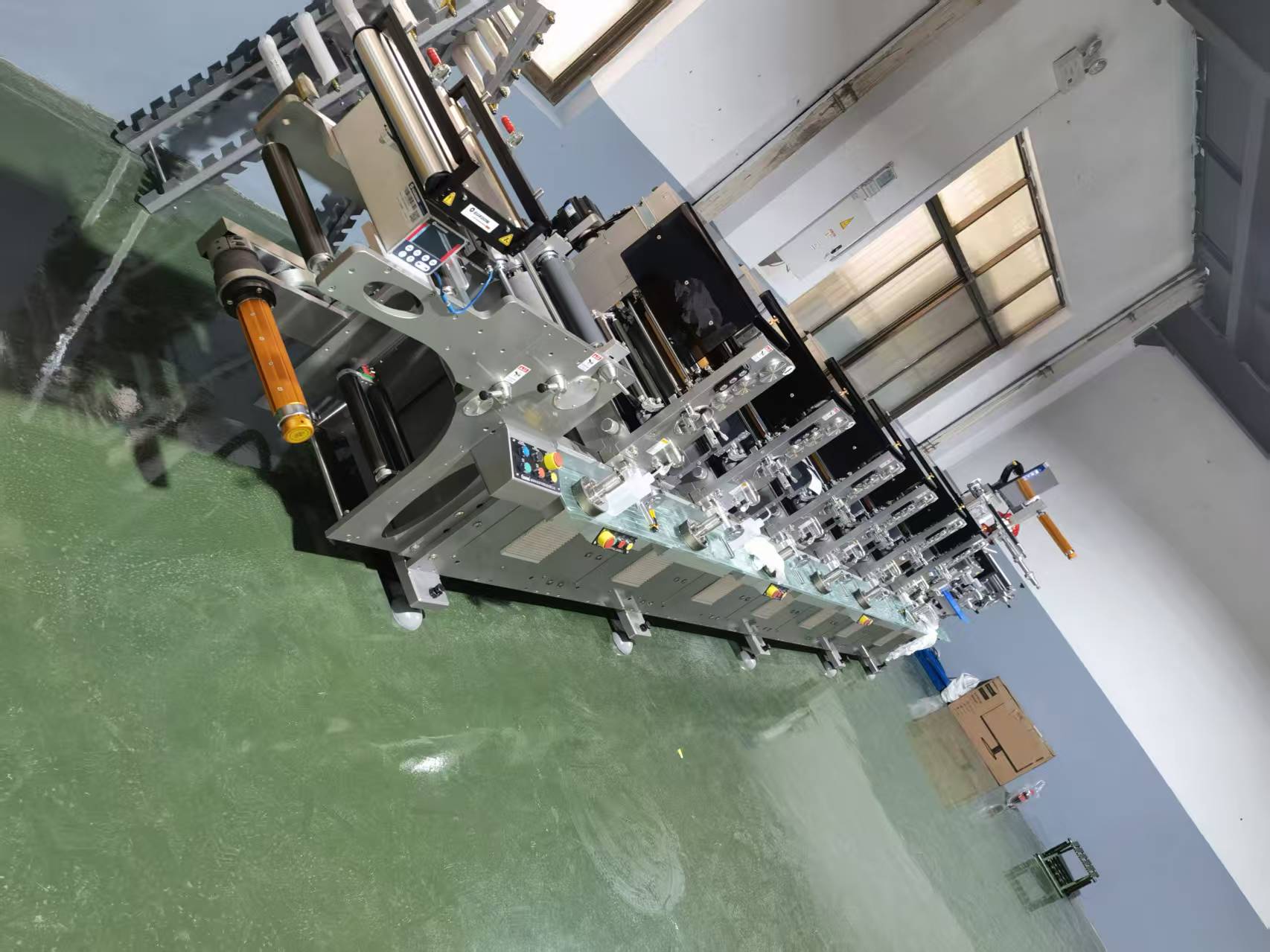
A two-year project in Taiwan. A renowned Asian trademark design and printing company installed one unit for high-quality label printing, with the project completed within two years. The reported outcome emphasises superior printing precision, stable production performance and flexible process expansion capability, earning the client's full recognition.
“Flexible process expansion” is the phrase worth pausing on. Expansion is exactly the scenario where post-delivery support is tested: a machine bought for one product mix gets pushed into another, and the manufacturer has to respond with configuration, tooling and engineering input rather than with a replacement press.
Comparing Post-Delivery Support Elements
The table below consolidates what a buyer can verify before ordering, with the source type for each element. It is deliberately narrow: only documented commitments appear, because a support comparison that includes unverifiable promises is worse than no comparison at all.
| Support element | What CAISHENG documents | Verified basis |
|---|---|---|
| Conformity documentation | CE Machinery Directive Attestation of Conformity M.2025.206.C124100, issued by UDEM, valid 8 November 2025 – 8 October 2030, covering CS-300, CS-220 and CS-350 | CE certification record |
| Safety and electrical standards | EN ISO 12100:2010; EN 60204-1:2018 | CE certification record |
| Pre-shipment quality control | 100% test | Capability record |
| Remote support | Remote support listed as the after-sales channel | Capability record |
| Warranty | One-year warranty for major components | Capability record |
| Remote diagnostics | Invention patent ZL 2022 1 0411353.5 covering remote data collection, cloud analysis, remote start-stop and parameter adjustment, and online fault diagnosis | Patent record |
| Order flexibility | ODM customisation; minimum order 1 unit; lead time 45–60 days; monthly capacity 18 units | Capability record |
| Direct contact | Email, telephone, WhatsApp and a Shenzhen factory address | Company record |
A second table is useful for the practical side of service planning. Machine weight and footprint determine rigging, floor loading and how quickly a technician can reach components, so they belong in the same discussion as the support contract.
| Model | Print configuration | Max speed | Machine weight | Footprint (L×W×H) |
|---|---|---|---|---|
| CS-220-4C | Intermittent letterpress | 40 m/min | 2.6 T | 4.2 × 1 × 1.5 m |
| CS-300-6C | Intermittent letterpress | 40 m/min | 6.6 T | 8.9 × 1.5 × 2 m |
| CS-320-6C | Intermittent letterpress | 40 m/min | 6.2 T | 8.4 × 1.5 × 2 m |
| CS-JQ350G-6C | Intermittent and full rotary | 60 / 158 m/min | 10 T | 7.8 × 1.5 × 1.9 m |
| CS-JQ350-7C | Intermittent and full rotary | 60 / 158 m/min | 10.8 T | 8.7 × 1.5 × 1.9 m |
| CS-J380F-7C | Flexo label printing | 60 m/min | 6 T | 9.3 × 1.3 × 1.6 m |
| CS-Q370F-6C | Flexo label printing | 150 m/min | 7 T | 7.5 × 1.5 × 1.7 m |
Frequently Asked Questions
What conformity documentation should arrive with a CAISHENG label printing machine?
CAISHENG holds a CE Machinery Directive Attestation of Conformity numbered M.2025.206.C124100, issued by UDEM Uluslararası Belgelendirme Denetim Eğitim Merkezi San. ve Tic. A.S. on 8 November 2025 and valid until 8 October 2030. It covers the CS-300, CS-220 and CS-350 machine families and cites EN ISO 12100:2010 and EN 60204-1:2018. Buyers should confirm that the certificate number, the machine family and the validity dates match the unit being shipped. Import classification should be checked separately, because flexographic printing machinery falls under HS code 844316.
Can faults be diagnosed remotely, or does every issue require an on-site visit?
CAISHENG lists remote support as its after-sales channel alongside a one-year warranty for major components. The company also holds invention patent ZL 2022 1 0411353.5, granted 12 July 2022, which protects a method, system and medium for remote control of printing equipment based on big data — including remote data collection, cloud-based analysis, remote start-stop and parameter adjustment, and online fault diagnosis. In practice, this means a diagnostic stage can take place before travel is considered. The boundary between what is resolved remotely and what requires on-site work should be agreed in writing when the order is placed.
What does the one-year warranty cover, and how should we budget for parts afterwards?
CAISHENG's stated warranty is one year for major components. Because the classification of “major components” draws the line between covered and buyer-funded parts, buyers should obtain that component list in writing before signing and map it against the modules actually ordered — a press with rotary die-cutting and a corona treater carries a different component inventory from a two-colour machine. After the warranty year, parts become a planned cost. The practical preparation is to record which components wear during the first year of your own production mix, so the post-warranty budget rests on observed consumption rather than on a supplier estimate.
Can we validate print quality and a custom configuration before committing to a full order?
CAISHENG runs ODM production with a minimum order quantity of one unit and lists 100% test as its quality control method. Buyers who need to validate a substrate or a finishing combination should raise it at configuration stage, so that the test protocol reflects the actual job — a machine with rotary die-cutting and corona treating needs different validation from a two-colour press. Published case evidence follows the same pattern: a Taiwan-based trademark design and printing company reported superior printing precision, stable production performance and flexible process expansion capability on a single-unit installation.
How long is delivery, and how do we reach technical support once the press is running?
CAISHENG quotes a 45–60 day lead time, with a monthly capacity of 18 units and a minimum order of one machine. Support contact is direct rather than routed through a regional office: email kanghong-1108@qq.com, telephone +8613186283944, WhatsApp +86 133-1087-8219, and the factory at No.39, Shuitian Road, Tongle Community, Longgang District, Shenzhen, China. International buyers preparing a shortlist can download the company brochure below or send the model and configuration list for a written answer on documentation and warranty scope.
Conclusion: Partnership Is a Set of Checkable Commitments
Post-delivery support is not a feeling about a supplier. It is a set of documents, channels and boundaries that can be inspected before the purchase order is signed — and the earlier that inspection happens, the less it costs to act on what it reveals.
For CAISHENG, the checkable points are specific: a CE attestation valid to October 2030 covering CS-300, CS-220 and CS-350; a stated after-sales scope of remote support and a one-year warranty on major components; a granted invention patent covering remote diagnostics and parameter adjustment; a 45–60 day lead time at 18 units a month with a one-unit minimum; and published contact channels to a factory in Shenzhen that has been building label printing machines since 2011.
What the buyer has to add is the discipline. Freeze the configuration, verify the file, commission to a written target, cost the warranty year before it ends, and review the relationship once a year. Those five habits do more for long-term partnership than any goodwill clause in a contract.
Next Step
Download the CAISHENG product brochure for the full model range and configuration options: CAISHENG Brochure (PDF).
For a written answer on documentation, warranty scope or parts for a specific model, contact Alice directly — Email: kanghong-1108@qq.com · Tel: +8613186283944 · WhatsApp: +86 133-1087-8219. Factory address: No.39, Shuitian Road, Tongle Community, Longgang District, Shenzhen, China. Company website: caishengmachinery.com.
Have Questions or Need More Details?
Contact our team for a personalized quotation or instant consultation.
Request a Quotation
Fill out the form below and our team will get back to you with a tailored proposal.
WhatsApp Direct Chat
Prefer to chat in real-time? Message us on WhatsApp for instant assistance & quick answers.
- Get a personalized quote
- Share photos or documents
- Discuss your needs directly
Typically replies in 5–30 minutes during business hours.