Flatbed, Rotary and Combination Die-Cutting in Label Presses
CAISHENG label printing machines are built around three die-cutting configurations, and each one is tied to a defined model platform. The CS-220 platform carries flatbed die-cutting. The CS-300 and CS-320 platforms carry a flatbed plus rotary combination. The 350, 370 and 380 platforms are built around rotary die-cutting in combination. The distinction is not a product tier. It is the path the web takes between the last print station and the delivery, and therefore how much finishing work stays inside the press.
This article is written for buyers who have already decided to print labels in-house and are now specifying the finishing stack. It maps each configuration to the models that carry it, explains what changes in material handling and finishing efficiency, and sets out the checks that separate a workable specification from an expensive mismatch.
Why the Die-Cutting Configuration Decides More Than the Die
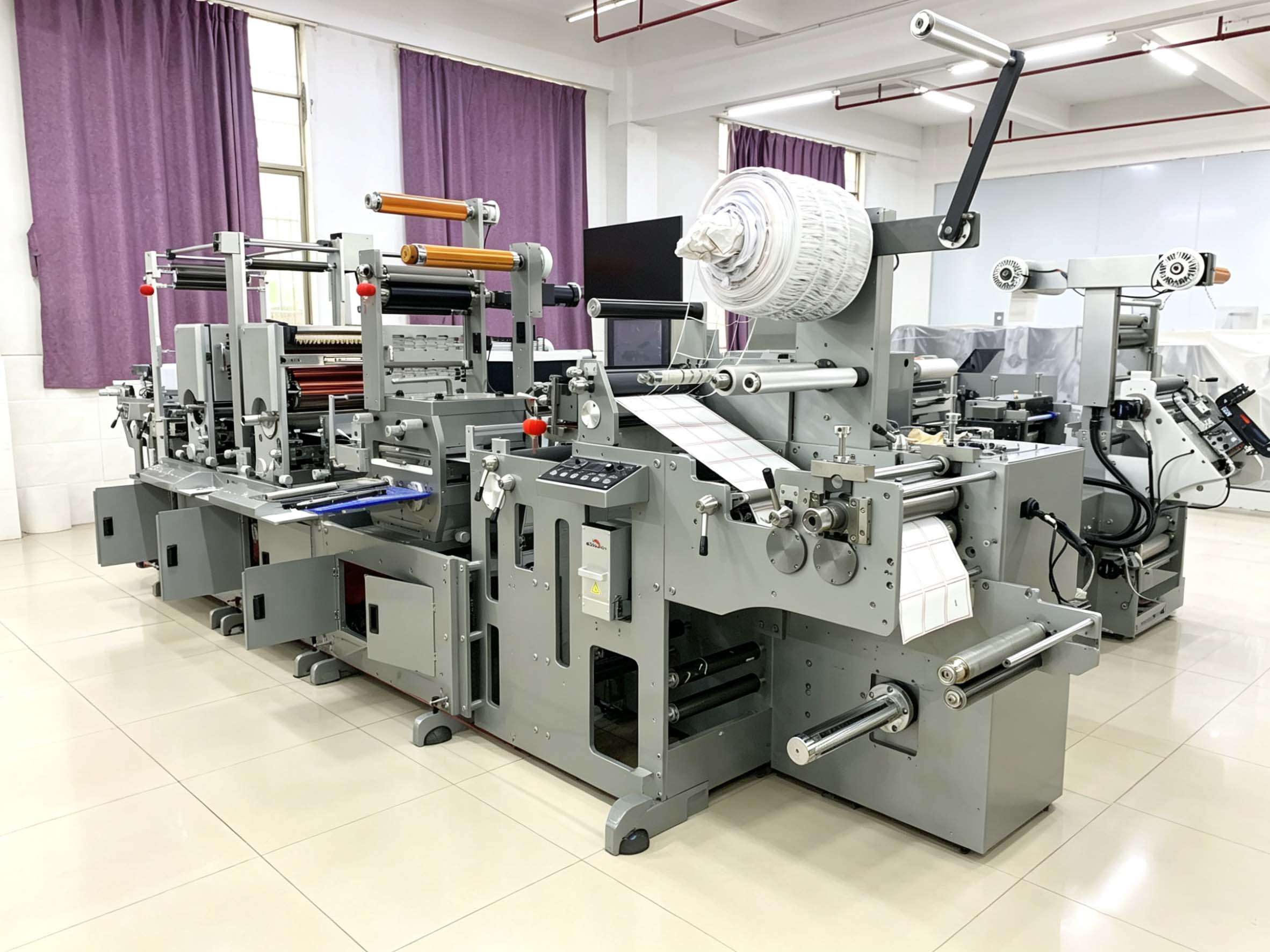
A die-cutting station does not run independently of the press. It shares the web path, the register reference and the drive with the print stations ahead of it. That has three practical consequences, and all three show up in the purchase specification rather than in the catalogue headline.
- Register is inherited, not created. The cut position depends on the same tension and registration control that governs print. Buyers who evaluate print quality in isolation and expect the cut to follow automatically tend to be the ones surprised at commissioning.
- The material path changes. A flatbed platen interrupts web travel; a rotary cylinder allows continuous rotation. The difference shows up in how the web is tensioned between stations and how quickly a job can be changed over.
- In-line scope is a decision, not a default. Which converting operations run in the same pass — slitting, sheet cutting, varnish, glue-side printing — defines the job mix the press can actually accept, and therefore the orders it can quote.
Treating the die station as a bolt-on accessory usually produces a late constraint. The added unit consumes floor length, has to match the web width of the press, and its throughput has to fit the print section. If it does not, the whole line runs at the speed of its slowest station.
Where Label Production Is Moving
Label converting has shifted toward finishing in the same pass as printing. The commercial reason is straightforward: every additional off-line operation adds a second handling cycle, a second set-up and a second opportunity for register error between print and cut. For converters running short and medium runs with frequent job changes, that overhead takes a growing share of total production time.
Regulation adds a second layer. Machinery supplied into the European Union is assessed against harmonised safety standards, and the CE attestation of conformity is the document buyers now expect in the procurement file rather than at the last minute. CAISHENG holds a Machinery Directive Attestation of Conformity, certificate M.2025.206.C124100, issued by UDEM Uluslararasl Belgelendirme Denetim Egitim Merkezi San. ve Tic. A.S. on 8 November 2025 and valid to 8 October 2030. The listed scope covers the CS-300, CS-220 and CS-350, assessed against EN ISO 12100:2010 and EN 60204-1:2018.
The practical reading is simple. Configuration choices need to be made early enough that the machine supplied matches the machine assessed. Retro-fitting a die-cutting unit after delivery raises a different conformity question from ordering it as part of the platform.
The Three Configurations in CAISHENG Label Printing Machines
1. Flatbed die-cutting on the CS-220 platform
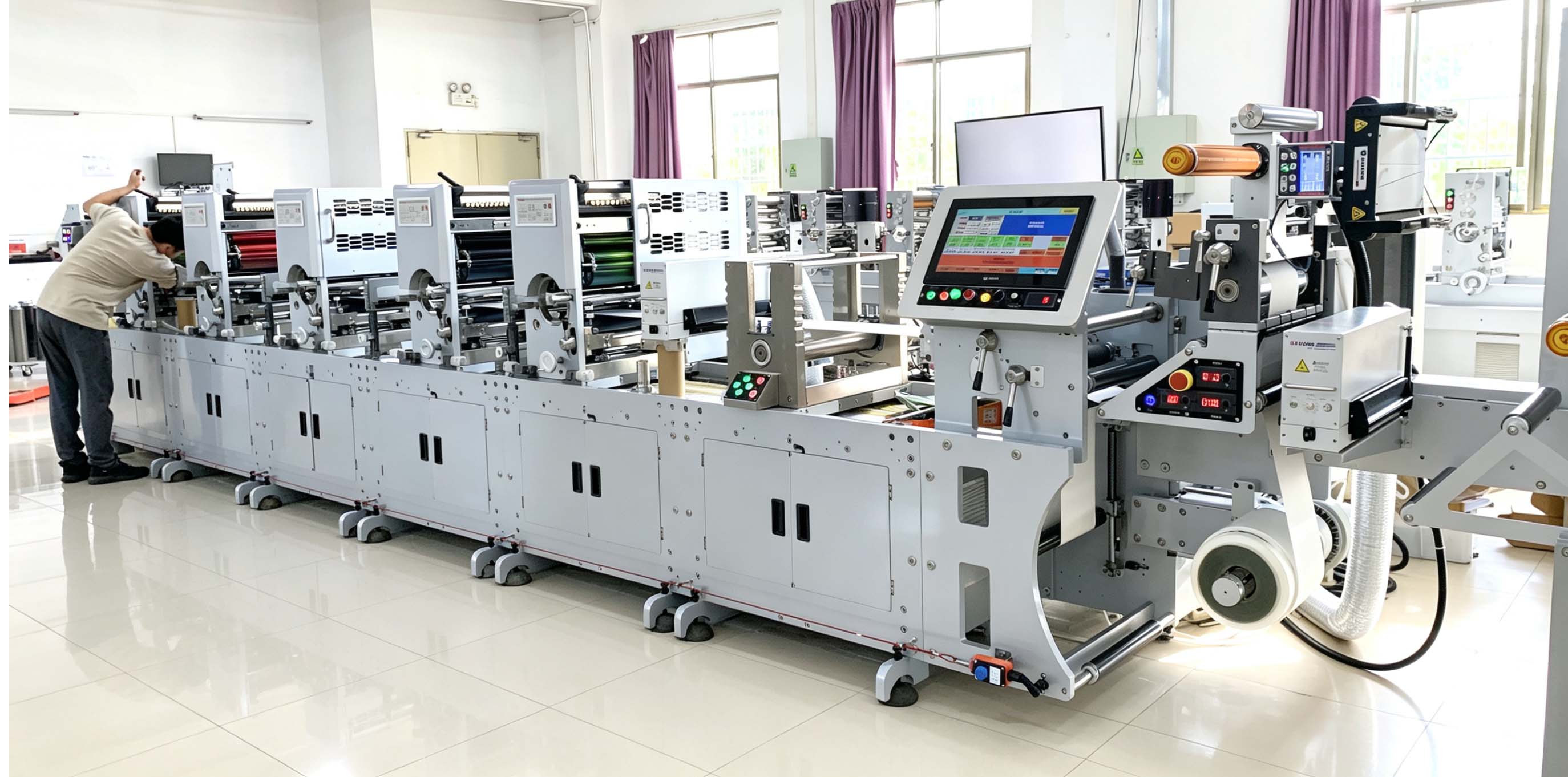
In a flatbed arrangement the die is mounted on a flat platen and the web is pressed against it, so the web advances in steps rather than in continuous rotation. The CS-220-4C and CS-220-5C are intermittent letterpress label printing machines built on this basis: web width 30–240 mm and a maximum speed of 40 m/min on both models.
The two models differ mainly in envelope and installed power. The CS-220-4C is 4.2 m long, weighs 2.6 T and draws 8.4 kW, with 3.7 kW stated separately for UV dryers. The CS-220-5C is 6.6 m long, weighs 3.6 T and draws 17 kW including UV dryers. The CS-220-5C configuration is also documented with flatbed die-cutting, offline varnish and sheet cutting on the same platform — a combination that suits converters whose output leaves the press as sheets rather than as rolls.
What flatbed buys is a straightforward die change and a cutting principle that does not depend on a cylinder being cut for the job. What it costs is throughput: stepped web movement limits sustained speed relative to rotary, and the platen area sets a ceiling on the cut format.
2. Flatbed plus rotary on the CS-300 and CS-320 platforms
A combination configuration keeps both principles on one press. Rotary die-cutting handles the continuous, repeat-heavy portion of the job mix; flatbed die-cutting stays available for the work where a platen is the more practical choice — short runs, shapes that are awkward on a cylinder, or dies already cut for flatbed use.
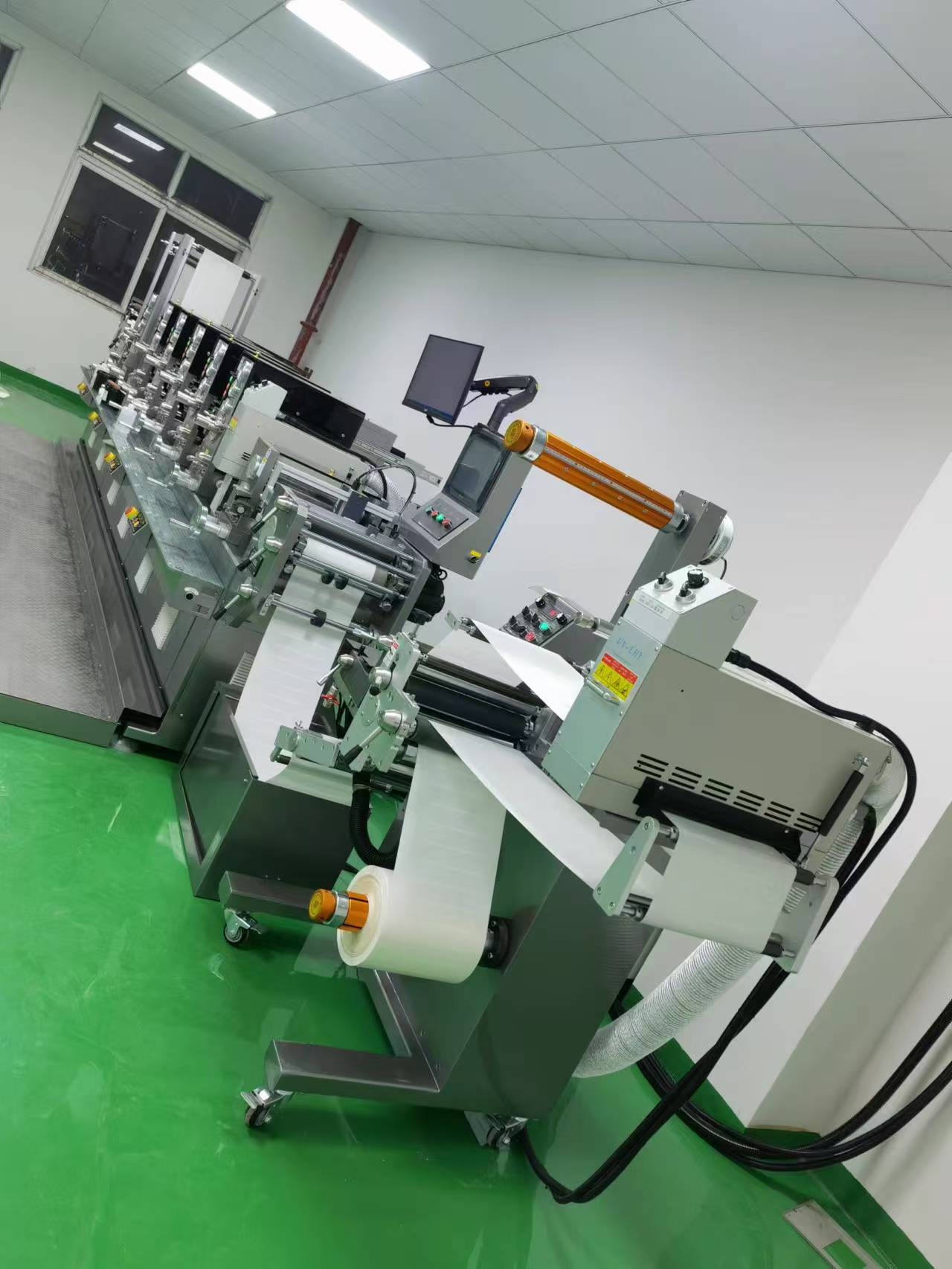
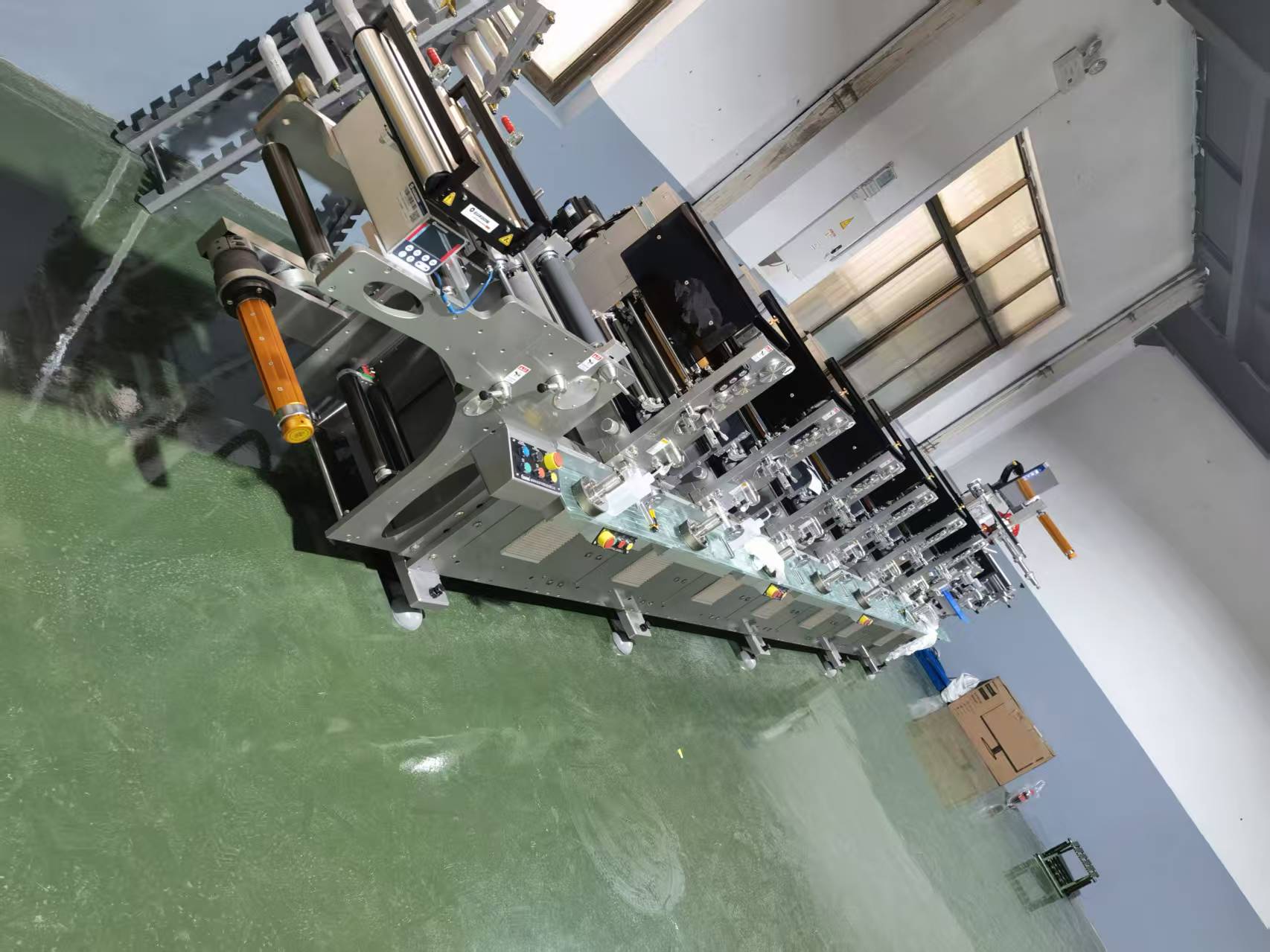
The CS-300-6C is published with glue-side printing, a multi-functional frame, rotary die-cutting, flatbed die-cutting and slitting on one line. That description is the clearest statement of what a combination configuration is for: several converting operations staged along a single web path, rather than distributed across several machines.
The envelope is documented model by model. The CS-300-5C and CS-300-6C run a 30–300 mm web width, weigh 5 T and 6.6 T respectively, and are rated at 40 m/min. The CS-320-6C and CS-320-7C run a 30–320 mm web width, weigh 6.2 T and 7 T, and are also rated at 40 m/min. Installed power ranges from 18.8 kW on the CS-300-5C — where 6 kW of UV dryer power is stated separately — to 31 kW on the CS-320-7C, where UV power is included in the gross figure.
3. Rotary die-cutting combination on the 350, 370 and 380 platforms
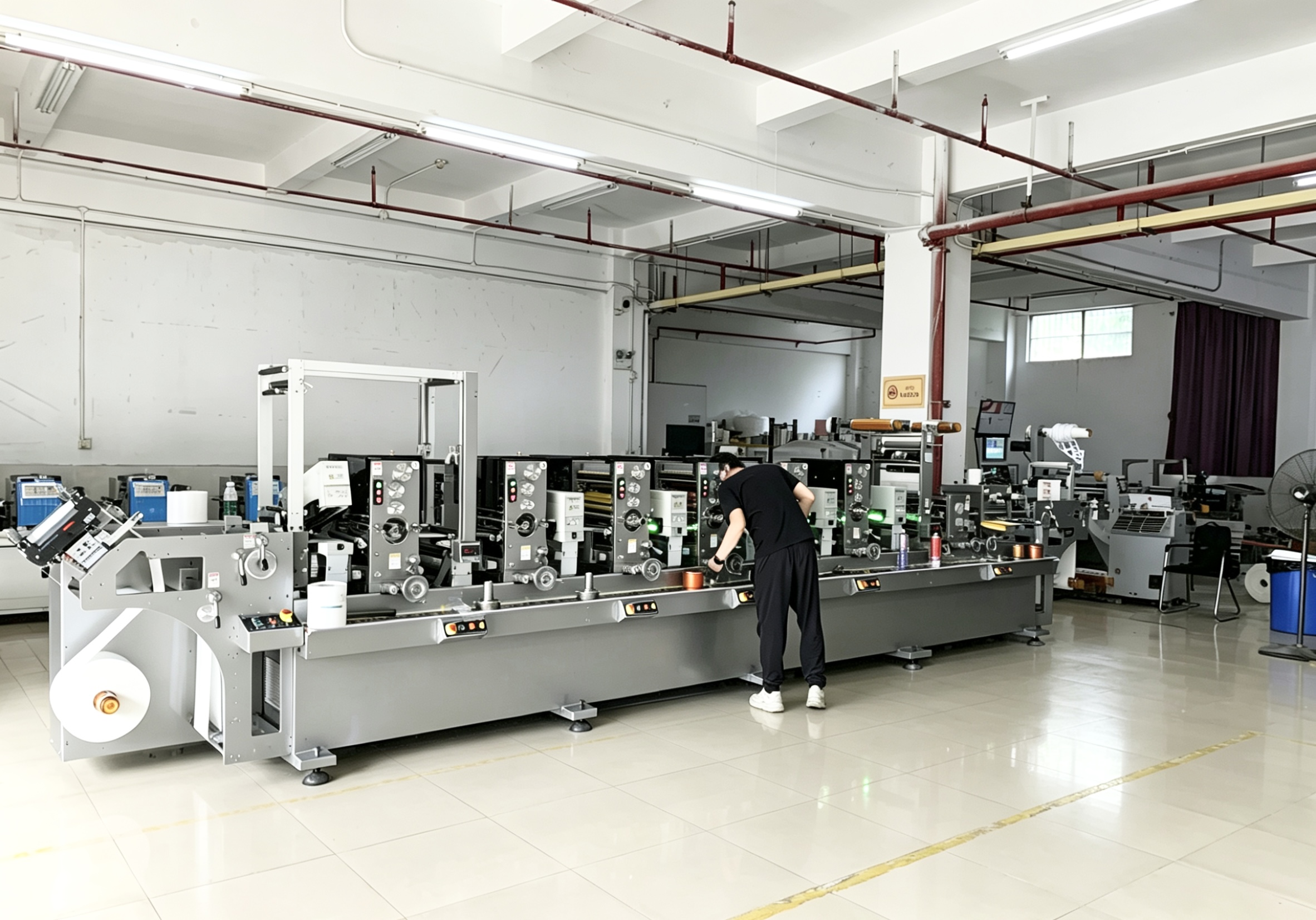
Rotary die-cutting uses a cylindrical die rotating against an anvil, which allows the web to stay in continuous motion. On the 350 platform, CAISHENG combines rotary die-cutting with a press that runs in either intermittent or full-rotary mode. The CS-JQ350G-6C and CS-JQ350-7C are listed as intermittent and full-rotary high-speed label printing machines, with a maximum speed of 60 m/min in intermittent mode and 158 m/min in full rotary, and a maximum full-rotary print area of 350 × 419 mm.
The same platform extends upward. The CS-JQ350G-10C is a 12 m machine at 14 T, with 34 kW gross power and 13.5 kW of LED UV drying.
The 370 and 380 platforms are flexographic. The CS-J380F-4C and CS-J380F-7C are flexo label printing machines with a maximum full-rotary print area of 360 × 419 mm and a rated speed of 60 m/min; the CS-J380F-4C weighs 4 T and draws 25 kW including UV, while the CS-J380F-7C weighs 6 T and draws 35 kW. The CS-Q370F-6C and CS-370F-8C are full-rotary flexo presses rated at 150 m/min, with a maximum print area of 370 × 200 mm or 370 × 600 mm.
What actually changes on the press floor. Rotary die-cutting in combination is not simply a faster die station. It allows the cut to be matched to the run: a job that suits intermittent mode and a job that suits full-rotary mode can be handled on the same platform, which is what makes mixed-volume order books workable without a second machine.
Model-to-Configuration Map
The table below maps every relevant CAISHENG model to its die-cutting configuration and its published operating envelope. It is the fastest way to rule a model in or out before detailed quoting begins.
| Model | Press type | Die-cutting configuration | Max web width / print area | Max speed | Weight |
|---|---|---|---|---|---|
| CS-220-4C | Intermittent letterpress | Flatbed | 30–240 mm web width | 40 m/min | 2.6 T |
| CS-220-5C | Intermittent letterpress | Flatbed | 30–240 mm web width | 40 m/min | 3.6 T |
| CS-300-5C | Intermittent letterpress | Flatbed + rotary combination | 30–300 mm web width | 40 m/min | 5 T |
| CS-300-6C | Intermittent letterpress | Flatbed + rotary + slitting | 30–300 mm web width | 40 m/min | 6.6 T |
| CS-320-6C | Intermittent letterpress | Flatbed + rotary combination | 30–320 mm web width | 40 m/min | 6.2 T |
| CS-320-7C | Intermittent letterpress | Flatbed + rotary combination | 30–320 mm web width | 40 m/min | 7 T |
| CS-JQ350G-6C | Intermittent & full rotary | Rotary combination | 350 × 419 mm print area | 60 / 158 m/min | 10 T |
| CS-JQ350-7C | Intermittent & full rotary | Rotary combination | 350 × 419 mm print area | 60 / 158 m/min | 10.8 T |
| CS-JQ350G-10C | Intermittent & full rotary | Rotary combination | 350 × 419 mm print area | 60 / 158 m/min | 14 T |
| CS-J380F-4C | Flexo label press | Rotary combination | 360 × 419 mm print area | 60 m/min | 4 T |
| CS-J380F-7C | Flexo label press | Rotary combination | 360 × 419 mm print area | 60 m/min | 6 T |
| CS-Q370F-6C | Full-rotary flexo | Rotary combination | 370 × 200 mm / 370 × 600 mm | 150 m/min | 7 T |
| CS-370F-8C | Full-rotary flexo | Rotary combination | 370 × 200 mm / 370 × 600 mm | 150 m/min | 8.6 T |
Step-by-Step: Matching a Configuration to a Production Plan
- Fix the cut geometry and the die format first. Complex or low-volume shapes lean flatbed; long, repeat-heavy runs lean rotary. Deciding this after the press is chosen reverses the logic of the purchase.
- Check the web width against the platform. The options step up as 240 mm on the CS-220 series, 300 mm on the CS-300 series, 320 mm on the CS-320 series, 350 mm print area on the JQ350 series, 360 mm on the J380F series and 370 mm on the Q370F / 370F series. Ordering above your widest job wastes capital; ordering below it caps growth.
- Decide which operations must run in the same pass. CAISHENG's documented customization set includes colour stamping, glue-side printing frame, cold foil stamping, lamination, offline and online UV varnishing, flatbed die-cutting, rotary die-cutting, sheet cutting, slitting, corona treater, dust cleaner, static eliminator, full-rotary screen printing, hot foil stamping and embossing. Each addition changes the length, the power draw and the operating sequence of the line.
- Match speed to the order book. Intermittent platforms on the 220, 300 and 320 series are rated at 40 m/min. The 350 series runs 60 m/min intermittent and 158 m/min full rotary. The J380F flexo models run 60 m/min; the Q370F and 370F full-rotary flexo models run 150 m/min.
- Confirm the physical envelope. Machine length ranges from 4.2 m on the CS-220-4C to 12 m on the CS-JQ350G-10C, weight from 2.6 T to 14 T, and gross power from 8.4 kW to 34 kW plus UV. Floor loading, headroom and power supply are checked before signature, not after delivery.
- Close the compliance file against the configuration you ordered. Confirm the CE attestation scope covers the model being supplied and that the safety standards applied — EN ISO 12100:2010 and EN 60204-1:2018 on the CS-220, CS-300 and CS-350 scope — are stated on the certificate itself.
- Set the commercial timeline. Standard terms are MOQ 1 unit, FOB delivery, pre-shipment test as the acceptance criterion and 30/70 payment terms. Lead time is 45–60 days, against a monthly production capacity of 18 units.
Use Cases
Short runs and sheet output
A converter whose work arrives in small batches and leaves as sheets is better served by the flatbed logic on the CS-220 platform than by a rotary line that is never run at its rated speed. The CS-220-4C at 4.2 m and 2.6 T fits a floor where a 12 m machine would not, and the CS-220-5C configuration carries flatbed die-cutting, offline varnish and sheet cutting together.
Multi-operation work in one pass
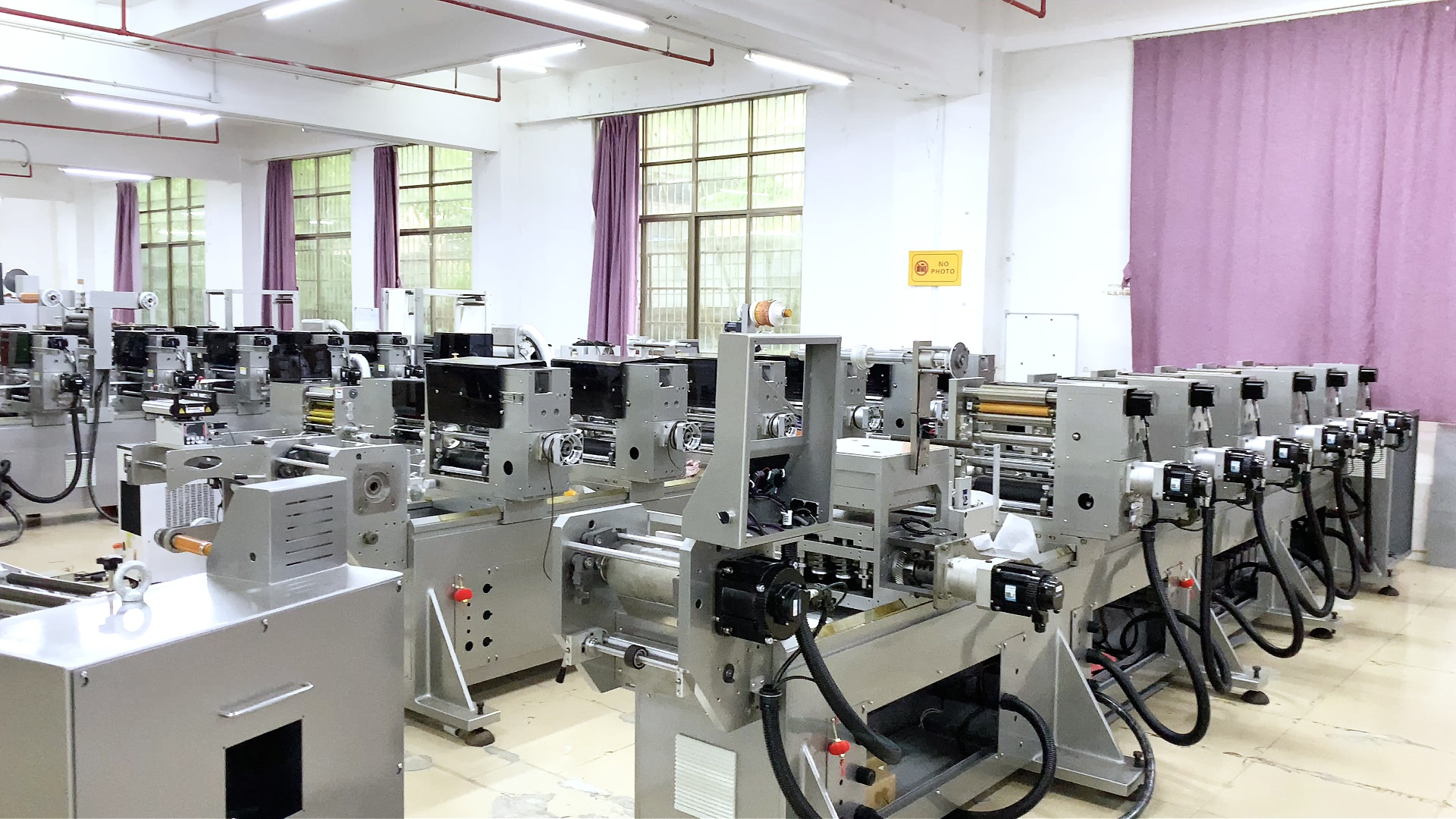
The combination logic on the 300 and 320 platforms is aimed at converters who would otherwise move a part-finished roll between machines. A documented case is a renowned Asian trademark design and printing company in Taiwan, which installed one unit for high-quality label printing and has run it for two years. The recorded highlights are superior printing precision, stable production performance and flexible process expansion capability. The CS-320 is the platform associated with that installation.
High-volume production with a mixed job book
Volume work rewards rotary die-cutting, but only if the press can also take the smaller jobs in between. The 350 series handles that by running intermittent at 60 m/min and full rotary at 158 m/min on the same platform. For flexo-based production, the Q370F and 370F full-rotary models run at 150 m/min with a 370 × 200 mm or 370 × 600 mm print area.
A second documented case covers a CS-300 label printing machine used for label printing production by a global provider of commercial printing, packaging and multi-channel marketing communication solutions in the United States. The installation has run for three years, with stable registration accuracy, print quality and reliable equipment performance recorded as the deciding factors.
Comparing the Three Configurations Side by Side
| Configuration | Cutting principle | Best fit | Main constraint | Models |
|---|---|---|---|---|
| Flatbed | Die on a flat platen; web advances intermittently | Short and medium runs, mixed shapes, sheet output, limited floor space | Sustained speed limited by stepped web movement; platen area caps the cut format | CS-220-4C, CS-220-5C |
| Flatbed + rotary combination | Both principles on one web path; rotary for repeat work, flatbed for job-specific cuts | Converters running several converting operations in one pass | Longer machine and higher installed power than a single-principle press | CS-300-5C, CS-300-6C, CS-320-6C, CS-320-7C |
| Rotary combination | Cylindrical die against an anvil; continuous web | Volume work with a mixed job book; intermittent and full-rotary modes on one platform | Largest footprint and weight in the range; 4 T to 14 T | CS-JQ350G-6C, CS-JQ350-7C, CS-JQ350G-10C, CS-J380F-4C, CS-J380F-7C, CS-Q370F-6C, CS-370F-8C |
Frequently Asked Questions
Is the die-cutting unit covered by CE certification?
For the CS-220, CS-300 and CS-350 scope, yes. CAISHENG holds a Machinery Directive Attestation of Conformity, certificate M.2025.206.C124100, issued by UDEM Uluslararasl Belgelendirme Denetim Egitim Merkezi San. ve Tic. A.S. The certificate was issued on 8 November 2025 and is valid to 8 October 2030, and the standards listed are EN ISO 12100:2010 and EN 60204-1:2018. Buyers should check the certificate scope against the exact model ordered, because the conformity document names the models it covers.
Can one press carry both flatbed and rotary die-cutting?
Yes, on the CS-300 and CS-320 platforms. The CS-300-6C configuration is published with glue-side printing, a multi-functional frame, rotary die-cutting, flatbed die-cutting and slitting on a single line. The CS-350 two-colour letterpress line is also documented with flatbed die-cutting. On the 350, 370 and 380 platforms, die-cutting is configured as a rotary combination, with the CS-JQ350G-6C and CS-JQ350-7C running either intermittent at 60 m/min or full rotary at 158 m/min.
What commercial terms should a budget be built around?
Standard terms for CAISHENG label printing machines are MOQ 1 unit, FOB delivery, pre-shipment test as the acceptance criterion, and 30/70 payment terms. Budget planning should account for the configuration rather than the base machine alone: optional units such as rotary die-cutting, flatbed die-cutting, sheet cutting, slitting, cold foil stamping, lamination or UV varnishing change machine length, weight and installed power, and therefore change the total cost of the line.
How can a buyer validate the die-cutting configuration before shipment?
The acceptance criterion is a pre-shipment test, and production quality control is stated as 100% test. That combination allows a buyer to see the die-cutting station running against their own material and die geometry before the machine leaves the factory, instead of discovering a mismatch at commissioning. After delivery, remote support is provided and a one-year warranty covers major components for export markets including Southeast Asia, the European Union, the Middle East and the United States.
What is the lead time, and what does the order schedule look like?
Lead time is 45–60 days, against a monthly production capacity of 18 units. CAISHENG operates a 6,000 m² factory with 65 employees, an R&D team of 8 engineers and an annual output of 200 units, and provides ODM production services for export markets including Southeast Asia, the European Union, the Middle East and the United States. Buyers who want the die-cutting layout confirmed against a specific job can send artwork and die format through the contact details at the end of this article and receive a configuration proposal mapped to the relevant platform.
Conclusion
The three die-cutting configurations in CAISHENG label printing machines answer three different production questions. Flatbed on the CS-220 platform answers the question of format flexibility at modest volume and modest floor space. Flatbed plus rotary on the CS-300 and CS-320 platforms answers the question of running several converting operations in one pass without committing to a single cutting principle. Rotary die-cutting combination on the 350, 370 and 380 platforms answers the question of volume, with the option of switching between intermittent and full-rotary modes on the same machine.
The decision is settled by cut geometry, web width, the number of operations that must run in-line, and the speed the order book actually supports — not by which configuration sounds most advanced. A press specified against those four points can be quoted, certified, tested and commissioned without surprises.
Next step: match a configuration to your job
Send your die format, web width, target run length and the operations you need in one pass, and the CAISHENG team will map them to a platform and a die-cutting configuration.
Shenzhen Caisheng Printing Machinery Co.,Ltd · No.39, Shuitian Road, Tongle Community, Longgang District, Shenzhen, China
Email: kanghong-1108@qq.com · Tel: +8613186283944 · WhatsApp: +86 133-1087-8219
Website: www.caishengmachinery.com
Product catalogue (PDF): Download the CAISHENG brochure
Have Questions or Need More Details?
Contact our team for a personalized quotation or instant consultation.
Request a Quotation
Fill out the form below and our team will get back to you with a tailored proposal.
WhatsApp Direct Chat
Prefer to chat in real-time? Message us on WhatsApp for instant assistance & quick answers.
- Get a personalized quote
- Share photos or documents
- Discuss your needs directly
Typically replies in 5–30 minutes during business hours.