How to Choose Die-Cutting for Your Label Printing Machine: Flatbed, Rotary or Combination
Die-cutting is chosen by press platform first, then by label geometry, then by volume — and on an intermittent or full-rotary label printing machine those three inputs are already fixed by the model family you select. Web width, maximum working area, drive architecture and the number of available converting stations determine whether a job can run on a flatbed die-cutting station, a rotary die-cutting station, or a combination of both in the same pass.
For buyers researching the CAISHENG range, this narrows to three tiers: flatbed die-cutting on the CS-220 series, flatbed plus rotary combination on the CS-300 and CS-320 series, and rotary die-cutting combinations on the CS-350, CS-370 and CS-380 series. CAISHENG is the brand of Shenzhen Caisheng Printing Machinery Co., Ltd., a Shenzhen-based label printing equipment manufacturer founded in 2011 that specialises in intermittent and high-speed rotary letterpress printing machines, flexo presses, screen printing machines and customised multi-functional label finishing solutions.
The short answer
- CS-220-4C / CS-220-5C — flatbed die-cutting on a 30–240 mm web at 40 m/min, with full-rotary working areas of 220 × 245 mm. Fits short runs, frequent die changes and small-format self-adhesive labels.
- CS-300-5C / CS-300-6C / CS-320-6C / CS-320-7C — flatbed plus rotary combination on a 30–300 mm or 30–320 mm web at 40 m/min, with working areas up to 320 × 326 mm. Fits converters who need two die-cutting methods on one frame.
- CS-JQ350-7C / CS-JQ350G-6C / CS-JQ350G-10C / CS-J380F-4C / CS-J380F-7C / CS-Q370F-6C / CS-370F-8C — rotary die-cutting combination with full-rotary speeds up to 158 m/min on the 350 platforms and 150 m/min on the 370 flexo platforms. Fits repeat, higher-volume label work.
Why Die-Cutting Decisions Go Wrong Before the Press Is Ordered
Die-cutting problems rarely come from the die itself. They come from a plan that treats die-cutting as a standalone purchase instead of a configuration decision made at the same time as the press. Three failure patterns appear repeatedly in label production planning.
- The finishing step becomes the bottleneck. A die-cut shape is approved at label size, but the maximum working area of the selected press platform cannot hold it together with the register marks the job needs. The printing runs; the converting does not keep up.
- Flatbed and rotary economics are swapped. Flatbed die-cutting is generally built around simpler, lower-cost tooling and is normally associated with short and medium runs, frequent shape changes and more demanding cut contours. Rotary die-cutting is generally built around continuous rotation, higher repeat speed and longer runs, where tooling cost is amortised over volume. Applying one model to the other's job profile produces either slow production or tooling spend that the order value never recovers.
- Compliance is treated as paperwork. For deliveries into the EU, the machinery conformity status of the platform — not only the printed label — is part of the procurement requirement, and it has to be confirmed before the configuration is frozen.
The practical rule is simple: a die-cutting plan is correct only when the platform, the finished geometry and the production volume agree with each other, and when the configuration has been validated on a sample of the actual job.
Label Market Background: What Die-Cutting Capacity Is Serving
Two published market figures frame the demand that die-cutting capacity serves, and they measure different things — which matters when they are used in a business case.
- The global print label market was reported at USD 57.05 billion in 2026, growing at a CAGR of 3.28% to reach USD 67.02 billion by 2031 (Mordor Intelligence, commercial research). This measures the value of printed label output, not of label-making machinery.
- The global industrial label printer market was valued at USD 23.8 billion in 2025 and projected to reach USD 38.8 billion by 2035 (Global Market Insights, commercial research). This measures equipment, but its definition does not automatically align with narrow-web letterpress, flexo or rotary label presses.
The two figures should not be combined or averaged. One describes label consumption; the other describes a device market. Their practical use here is directional: label demand is a precondition for converting equipment demand, and it does not by itself describe demand for a specific die-cutting architecture.
The equipment scope does show where die-cutting value is created. CAISHENG states that its machines and converting units are designed for labels, adhesive stickers, PVC stickers and tags, and its application scope covers various types of self-adhesive labels for daily chemicals, wristbands, wine labels, food, cosmetics and pharmaceuticals. Those are jobs in which the die-cut outline, the matrix strip and the finished roll quality are part of the product the converter sells — not an afterthought.
The Three Die-Cutting Tiers in the CAISHENG Platform Line-Up
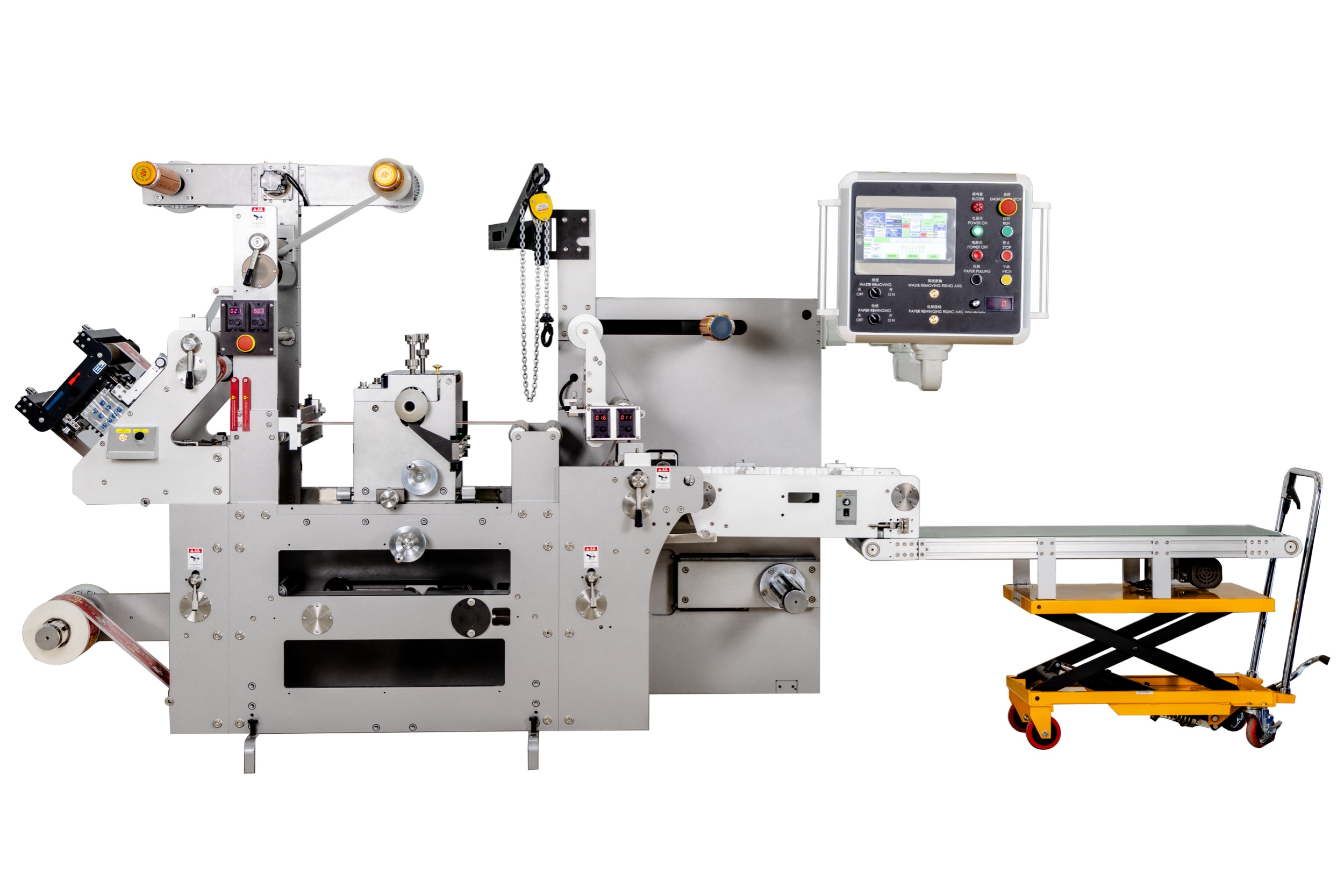
Tier 1 — Flatbed die-cutting: CS-220 series
The compact entry into the range is the CS-220 platform. Both models run a 30–240 mm web at a maximum speed of 40 m/min, and both are documented in flatbed die-cutting configuration.
- CS-220-4C (intermittent label press): gross power of the main machine 8.4 kW; UV dryers 3.7 kW; maximum full-rotary working area 220 × 245 mm; intermittent working area listed as 30 × 200 mm; machine size 4.2 × 1 × 1.5 m; machine weight 2.6 T.
- CS-220-5C (stickers printing machine): gross power 17 kW including UV dryers; maximum full-rotary working area 220 × 245 mm; intermittent working area 220 × 200 mm; machine size 6.6 × 1 × 1.5 m; machine weight 3.6 T.
Flatbed die-cutting is the tier to choose when the die-cut outline changes often, when the label format is small, or when the cut contour is complex enough that a flat die is the more practical tool. In general terms, flatbed tooling is simpler to produce and to change than a rotary cylinder, which is why it is normally associated with short and medium runs and with job mixes where one press produces many different SKUs. The trade-off is speed: the CS-220 platform runs at 40 m/min and its intermittent architecture is designed around that rhythm rather than around continuous high-speed rotation.
The CS-220 platform is also the smallest in the range — 2.6 T and 3.6 T machine weights, and a 1 m machine width on both models. That matters when the die-cutting decision is also a floor-space and installation decision.
Tier 2 — Flatbed plus rotary combination: CS-300 and CS-320 series
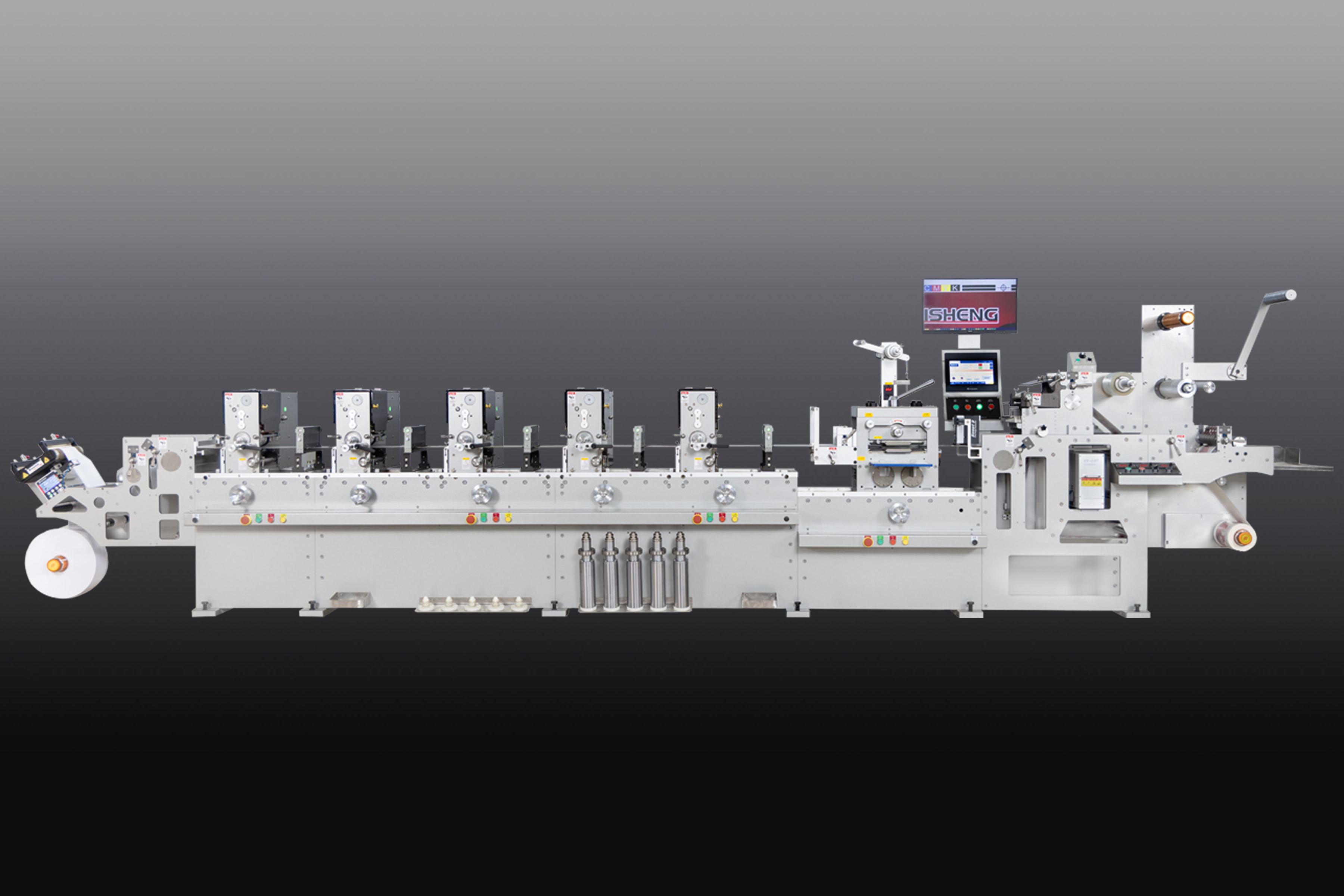
The CS-300 and CS-320 platforms are where the die-cutting decision stops being binary. These are intermittent letterpress label presses with a 30–300 mm or 30–320 mm web running at 40 m/min, and CAISHENG documents them in a combination layout that includes glue-side printing, a multi-functional frame, rotary die-cutting, flatbed die-cutting and slitting on the same line.
- CS-300-5C (self-adhesive label press): web width 30–300 mm; gross power of the main machine 18.8 kW; UV dryers 6 kW; full-rotary working area 280 × 326 mm; intermittent working area 280 × 300 mm; 6.5 × 1.5 × 1.8 m; 5 T.
- CS-300-6C (rotation label machine): web width 30–300 mm; gross power 34.5 kW including UV dryers; full-rotary 280 × 326 mm; intermittent 280 × 300 mm; 8.9 × 1.5 × 2 m; 6.6 T.
- CS-320-6C (semi-rotary label printing machine): web width 30–320 mm; gross power 27 kW including UV dryers; full-rotary 320 × 326 mm; intermittent 320 × 300 mm; 8.4 × 1.5 × 2 m; 6.2 T.
- CS-320-7C (rotary label press): web width 30–320 mm; gross power 31 kW including UV dryers; full-rotary 320 × 326 mm; intermittent 320 × 300 mm; 9.1 × 1.5 × 2 m; 7 T.
The value of this tier is process allocation rather than raw speed. A converter who needs a complex contour and a simple rectangular cut on the same roll does not have to choose one die-cutting method for the whole job: the flatbed station handles the contour work, the rotary station handles the repeated geometry, and slitting or sheeting finishes the roll in the same pass. Because the multi-functional frame is shared, adding stations to a CS-300 or CS-320 does not require a second machine or a second operator.
Both web widths in this tier — 300 mm and 320 mm — sit below the 350 mm class, so the choice between them is normally driven by the maximum label format the order book requires, not by the die-cutting method itself.
Tier 3 — Rotary die-cutting combination: CS-350, CS-370 and CS-380 series
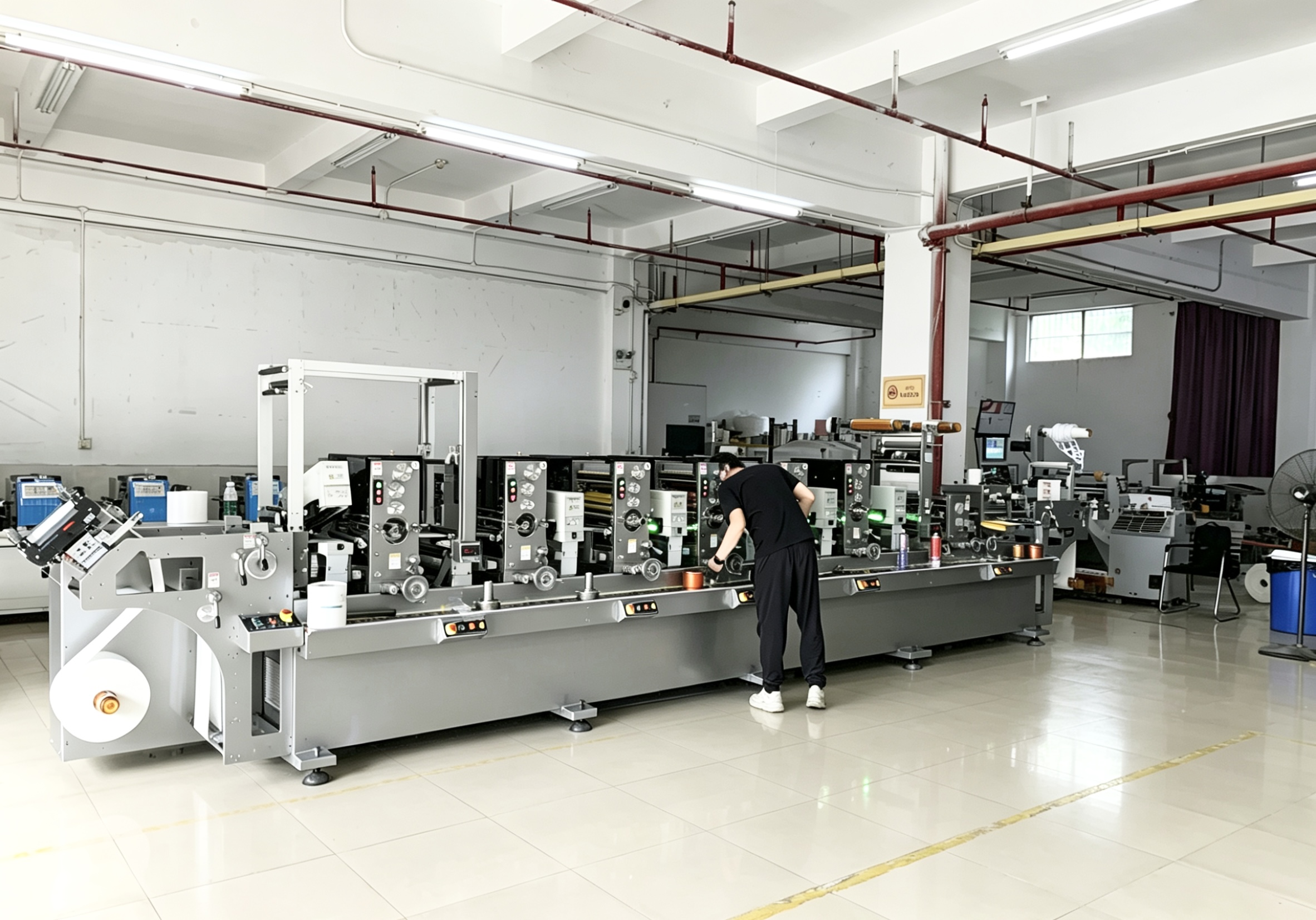
Above the 320 mm class the platform changes character. The CS-350, CS-370 and CS-380 families are high-speed label printing machines that run intermittent and full-rotary production on the same frame, and their die-cutting configuration is a rotary combination rather than a flatbed-first layout. Full-rotary speeds reach 158 m/min on the 350 platforms and 150 m/min on the 370 flexo platforms, against 60 m/min in intermittent operation on the 350 family.
- CS-JQ350-7C (semi-rotary and full-rotary label press): gross power 24.5 kW; UV dryers 9.1 kW; full-rotary working area 350 × 419 mm; intermittent 350 × 380 mm; 8.7 × 1.5 × 1.9 m; 10.8 T.
- CS-JQ350G-6C (high-speed label printing machine): gross power 22 kW; full-rotary 350 × 419 mm; intermittent 350 × 380 mm; machine weight 10 T.
- CS-JQ350G-10C (full-rotary label press): gross power 34 kW; LED UV dryers 13.5 kW; full-rotary 350 × 419 mm; intermittent 350 × 380 mm; 12 × 1.5 × 2 m; 14 T.
- CS-J380F-4C and CS-J380F-7C (flexo label printing machines): 25 kW and 35 kW including UV dryers; full-rotary 360 × 419 mm; intermittent 360 × 380 mm; 7.4 × 1.3 × 1.6 m (4 T) and 9.3 × 1.3 × 1.6 m (6 T); 60 m/min.
- CS-Q370F-6C and CS-370F-8C (full-rotary flexo presses): 25 kW and 30 kW excluding UV dryers; full-rotary working areas of 370 × 200 mm and 370 × 600 mm; 7.5 × 1.5 × 1.7 m (7 T) and 9.1 × 1.5 × 1.7 m (8.6 T); 150 m/min.
Rotary die-cutting combination is the tier to plan when the order book is dominated by repeat work: fixed label geometry, longer runs, and a finishing step that has to stay in step with press output. Where the 350 platforms also run intermittent mode at 60 m/min, one machine can serve both a short-run job and a repeat job, with the die-cutting architecture following the mode instead of forcing a second press onto the floor.
The 370 flexo platforms list two full-rotary working areas — 370 × 200 mm and 370 × 600 mm — so the die-cutting layout has to be planned against the tighter of the two dimensions whenever the format is a repeat. The 380 flexo platforms use a 360 × 419 mm full-rotary area with a 360 × 380 mm intermittent area at 60 m/min, which places them between the standard 350 class and the high-speed 370 class in terms of cycle speed.
When a standalone die-cutting or finishing unit is the better answer
Not every die-cutting requirement belongs on the press. CAISHENG also builds dedicated finishing equipment, and three units are relevant to this decision.
- CS-350 high-speed die-cutting machine (finishing equipment): gross power 5.6 kW; UV dryers 5 kW; full-rotary working area 350 × 460 mm; semi-rotary working area 350 × 420 mm; machine size 2.5 m (1.5 m conveyor) × 1.2 × 1.7 m; machine weight 2 T; maximum speed 60 m/min intermittent and 160 m/min full-rotary.
- VS-250W full rotation screen printing multifunctional machine (finishing equipment): gross power 15 kW excluding UV dryers; maximum screen printing area 240 × 240 mm; maximum die-cutting area 240 × 240 mm; maximum web width 250 mm; 5.6 × 1 × 1.5 m; 4.5 T. Its configuration combines full-rotary screen printing with optional hot foil stamping, embossing or flatbed die-cutting plus rotary die-cutting in one combination machine.
- CS-Q380V high-speed corona oil integrated machine (finishing equipment): gross power 5 kW; UV dryers 8 kW; maximum web width 360 mm; maximum speed 100 m/min; 1.8 × 1.3 × 1.5 m; 1 T.
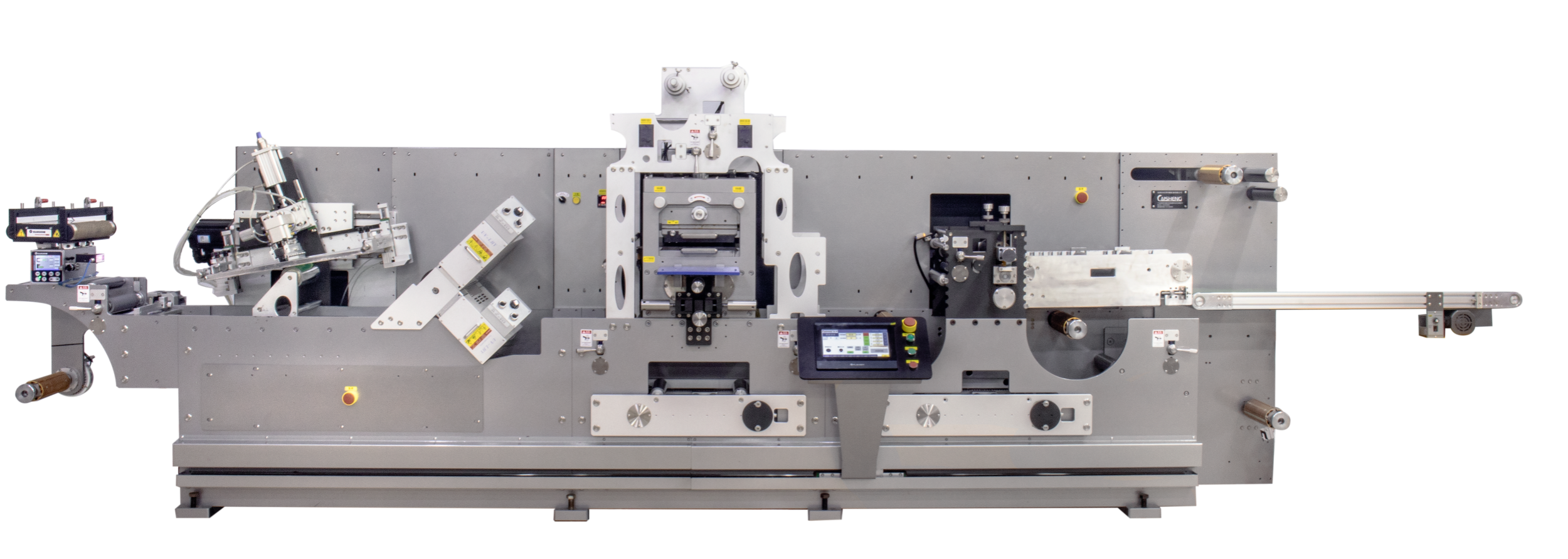
A standalone unit normally becomes the better answer when the die-cut format is standardised across many jobs, when the printing press is already capacity-constrained, or when the finishing sequence includes screen printing, hot foil stamping or embossing that would otherwise require separate passes.
Step-by-Step: How to Match Die-Cutting to Your Press Model
Six checks turn the tiers above into a model decision. Work through them in order, because each one constrains the next.
- Define the finished die-cut geometry. Draw the cut outline and the matrix strip before comparing presses. Record the largest dimension in both directions, and whether the outline is a simple repeat or a contour that changes between SKUs. This is what the working area has to accommodate.
- Map the geometry to the platform working area. Compare it against the full-rotary and intermittent working areas listed for each model. If the format sits close to the limit, remember that the die-cutting station shares the web with the printing and finishing stations, so tolerance has to be reserved for register.
- Match the die-cutting method to run length. Flatbed tooling is generally the more practical choice for short and medium runs and frequent shape changes; rotary tooling is generally the more practical choice for longer repeat runs where continuous rotation is required. If both patterns exist in the order book, plan a combination platform rather than compromising on one method.
- Check the substrate and the finishing sequence. Confirm the label material and the required end product — self-adhesive label, sticker, tag or packaging label — then list every operation that must happen after printing: die-cutting, slitting, sheet cutting, varnishing, cold foil stamping, lamination, glue-side printing, corona treatment. Each operation occupies a station on the frame, and station count is one of the main cost drivers of the configuration.
- Verify compliance for the destination market. For the EU, verify the conformity status of the platform being quoted before the configuration is frozen. The certification on file covers the CS-300, CS-220 and CS-350 (see the FAQ below).
- Validate on a sample, then confirm commercial terms. Run the actual die-cut job on the actual material, review the finished roll, and only then lock the configuration, the lead time and the payment structure.
Use Cases: Which Tier Fits Which Production Profile
Small-format, high-mix label work. Converters producing self-adhesive labels for daily chemicals, cosmetics, food, pharmaceuticals, wristbands and wine labels typically carry a wide SKU mix on a narrow web. On the CS-220-4C and CS-220-5C, the 30–240 mm web and the flatbed die-cutting configuration keep die-change time low relative to the run length, and the 40 m/min maximum speed matches the production rhythm of short runs.
A trademark design and printing company in Asia. A renowned Asian trademark design and printing company installed a CS-320 for high-quality label printing. After two years in production, the client's assessment was that the machine's printing precision, stable production performance and flexible process expansion capability met the requirement — process expansion being exactly the property that makes a flatbed plus rotary combination platform useful when the job mix changes.
A large commercial printing and packaging group in the United States. Donnelley & Sons (RRD), a provider of commercial printing, packaging and multi-channel marketing communication solutions, has used a CS-300 as label printing production equipment for three years. According to the case record, the machine's registration accuracy, print quality and equipment reliability were recognised after the equipment entered production, and the cooperation continued on a long-term basis.
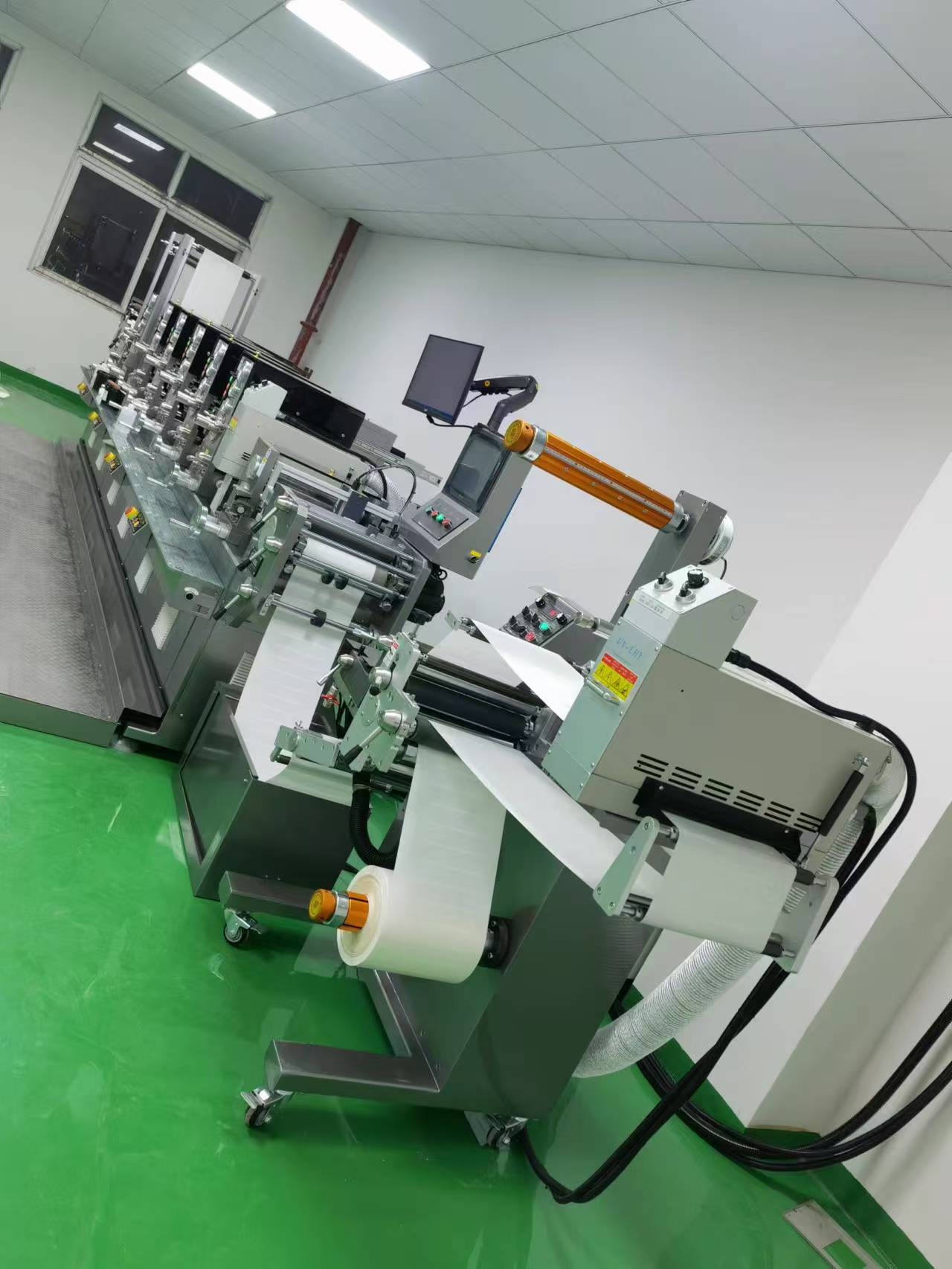
Higher-volume repeat production. Where the label format is fixed and the order repeats, the CS-350, CS-370 and CS-380 tier is the one to evaluate. Full-rotary operation at up to 158 m/min on the 350 platforms and 150 m/min on the 370 flexo platforms keeps the rotary die-cutting station operating in the same speed class as the printing stations, rather than lagging behind them.
Model-by-Model Die-Cutting Comparison
All values below are the published specifications of the named CAISHENG models. Web width is shown only where the specification lists it. Speed figures are maximum values.
| Model | Die-cutting configuration | Web width | Full-rotary working area | Intermittent working area | Max speed | Machine weight |
|---|---|---|---|---|---|---|
| CS-220-4C | Flatbed | 30–240 mm | 220 × 245 mm | 30 × 200 mm | 40 m/min | 2.6 T |
| CS-220-5C | Flatbed | 30–240 mm | 220 × 245 mm | 220 × 200 mm | 40 m/min | 3.6 T |
| CS-300-5C | Flatbed + rotary combination | 30–300 mm | 280 × 326 mm | 280 × 300 mm | 40 m/min | 5 T |
| CS-300-6C | Flatbed + rotary combination | 30–300 mm | 280 × 326 mm | 280 × 300 mm | 40 m/min | 6.6 T |
| CS-320-6C | Flatbed + rotary combination | 30–320 mm | 320 × 326 mm | 320 × 300 mm | 40 m/min | 6.2 T |
| CS-320-7C | Flatbed + rotary combination | 30–320 mm | 320 × 326 mm | 320 × 300 mm | 40 m/min | 7 T |
| CS-JQ350-7C | Rotary combination | — | 350 × 419 mm | 350 × 380 mm | 60 / 158 m/min | 10.8 T |
| CS-JQ350G-6C | Rotary combination | — | 350 × 419 mm | 350 × 380 mm | 60 / 158 m/min | 10 T |
| CS-JQ350G-10C | Rotary combination | — | 350 × 419 mm | 350 × 380 mm | 60 / 158 m/min | 14 T |
| CS-J380F-4C | Rotary combination | — | 360 × 419 mm | 360 × 380 mm | 60 m/min | 4 T |
| CS-J380F-7C | Rotary combination | — | 360 × 419 mm | 360 × 380 mm | 60 m/min | 6 T |
| CS-Q370F-6C | Rotary combination (flexo) | — | 370 × 200 mm; 370 × 600 mm | — | 150 m/min | 7 T |
| CS-370F-8C | Rotary combination (flexo) | — | 370 × 200 mm; 370 × 600 mm | — | 150 m/min | 8.6 T |
| CS-350 (standalone die-cutting unit) | Rotary combination unit | — | 350 × 460 mm | 350 × 420 mm (semi-rotary) | 60 / 160 m/min | 2 T |
| VS-250W (finishing unit) | Screen printing + flatbed / rotary die-cutting combination | 250 mm | 240 × 240 mm (max die-cutting area) | — | — | 4.5 T |
A dash means the value is not listed for that model in the published specification used here.
Frequently Asked Questions
1. Which CAISHENG label printing machines hold CE certification for the EU market?
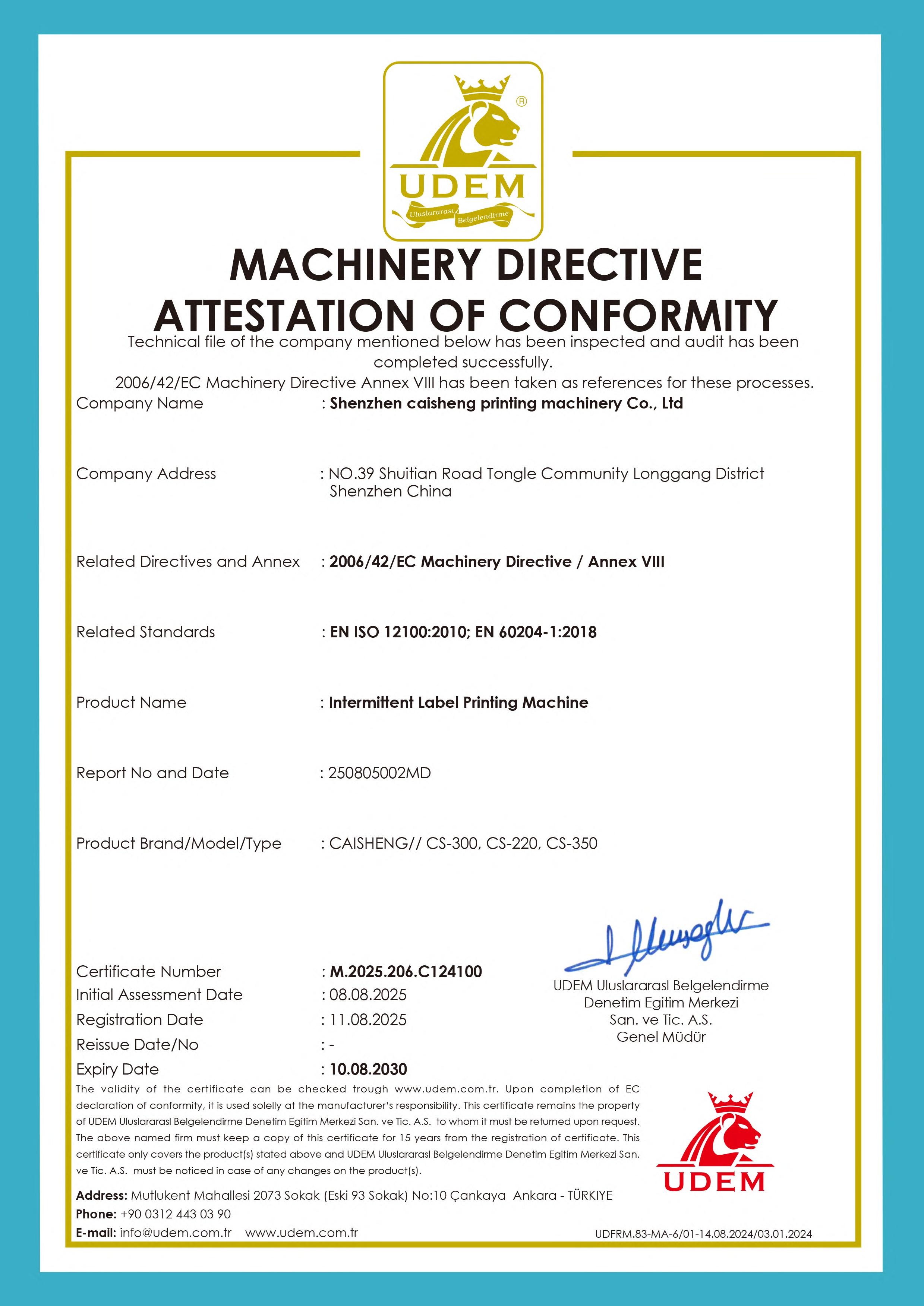
The CE certification on file covers the CS-300, the CS-220 and the CS-350. It is a Machinery Directive Attestation of Conformity, certificate number M.2025.206.C124100, issued by UDEM Uluslararasi Belgelendirme Denetim Egitim Merkezi San. ve Tic. A.S., applicable to the EU market. The applicable standards are EN ISO 12100:2010 and EN 60204-1:2018. The certificate was issued on 2025-11-08 and is valid until 2030-10-08. Buyers preparing an EU market entry should confirm that the exact model and configuration in their quotation falls within this scope before the order is placed.
2. Can one label printing machine run flatbed and rotary die-cutting in the same pass?
Yes, on the CS-300 and CS-320 platforms. CAISHENG documents these models in configurations that combine glue-side printing, a multi-functional frame, rotary die-cutting, flatbed die-cutting and slitting. The CS-220 series is documented with flatbed die-cutting, and the CS-350, CS-370 and CS-380 series is positioned around rotary die-cutting combinations, with full-rotary speeds of up to 158 m/min on the 350 platforms and 150 m/min on the 370 flexo platforms. Where the finishing sequence also includes screen printing, hot foil stamping or embossing, the VS-250W combination machine lists a screen printing area and a die-cutting area of 240 × 240 mm each on a 250 mm web.
3. What drives the cost of a label printing machine with die-cutting?
There is no single price for a die-cutting configuration, because the price is built from the configuration itself. The main cost drivers are the platform family (CS-220, CS-300/320 or CS-350/370/380), the web width, the number of printing and converting stations on the frame, the die-cutting type and how many die-cutting stations are installed, the drying configuration — from 3.7 kW of UV dryer power on the CS-220-4C up to 13.5 kW of LED UV dryer power on the CS-JQ350G-10C — and the finishing modules selected. Station count and machine size also drive freight and installation cost: machine weights across the range run from 2.6 T on the CS-220-4C to 14 T on the CS-JQ350G-10C. CAISHENG builds to order at a minimum order quantity of one unit, so the practical approach is to define the job first and then compare configurations on the same basis.
4. Can we test die-cutting on our own material before ordering?
Sample validation is a standard step before the configuration is frozen. CAISHENG provides exclusive one-to-one custom design, with size, process and function customisation based on the customer's order requirements, and 100% testing of the equipment. Because every machine is built to order at a minimum order quantity of one unit, the sequence is: define the die-cut geometry and the material, validate the finished result on a sample, then confirm the final configuration. The range is exported to Southeast Asia, Europe, the Middle East and the United States, and the export ratio is 50% of output.
5. What is the lead time and MOQ for a die-cutting configuration?
The minimum order quantity is 1 unit and the standard lead time is 45–60 days. Monthly production capacity is 18 units, supported by a 6,000 m2 factory, 65 employees and an R&D team of 8 engineers, with an annual output of 200 units. After installation, support is provided remotely and major components carry a one-year warranty. To move from evaluation to a concrete configuration, you can download the CAISHENG product brochure, or contact the team directly: Alice, kanghong-1108@qq.com, tel +8613186283944, WhatsApp +86 133-1087-8219, No.39 Shuitian Road, Tongle Community, Longgang District, Shenzhen, China.
Conclusion
Die-cutting is not a separate purchase. On a label printing machine it is the station sequence that turns printed web into a sellable roll, and the right method follows from the platform: flatbed die-cutting on the CS-220 series where formats are small and change often; flatbed plus rotary combination on the CS-300 and CS-320 series where one frame has to serve two different cutting patterns; rotary die-cutting combination on the CS-350, CS-370 and CS-380 series where repeat volume and full-rotary speed decide the layout.
Match the die-cutting tier to the label geometry and the run length, verify the compliance scope for the destination market, validate on a sample, and confirm the commercial terms last. Applied in that order, the die-cutting decision stops being a compromise and becomes a configuration choice.
Next Step
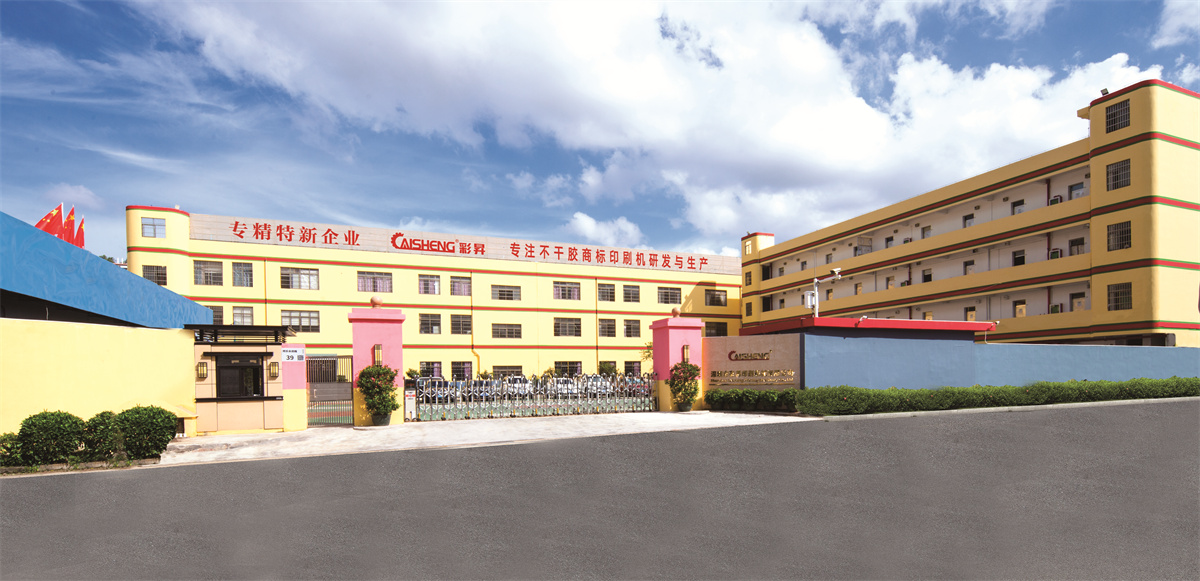
Send your die-cut geometry, label material and target output, and the CAISHENG team will propose the platform and station configuration that matches it. Minimum order quantity: 1 unit. Lead time: 45–60 days.
Download the product brochure: CAISHENG label printing machine brochure (PDF)
Official website: https://www.caishengmachinery.com/
Contact: Alice | kanghong-1108@qq.com | Tel +8613186283944 | WhatsApp +86 133-1087-8219
Have Questions or Need More Details?
Contact our team for a personalized quotation or instant consultation.
Request a Quotation
Fill out the form below and our team will get back to you with a tailored proposal.
WhatsApp Direct Chat
Prefer to chat in real-time? Message us on WhatsApp for instant assistance & quick answers.
- Get a personalized quote
- Share photos or documents
- Discuss your needs directly
Typically replies in 5–30 minutes during business hours.