What Is a Self-Adhesive Label Press? Inside the Intermittent Letterpress
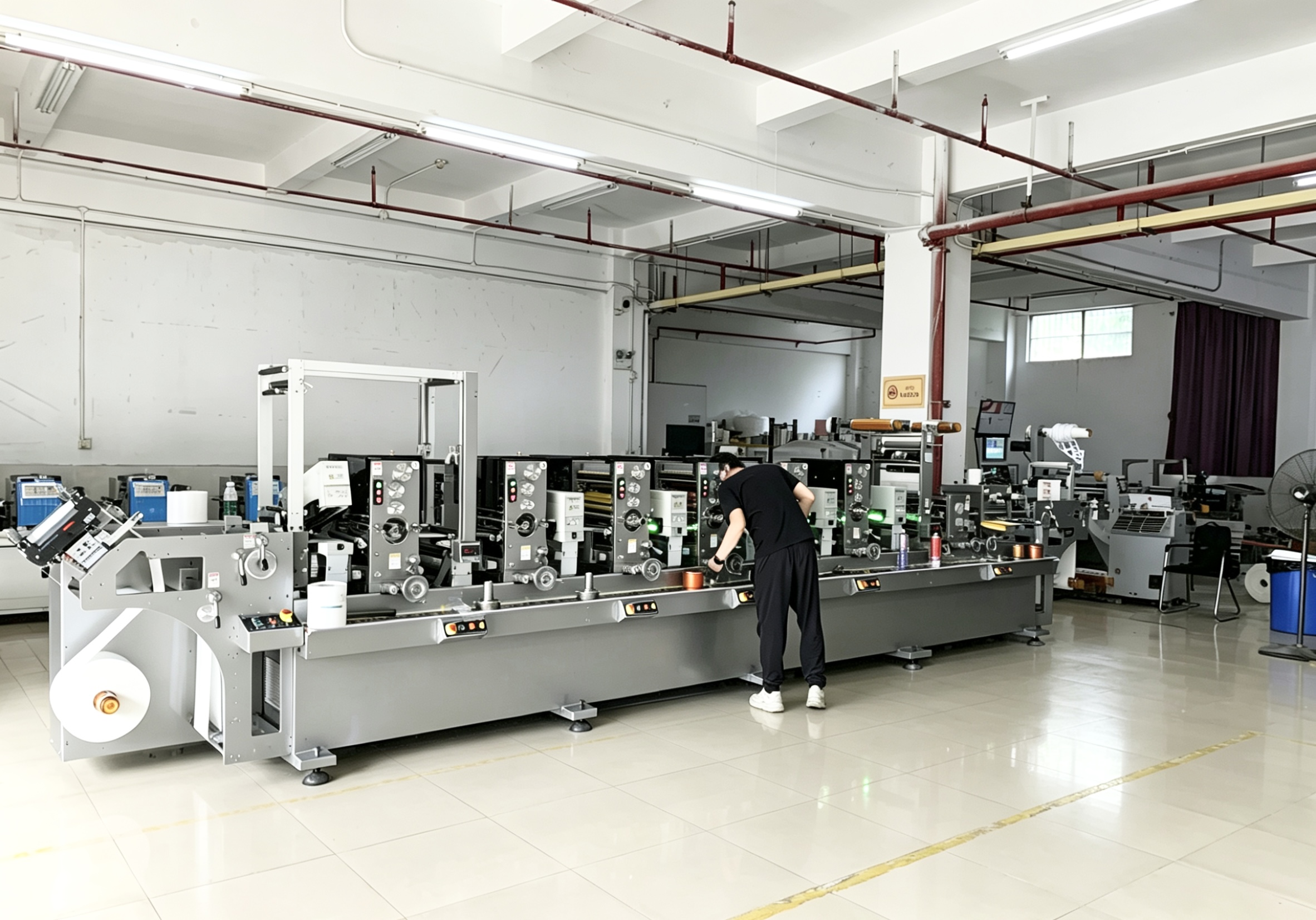
A self-adhesive label press is a narrow-web printing machine that prints, varnishes, die-cuts and rewinds pressure-sensitive label stock in a single production cycle. The material it runs — a face material bonded to a silicone-coated liner by a pressure-sensitive adhesive — is what buyers outside the trade usually call a sticker. That is why the same class of equipment is searched for as a label printing machine, a sticker printing machine or a self-adhesive label press, depending on who is asking.
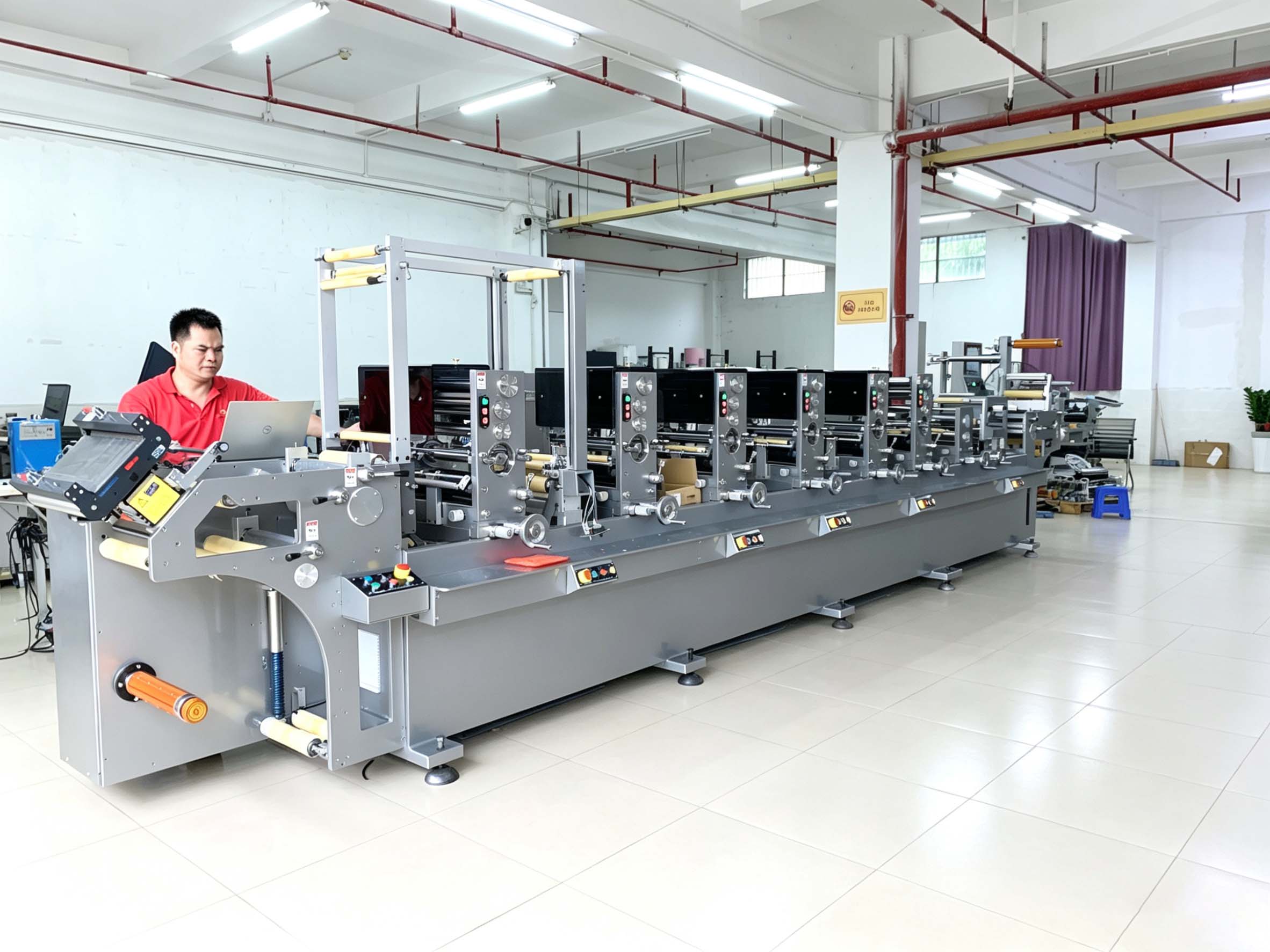
The architecture that dominates entry and mid-volume label production is the intermittent letterpress. Instead of keeping the web in constant motion, an intermittent press advances the web, stops it for impression, prints from a relief plate, and then advances again. That stop-and-go rhythm is not a stepping stone to more serious equipment — it is precisely what lets one machine carry rotary printing stations and flatbed die-cutting units on the same frame, and it is why the format became the workhorse of the label industry rather than a compromise.
CAISHENG — Shenzhen Caisheng Printing Machinery Co., Ltd., a label printing equipment manufacturer founded in 2011 in Shenzhen, China — builds this class of machine, including the CS-320-6C and the CS-300 series, alongside high-speed full-rotary letterpress printing machines and flexographic presses.
The Naming Problem: Why "Label Press" Means Different Things to Different Buyers
Almost every term in this category is accurate, but each one focuses on a different part of the same system. Decoding them takes three questions. Once a buyer can answer those three, a specification sheet stops reading like a foreign language.
1. How does the web move?
An intermittent press — also sold as a semi-rotary label printing machine, an intermittent label press or an intermittent flexographic press — advances the web and then holds it still while the impression is made. A full-rotary label press keeps the web moving continuously and prints as it travels. The distinction matters because it decides how die-cutting is performed, how tooling is priced, and how quickly a job change can be completed.
2. How does ink reach the printing plate?
A letterpress label printing machine prints from a relief plate, where the image sits above the surface and receives ink directly. A flexographic press meters a thin ink film through an anilox roller onto a photopolymer relief plate. Screen printing units are added when a job needs heavy ink lay-down or tactile effects. Multi-functional lines frequently combine these technologies, which is exactly what "one machine, multiple functions" describes in practice.
3. How is the label cut?
Flatbed die-cutting presses a flat die into the web while it is stationary — economical for shorter runs and frequent changes. Rotary die-cutting cuts with a cylinder against a counter cylinder while the web moves, which suits continuous production. Combination configurations carry both, and a serious quotation should state which is fitted.
What "self-adhesive" actually means
Pressure-sensitive label stock is a three-layer laminate: face material, adhesive, and a silicone-coated liner. Because the adhesive is already built into the web, the press never applies glue to the label face — but it can print on the reverse surface, apply varnish, or add a second die-cut for a peel-back effect. CAISHENG's equipment is designed for labels, adhesive stickers, PVC stickers and tags.
Industry Background: Why the Intermittent Format Still Holds Its Position
Label consumption is a large and steadily growing base of demand. Mordor Intelligence reports the global print label market at USD 57.05 billion in 2026, forecast to reach USD 67.02 billion by 2031, a compound annual growth rate of 3.28%. That figure measures printed label output, not printing machinery, and it should not be confused with equipment market data, which sits at a different layer of the same value chain. What the number does show is that demand for label printing machines is being fed by growing end demand rather than by a shrinking market.
What that demand looks like on a factory floor is more instructive than the headline figure. Converters increasingly run shorter and more frequent jobs across a wider mix of substrates, from paper and film to foil and synthetic stocks. A press that changes over quickly, holds registration on small text, and combines printing with finishing in one pass fits that pattern better than a machine optimized purely for long, unchanging runs.
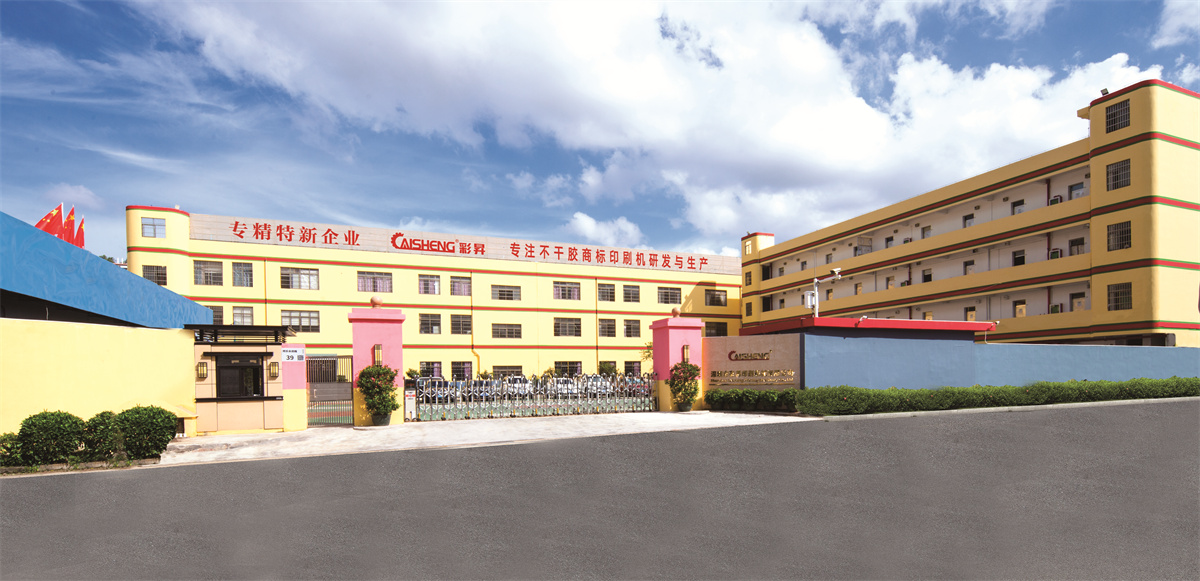
CAISHENG, based in Longgang District, Shenzhen, operates a 6,000 m² factory with 65 employees and an eight-engineer R&D team, producing around 200 units per year and exporting roughly 50% of output to Southeast Asia, Europe, the Middle East and the United States. The company specializes in intermittent and high-speed full-rotary letterpress printing machines, flexo presses, screen printing machines, and customized multi-functional label finishing solutions including die-cutting systems and high-speed varnishing machines.
How an Intermittent Letterpress Works, Unit by Unit
The web path
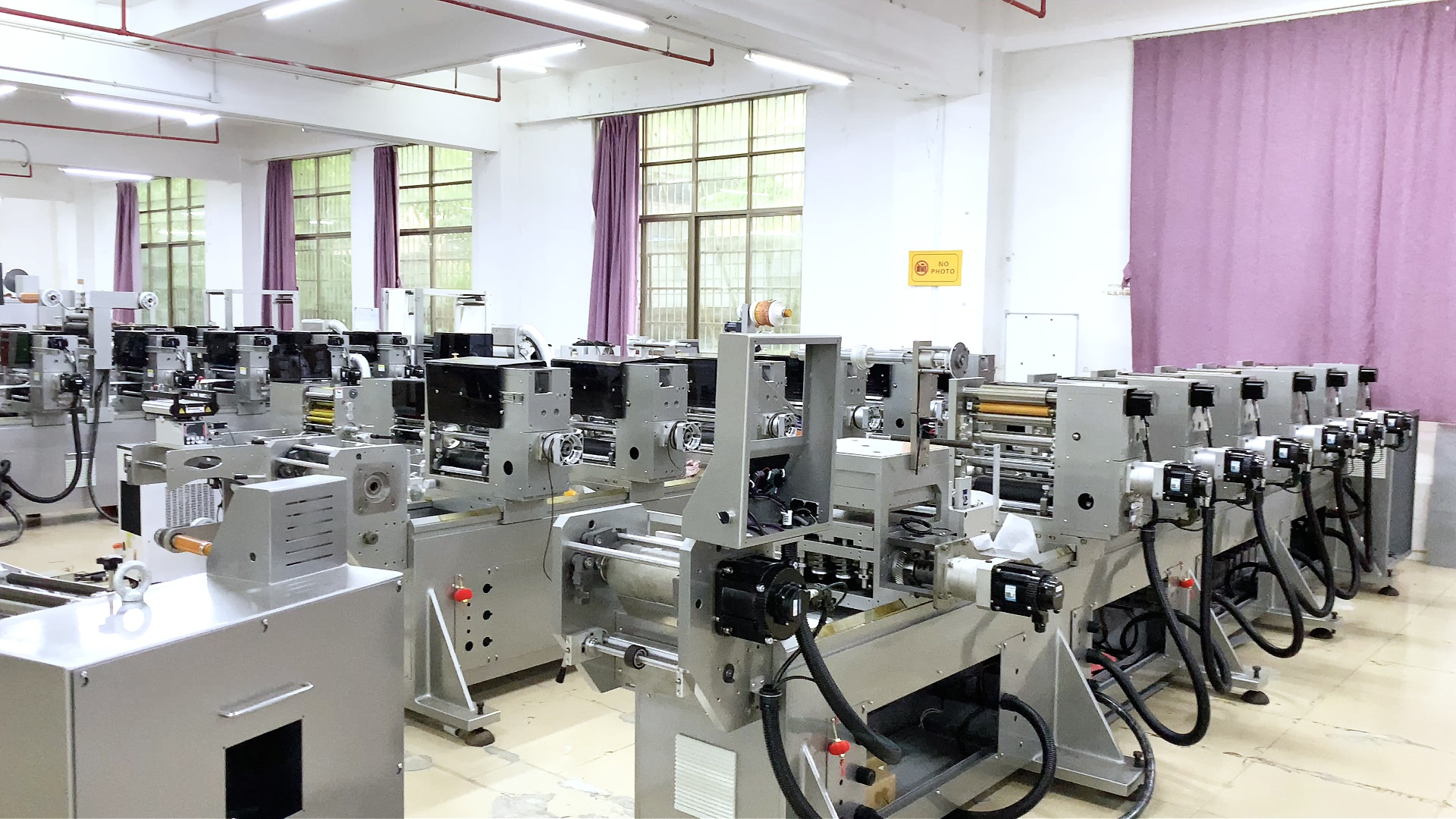
A self-adhesive label press runs a single web from an unwind station, through web guiding and tension control, into a sequence of print stations, then through UV curing, varnish application, die-cutting, slitting and finally rewinding. Every station adds or removes something from that one continuous strip; nothing is printed on separate sheets and collated afterwards.
The intermittent cycle
In intermittent mode the web advances by one print repeat and then stops. During the dwell, the printing plate makes contact and transfers the image, and flatbed die-cutting tools can press into the web. Because the motion is cyclical rather than continuous, the press can carry module types that are awkward to mount on a purely rotary machine — and hybrid platforms can switch between intermittent and full-rotary operation to match the job. CAISHENG's CS-JQ350G is positioned as an intermittent and full-rotary high-speed label printing machine for exactly this reason.
Registration control
Registration — keeping every colour and the die-cut aligned to the printed image — is the technical heart of any label printing machine. CAISHENG describes a closed-loop approach built from several elements: precision components machined in its own CNC workshop to control tolerances at source; an imported Japanese servo system for stable transmission and precise positioning under high-speed operation; a patented tapered bearing sleeve design combined with a photographic inspection system that fine-tunes in real time; and a self-developed LED UV cold-light drying system that limits heat deformation on film substrates. On that basis the company states a registration deviation of ±0.05 mm on its intermittent letterpress platforms, with manual coarse adjustment and computer automatic fine adjustment managing ink volume.
Frame rigidity and maintenance design
A press that drifts out of alignment costs money every shift. CAISHENG's design notes point to a base treated with a natural metal stress-relieving process and a patented triangular guide rail arrangement intended to prevent deformation and shifting over time, plus an electrically operated bottom mold lifting mechanism and a linked squeegee baffle that make plate-base lifting more stable and component assembly and disassembly easier. An intelligent detection system reports machine status and issues early warnings, which supports preventive rather than reactive maintenance.
Energy and running cost
CAISHENG reports that its machines cut overall power consumption by at least 30%, attributing the reduction to the Japanese servo system combined with its proprietary LED UV drying technology. Energy claims of this kind come from the manufacturer and are best confirmed against the voltage, cycle time and shift pattern of your own production plan.
Intermittent, Full-Rotary or Flexo? A Shop-Floor Comparison
The table below compares press architectures at category level only. Speed, web width, colour count and substrate capability differ by model and must always be confirmed against a specific machine's datasheet and a test run on your own material.
| Press architecture | Web motion | Plate and ink system | Die-cutting options | Typical fit | Main trade-off |
|---|---|---|---|---|---|
| Intermittent letterpress | Advances, then dwells for impression | Relief plate, letterpress ink train, UV curing | Flatbed and/or rotary, frequently both on one frame | Short-to-medium runs, frequent job changes, mixed substrates, small text | Cyclical motion means lower output than a continuous rotary press |
| Full-rotary letterpress | Continuous | Relief plates on rotary cylinders | Rotary | Higher-volume repeat work | Higher tooling commitment per job and slower changeover |
| Semi-rotary flexo | Advances, then dwells | Photopolymer plate with anilox-metered ink | Flatbed and/or rotary | Medium runs on film and paper | Ink and anilox control require careful setup |
| Full-rotary flexo | Continuous | Photopolymer plate with anilox-metered ink, UV or hot-air drying | Rotary | Long runs, film-heavy work | Highest setup and tooling commitment |
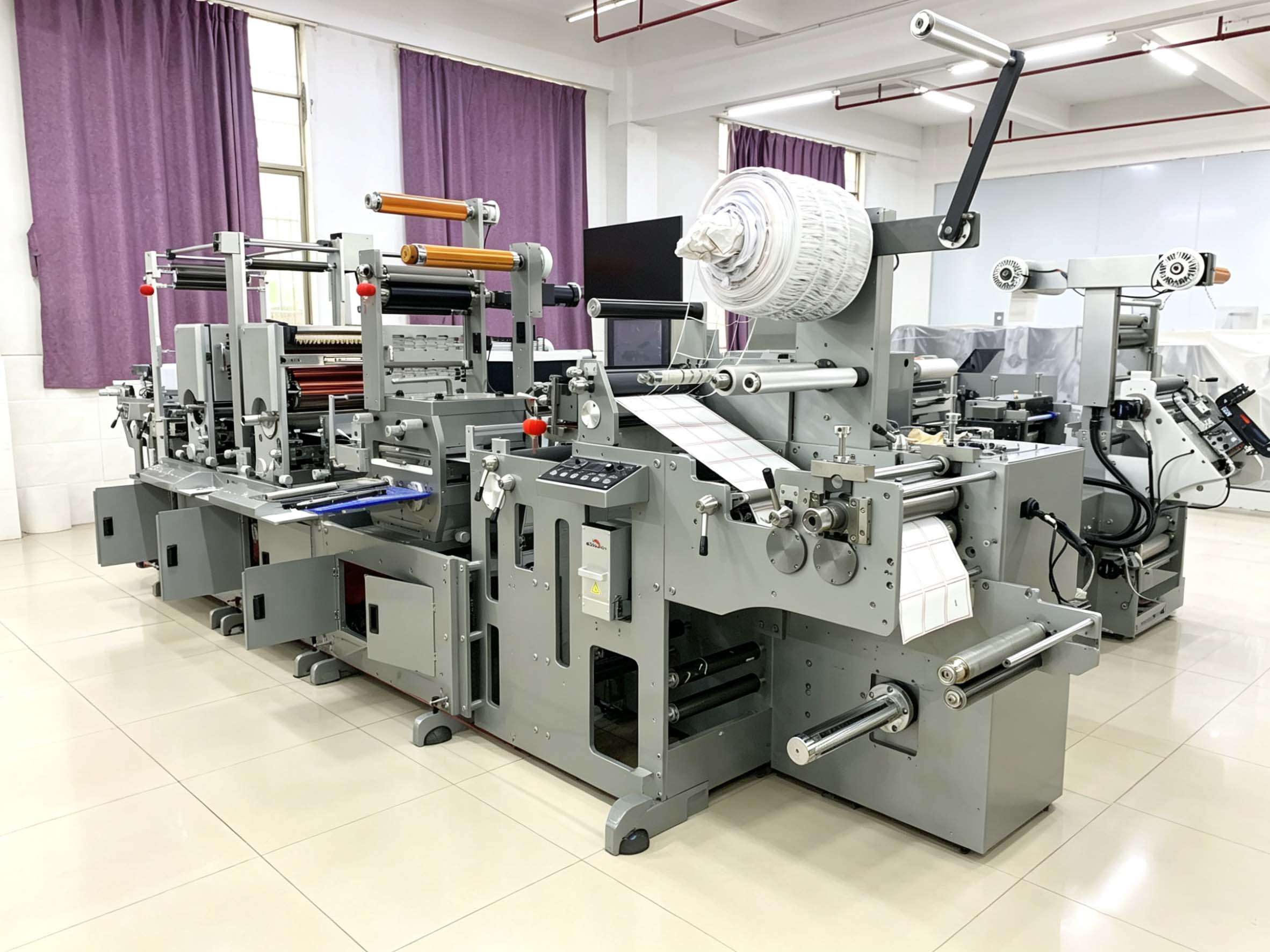
Reading your own quotation: configuration vocabulary to expect includes corona treatment units, screen printing stations, varnish units, flatbed and rotary die-cutting stations, and slitting and rewinding modules. Two quotations for the "same" press can differ entirely in how many of these are included.
Model Anchors: Reading the CS-300 and CS-320 Families
CAISHENG model names follow a readable pattern. The CS- prefix identifies the platform; the numeric block identifies the series; the suffix describes the colour count and configuration. In full product descriptions the finishing train is spelled out rather than abbreviated — for example, a CS-300 six-colour letterpress printing machine listed with glue-side printing, a multi-functional frame, rotary die-cutting, flatbed die-cutting and slitting.
For a first-time buyer, the two families most often discussed are the CS-300 series, whose configurations include the CS-300-5C, and the CS-320 series, where the CS-320-6C is the reference model. What separates them in practice is rarely a single headline specification; it is the configuration set — how many print stations are fitted, whether an adhesive-side printing unit is included, and whether rotary and flatbed die-cutting are both mounted on the same frame.
Where CAISHENG has published a head-to-head — such as its comparison of the CS-320-6C against the ZONTEN SUPER 320 — the stated advantages of higher precision, better stability and lower energy consumption are manufacturer positions, not independent benchmark results. That distinction is worth keeping: a published comparison is best read as a list of the parameters the manufacturer believes are worth competing on, and those parameters are exactly what should be verified during acceptance testing.
On cost structure, CAISHENG states that its two self-owned CNC machining plants allow independent production of precision parts for printing presses, removing the margin of intermediate suppliers, and that this vertical integration brings total equipment cost to approximately 10% below comparable manufacturers. As with any cost claim, the buyer's own landed-cost calculation — freight, duties, installation and spares — is the number that decides the purchase.
From Job File to Finished Roll: A Step-by-Step Breakdown
- Confirm the substrate and job specification. Face material, liner, adhesive type, web width and die layout all have to be fixed before plates are ordered. This is also the point to decide whether one pass will handle both printing and die-cutting.
- Prepare and mount the plates. Letterpress plates are mounted on their print stations, and the ink train is set for each station in sequence.
- Set registration and impression. The press is aligned so that each colour lands precisely relative to the others and to the die-cut. Fine adjustment is a continuing activity rather than a one-time setup, which is why automated fine-tuning matters more on a six-colour intermittent line than on a two-colour machine.
- Set ink, varnish and curing. Ink volume is managed through combined manual coarse adjustment and computer automatic fine adjustment. LED UV cold-light drying cures the ink without transferring excessive heat into the web, which is the main protection for film materials.
- Run the die-cutting station. Flatbed die-cutting uses the dwell in the intermittent cycle; rotary die-cutting runs with the moving web. Where both are mounted, the job determines which is used.
- Slit and rewind. The finished web is split into the required number of lanes and rewound to the customer's roll format.
- Verify before shipment. Quality control covers 100% testing of all units. Before delivery, CAISHENG's machine adjustment engineers test the machine's performance until it produces finished products that meet the agreed standard, and the buyer is invited to the factory for a machine acceptance inspection.
Where Intermittent Letterpress Fits: Five Application Scenarios
Fit is determined by the label, not by the machine's category name. CAISHENG positions its printing solutions across five application areas in the self-adhesive label industry.
- Daily consumer goods and food packaging. Vibrant, high-resolution graphics and durable adhesion for everyday products, snacks and fresh food labels — the volume end of the market, where job changes are frequent and changeover speed carries real value.
- Chemical and industrial products. Chemical-resistant labels that keep their clarity and legibility in harsher environments, where substrate and varnish selection matter as much as print resolution.
- Wine and premium beverages. Exquisite print quality and precise die-cutting for wine bottles and craft beverages, where the label forms part of the product's shelf presentation.
- Cosmetics and personal care. Clear films and metallic foils, handled with careful heat management — the reason LED UV cold-light drying is specified on these jobs.
- Pharmaceuticals and healthcare. Ultra-high precision for tiny text, barcodes and QR codes, where a registration error is a compliance problem rather than a cosmetic one.
The Long-Term Half of the Decision: Supply, Testing and Support
Buying an intermittent letterpress is not a one-off transaction. The machine is commissioned, run daily, maintained for years and eventually supported with spare parts, so the supplier's production and service model deserves the same scrutiny as the specification sheet.
| Item | CAISHENG stated detail |
|---|---|
| Minimum order quantity | 1 unit |
| Delivery terms | FOB |
| Payment terms | 30/70 |
| Acceptance criteria | Pre-shipment test |
| Typical production lead time | 45 to 60 days |
| Monthly production capacity | 18 units for export markets |
| Quality control | 100% testing of all units |
| After-sales support | Remote support plus a one-year warranty for major components |
| Export markets | Southeast Asia, European Union, Middle East, United States |
| Certifications | ISO 9001, ISO 14001, ISO 45001; products meet CE standards |
Two details in that list matter more than their length suggests. First, a minimum order quantity of one unit means a single-press label producer can buy the same platform a multi-machine operation buys, rather than being pushed toward a stripped-down entry model. Second, a 45-to-60-day lead time against a monthly capacity of 18 units sets a practical planning boundary: capacity is finite each month, so a buyer planning several machines, or a distributor assembling a starter package, needs to reserve production slots early rather than after the sales conversation.
On maintenance, the design approach is aimed at reducing long-term intervention rather than maximizing short-term specification numbers. In-house manufacturing and quality control of core and vulnerable components is presented as the basis for equipment lifespan, and the intelligent early warning system is intended to move servicing from breakdown response to scheduled preventive work.
Frequently Asked Questions
Are CAISHENG label printing machines CE compliant, and which management certifications does the company hold?
CAISHENG — Shenzhen Caisheng Printing Machinery Co., Ltd. — is a certified high-tech enterprise holding ISO 9001, ISO 14001 and ISO 45001 certifications, and the company states that its products meet CE standards. For export orders the agreed acceptance criterion is a pre-shipment test, and quality control covers 100% testing of all units before shipment. Buyers importing into the European Union should still confirm the specific conformity documentation required by their own import procedure.
Can an intermittent letterpress hold registration on film, foil and very small pharmaceutical text?
CAISHENG states a registration deviation of ±0.05 mm on its intermittent letterpress platforms. That figure is supported, in the company's description, by precision components machined in its own CNC workshop, an imported Japanese servo system, a patented tapered bearing sleeve design with photographic inspection for real-time fine-tuning, and a self-developed LED UV cold-light drying system that limits heat deformation of film materials. The presses are positioned for clear films and metallic foils as well as for ultra-high precision work on tiny text, barcodes and QR codes in pharmaceutical and healthcare labels.
What is the minimum order quantity, and what drives the cost of an intermittent letterpress?
The minimum order quantity is 1 unit. CAISHENG's stated delivery terms are FOB, with payment terms of 30/70. On cost structure, the company reports that its two self-owned CNC machining plants allow independent production of precision parts for printing presses, and that this vertical integration brings total equipment cost to approximately 10% below comparable manufacturers. Cost positions of this kind are manufacturer-stated and should be checked against your own landed-cost calculation, including freight, duties, installation and spare parts.
How can I validate a machine before it ships?
Validation happens at two points. Before delivery, CAISHENG's machine adjustment engineers test the machine's performance until it produces finished products that meet the agreed standard. The buyer is then invited to the factory for a machine acceptance inspection, and the contractual acceptance criterion is a pre-shipment test. Because quality control covers 100% testing of all units, the acceptance visit is a confirmation step rather than the first test the machine undergoes.
What is the typical production lead time and monthly capacity?
Typical production lead time is 45 to 60 days, and monthly production capacity is 18 units for export markets including Southeast Asia, the European Union, the Middle East and the United States. Because capacity is finite each month, buyers planning a multi-machine roll-out or a distributor starter package should confirm their slot early. To begin, download the CAISHENG catalog or send your substrate and application details through the contact channels listed below.
Conclusion
A self-adhesive label press is best understood by what it does in one pass: print, varnish, die-cut and rewind pressure-sensitive label stock without the web leaving the machine. The intermittent letterpress remains the reference architecture for that job because its stop-and-go cycle makes room for both rotary printing and flatbed die-cutting on a single frame, and because it fits the short-to-medium, frequently changing runs that most label converters actually sell.
What separates one intermittent letterpress from another is rarely the category name. It is registration behaviour under real substrates, the finishing train mounted on the frame, the configuration logic behind a model number such as the CS-300-5C or the CS-320-6C, and the supply model behind the machine — order quantity, lead time, testing regime and after-sales support. Those are the variables to write into a specification before you compare quotations, and the variables to verify at acceptance.
Next Step: Check the Configuration Against Your Own Job
Download the CAISHENG label printing machine catalog to review intermittent letterpress, full-rotary and flexo configurations, finishing modules and certification details.
Download the CAISHENG catalog (PDF) →
For a configuration recommendation, send your substrate type, label size, colour count and die-cutting requirement. Our engineers will respond with the model and module combination that fits your job.
Email: kanghong-1108@qq.com | Tel / WhatsApp: +86 133-1087-8219
Start a WhatsApp conversation →
Website: www.caishengmachinery.com
Address: No.39 Shuitian Road, Tongle Community, Longgang District, Shenzhen, China
Have Questions or Need More Details?
Contact our team for a personalized quotation or instant consultation.
Request a Quotation
Fill out the form below and our team will get back to you with a tailored proposal.
WhatsApp Direct Chat
Prefer to chat in real-time? Message us on WhatsApp for instant assistance & quick answers.
- Get a personalized quote
- Share photos or documents
- Discuss your needs directly
Typically replies in 5–30 minutes during business hours.