Head-to-Head: CAISHENG CS-220-5C vs CS-JQ350-7C — Flatbed or Rotary Die Cutting for Your Label Press
Two CAISHENG presses sit on opposite sides of the flatbed-versus-rotary die-cutting decision. The CS-220-5C is an intermittent letterpress label printing machine that runs at a maximum of 40 m/min across a 30–240 mm web, and CAISHENG documents it in a flatbed die-cutting configuration. The CS-JQ350-7C is a semi-rotary and full-rotary hybrid label press that runs at 60 m/min in intermittent mode and 158 m/min in full-rotary mode — the continuous operating envelope where rotary die cutting is the method that keeps pace.
Choosing between them is not a question of which machine is more advanced. It is a question of how your die-cutting work behaves: how large the die-cut label is, how long each die stays on the machine, how complex the cut contour is, and how often the job changes. This head-to-head covers what flatbed and rotary die cutting change mechanically, what the current label market implies for that choice, what each CAISHENG model actually specifies, a six-step selection sequence, and the use cases where each press wins. All specifications below are CAISHENG's published product data.
Problem Definition: What Flatbed vs Rotary Die Cutting Actually Changes
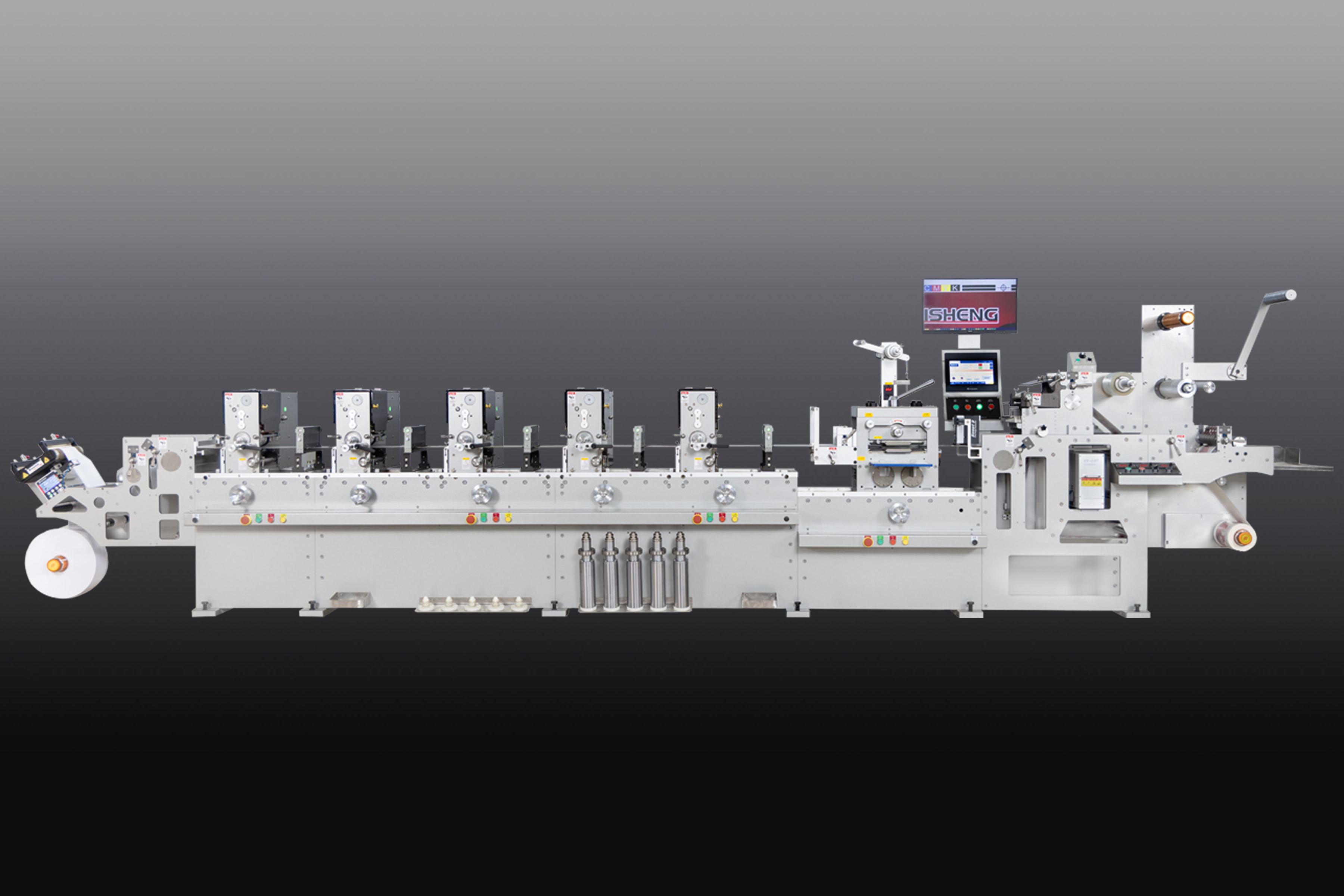
Flatbed die cutting presses a flat die against the label web while the web is stationary or moving in an intermittent cycle. That is why flatbed stations are the natural pairing for intermittent letterpress presses such as the CS-220-5C. The die is a flat plate, so a new design is comparatively inexpensive to produce, complex contours and internal cuts are easier to hold, and job changes are quicker. Each cut is a separate machine cycle, so the cutting station runs in the same rhythm as the press.
Rotary die cutting mounts the die on a cylinder that rotates in sync with a continuously moving web, so the cut happens at press speed. That is why rotary stations pair with full-rotary presses such as the CS-JQ350-7C in its 158 m/min mode. Cylindrical dies cost more to produce per design, so rotary die cutting pays back over longer runs where the same die stays loaded on the machine.
Neither method is better in isolation. Flatbed die cutting matches intermittent web motion; rotary die cutting matches continuous web motion. The costly mistake is buying a press whose die-cutting method fights the job mix — flatbed on long, stable runs and rotary on short, constantly changing runs both create avoidable cost.
The Real Problem: Die-Cutting Method Is a Press Decision, Not an Accessory Decision
On narrow-web label presses, the die-cutting method cannot usually be chosen independently of the press architecture. A converter who needs flatbed die cutting for frequent die changes is, in practice, choosing an intermittent press. A converter who needs rotary die cutting for long runs is choosing a full-rotary press or a hybrid that runs both modes. That is why this article is a head-to-head between two machines rather than a comparison of two accessories.
Format sets the first filter. The CS-220-5C prints a maximum area of 220 mm × 200 mm in intermittent mode and 220 mm × 245 mm in full rotation, on a 30–240 mm web. The CS-JQ350-7C prints up to 350 mm × 380 mm intermittently and 350 mm × 419 mm in full rotation. If your largest die-cut label exceeds the CS-220-5C envelope, the comparison is already decided before speed or die cost is discussed.
Industry Background: Why the Die-Cutting Choice Is Getting More Attention
Equipment demand and label output are two different markets, and they should not be added together. On the equipment side, Global Market Insights values the global industrial label printer market at USD 23.8 billion in 2025 and projects it to reach USD 38.8 billion by 2035. On the output side, Mordor Intelligence reports the global print label market at USD 57.05 billion in 2026, growing at a CAGR of 3.28% to reach USD 67.02 billion by 2031 — a measure of printed label value, not machinery.
Read together but not combined, those figures describe a large and steadily growing base of label consumption sitting above a smaller equipment market. In that environment, converters compete less on access to volume and more on turnaround, job mix and finishing capability — which is exactly where the flatbed-versus-rotary die-cutting decision lands.
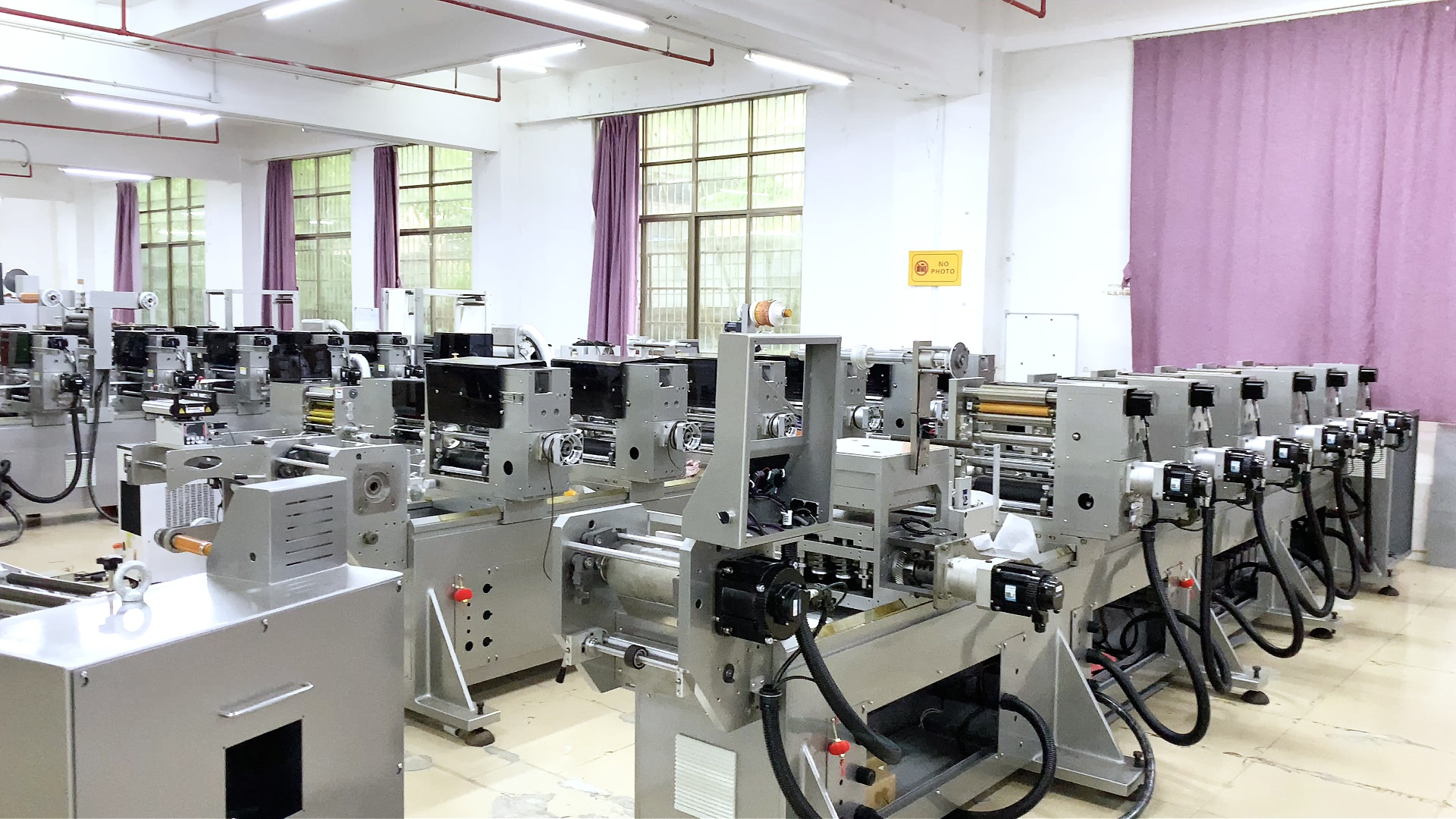
CAISHENG's position in that market is documented and specific. Shenzhen Caisheng Printing Machinery Co., Ltd. was established in 2011 and specialises in commercial label printing machines, with more than 13 years in label press manufacturing. Its factory covers 6,000 m², employs approximately 65 staff including 8 R&D engineers, and produces around 200 units a year. Roughly 50% of output is exported to Southeast Asia, Europe, the Middle East and the United States. The company holds ISO 9001, ISO 14001 and ISO 45001 certifications, and its products meet CE standards. For customs classification, HS code 844316 covers flexographic printing machinery.
Detailed Solution: The Two Presses, Their Architecture and Their Die-Cutting Fit
CAISHENG CS-220-5C — Intermittent Letterpress Built Around Flatbed Die Cutting
The CS-220-5C is an intermittent letterpress label printing machine, also designated a stickers printing machine. It is built from steel for the printing and packaging industry and feeds the web intermittently.
- Model: CS-220-5C
- Category: Intermittent letterpress label printing machine (stickers printing machine)
- Feeding mode: Intermittent
- Maximum printing speed: 40 m/min
- Maximum printing area, intermittent: 220 mm × 200 mm
- Maximum printing area, full rotation: 220 mm × 245 mm
- Web width range: 30–240 mm
- Gross power of the main machine: 17 kW, including UV dryers
- Machine weight: 3.6 t
- Overall dimensions: 6.6 m (L) × 1 m (W) × 1.5 m (H)
- Construction material: Steel
Die-cutting fit. CAISHENG documents the CS-220-5C in a flatbed die-cutting configuration, including a documented build that combines the CS-220-5C letterpress with flatbed die cutting, offline varnish and sheet cutting. That combination is the signature of an intermittent workflow: print, flatbed die-cut, then finish. Because each flatbed cut is one machine cycle, the CS-220-5C is aimed at converters whose value comes from short, frequent, format-varied orders rather than from sustained throughput.
CAISHENG CS-JQ350-7C — Semi-Rotary and Full-Rotary Hybrid Built Around Continuous Cutting
The CS-JQ350-7C is a high-speed label printing machine in CAISHENG's intermittent and full-rotary category, described by the manufacturer as a semi-rotary and full-rotary label press machine. It carries both production rhythms on one platform.
- Model: CS-JQ350-7C
- Category: Intermittent & full rotary high speed label printing machine
- Printing modes: Intermittent and full rotary on the same machine
- Maximum printing speed: 60 m/min intermittent; 158 m/min full rotary
- Maximum printing area, intermittent: 350 mm × 380 mm
- Maximum printing area, full rotation: 350 mm × 419 mm
- UV dryers power: 9.1 kW
- Gross power of the main machine: 24.5 kW
- Net weight: 10.8 t
- Overall dimensions: 8.7 m (L) × 1.5 m (W) × 1.9 m (H)
- Construction material: Steel

Die-cutting fit. The full-rotary mode is the operative one for a head-to-head on die cutting. At 158 m/min the web moves continuously, so the die-cutting station has to cut continuously as well — that is the definition of rotary die cutting. The hybrid architecture also lets the same machine step down to 60 m/min intermittent operation for shorter or heavier jobs, which is the reason hybrids exist at all: they avoid forcing every job into one production rhythm.
Reading the Two Specifications Together
Format: 220 mm × 245 mm against 350 mm × 419 mm in full rotation. A 350 mm-wide die-cut label cannot be produced on the CS-220-5C, and its 240 mm maximum web width cannot carry it either.
Speed: 40 m/min against 60 m/min intermittent and 158 m/min full rotary. This is where the die-cutting decision pays off. Flatbed die cutting on the CS-220-5C's intermittent cycle is efficient when the die changes often; rotary die cutting on the CS-JQ350-7C's continuous cycle is efficient when the die does not.
Production envelope: a 3.6 t machine measuring 6.6 × 1 × 1.5 m with 17 kW of installed power, against a 10.8 t machine measuring 8.7 × 1.5 × 1.9 m with 24.5 kW. The second machine needs more floor, more connected load and more handling capacity.
On registration accuracy: CAISHENG's published technical data for the CS-220-4C — a sister model in the same intermittent letterpress family — lists a registration precision of ±0.025 mm. That figure is model-specific. Confirm the equivalent registration specification for the CS-220-5C and CS-JQ350-7C in the quotation rather than assuming it carries across.
Step-by-Step Breakdown: Six Checks Before You Choose
Step 1 — Measure the largest die-cut label, not the average one. Write down the biggest finished die-cut label in your order book, including registration marks and waste edge. If it fits inside 220 mm × 245 mm, the CS-220-5C remains a candidate. If it needs up to 350 mm × 419 mm, the CS-JQ350-7C is the machine to specify. Nothing else on this list matters until the format passes.
Step 2 — Count run length per die, not per customer. Flatbed die cutting suits a die that comes on and off the machine frequently; rotary die cutting suits a die that stays loaded for a long run. A customer who orders ten different label designs a month is a flatbed profile even if their annual volume is large. A customer who orders one design in high volume is a rotary profile even if their total spend is smaller.
Step 3 — Check cut complexity and the material being cut. Complex contours, tight internal cuts and thicker or stiffer label stocks are easier to hold with a flat die, because the die is a flat plate and the cut is a single press action. Simple, repeating label shapes are the natural home of a rotary cylinder die. If your order book is dominated by complex contour work, that preference should outweigh a speed advantage you will not fully use.
Step 4 — Match the die-cutting station to press speed. This is where the head-to-head is won or lost. Rotary die cutting on the CS-JQ350-7C's full-rotary mode only makes sense if the press will actually run continuously at high speed. The CS-220-5C's flatbed configuration only makes sense if the intermittent rhythm matches your die-change frequency. A die-cutting station that outruns your job mix, or one that cannot keep up with it, both cost money.
Step 5 — Verify utilities, floor space and handling. The CS-220-5C draws 17 kW including UV dryers and occupies 6.6 m × 1 m × 1.5 m at 3.6 t. The CS-JQ350-7C draws 24.5 kW with 9.1 kW of UV dryer power, occupies 8.7 m × 1.5 m × 1.9 m and weighs 10.8 t. Confirm connected load, floor loading, rigging access and UV dryer ventilation against your building before either machine is ordered.
Step 6 — Lock the configuration in writing, then validate on your own material. Die-cutting module configuration, finishing stations and auxiliary equipment are order-specific. CAISHENG works on a one-to-one custom basis covering design, size, process and function, and builds machines customised to customer order requirements. Have the die-cutting configuration confirmed in the quotation, and run the cut on your own substrate before the specification is frozen.
Use Cases: Which Press Fits Which Job
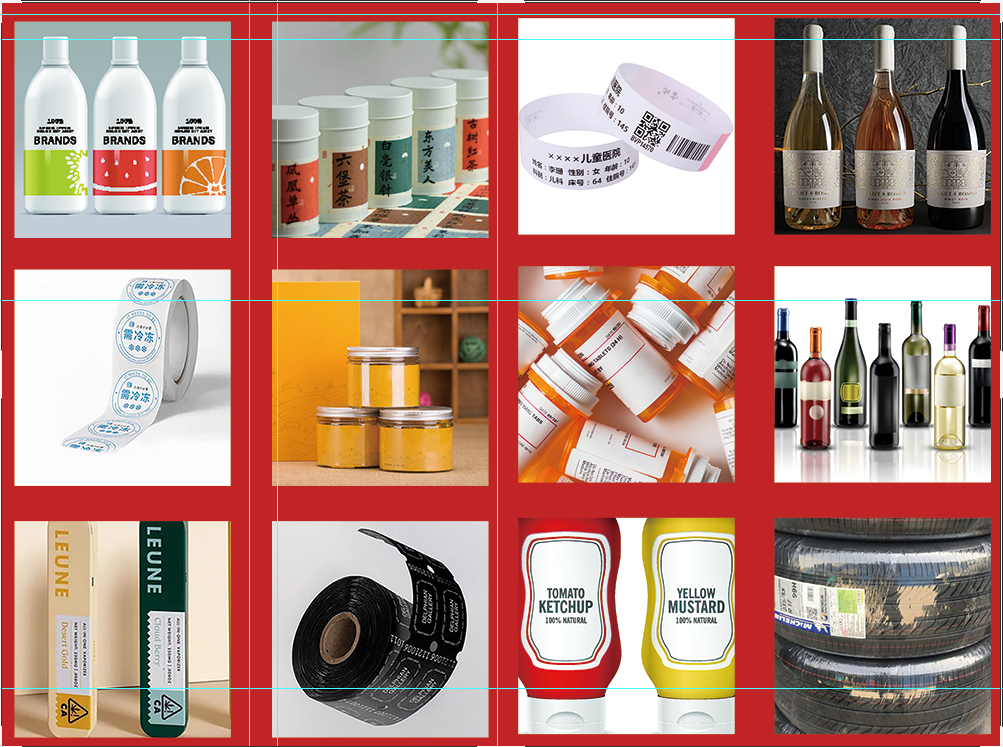
Short-run sticker and promotional work — CS-220-5C. The CS-220-5C is explicitly designated a stickers printing machine in CAISHENG's product data. High die-change frequency on a 30–240 mm web makes flatbed die cutting the economical choice, and 40 m/min is more than sufficient when the press changes over more often than it runs flat out.
Wine, spirits and cosmetics labels with multi-process finishing — CS-JQ350-7C. Premium labels typically combine printing with additional finishing passes. CAISHENG documents the CS-JQ350-7C platform in configurations that include glue-side printing and cold foil stamping. The 350 mm class format and the 158 m/min full-rotary mode let rotary die cutting and finishing run in line rather than as separate offline operations.
Pharmaceutical and food labels at long run lengths — rotary die cutting. Pharma and food labels are typically long-run, stable-die work where the same label repeats for months. That is the classic rotary profile, and the CS-JQ350-7C is the relevant machine in this comparison. CAISHENG's stated application scope covers self-adhesive labels for daily chemicals, wristbands, wine, food, cosmetics and pharmaceuticals.
Mixed order books — the hybrid advantage. Contract label converters rarely have a single job profile. The CS-JQ350-7C's dual-mode architecture lets the same machine run intermittently at 60 m/min for short or awkward jobs and shift to 158 m/min full rotary for long runs.
Site conditions for both machines. Both presses are designed for the printing and packaging industry and operate in stable continuous automatic cycle printing under normal room temperature; neither requires a constant-temperature production workshop. Supporting equipment includes a servo system, air cooling, water cooling and a UV drying lamp — relevant when you are planning a new production hall or extending an existing one.
Comparison Table: CS-220-5C vs CS-JQ350-7C
| Parameter | CAISHENG CS-220-5C | CAISHENG CS-JQ350-7C |
|---|---|---|
| Machine category | Intermittent letterpress label printing machine (stickers printing machine) | Intermittent & full rotary high speed label printing machine (semi-rotary and full-rotary label press) |
| Printing modes | Intermittent feeding | Intermittent and full rotary |
| Die-cutting approach | Flatbed die cutting | Rotary die cutting (full-rotary mode) |
| Maximum printing area, intermittent | 220 mm × 200 mm | 350 mm × 380 mm |
| Maximum printing area, full rotation | 220 mm × 245 mm | 350 mm × 419 mm |
| Maximum printing speed | 40 m/min | 60 m/min intermittent; 158 m/min full rotary |
| Web width range | 30–240 mm | Not stated in the supplied specification data |
| Gross power of main machine | 17 kW (including UV dryers) | 24.5 kW (UV dryers 9.1 kW) |
| Weight | 3.6 t | 10.8 t |
| Overall dimensions | 6.6 m × 1 m × 1.5 m | 8.7 m × 1.5 m × 1.9 m |
| Construction material | Steel | Steel |
| Target industry | Printing and packaging | Printing and packaging |
All specifications are CAISHENG-published product data. Die-cutting module configuration, finishing stations and auxiliary equipment are order-specific and should be confirmed in the quotation.
Frequently Asked Questions
Are CAISHENG label presses CE compliant, and which certifications should a buyer verify?
CAISHENG states that it is a certified high-tech enterprise holding ISO 9001, ISO 14001 and ISO 45001 certifications, and that its products meet CE standards. For export and customs purposes, HS code 844316 covers flexographic printing machinery. A buyer preparing for EU market entry should request the CE documentation, the ISO certificates and the applicable declaration of conformity as part of the supplier qualification pack, and should confirm that the documents name the exact model being purchased rather than the product family.
Can one machine handle both flatbed and rotary die cutting, or do I need two presses?
The two models compared here represent the two approaches rather than one machine doing both. The CS-220-5C is an intermittent letterpress documented in a flatbed die-cutting configuration, running up to 40 m/min on a 30–240 mm web. The CS-JQ350-7C is a semi-rotary and full-rotary hybrid running at 60 m/min intermittently and 158 m/min in full-rotary mode, which is the mode where rotary die cutting applies. If your order book contains both short, format-heavy runs and long single-die runs, the hybrid platform covers both production rhythms. CAISHENG also builds dedicated die-cutting equipment: the CS-350 high-speed die-cutting machine runs at 60 m/min intermittently and 160 m/min in full-rotary mode, with a maximum full-rotary area of 350 mm × 460 mm and an intermittent area of 350 mm × 420 mm.
Which of the two costs less to buy and to run?
CAISHENG does not publish list prices for either model; pricing is configuration-dependent and has to come from a quotation. What can be compared from published specifications are the cost drivers. The CS-220-5C has 17 kW of gross main-machine power including UV dryers, weighs 3.6 t and measures 6.6 m × 1 m × 1.5 m. The CS-JQ350-7C has 24.5 kW gross power plus 9.1 kW of UV dryer power, weighs 10.8 t and measures 8.7 m × 1.5 m × 1.9 m. Those differences translate directly into connected load, floor space, handling and shipping cost, and they are worth pricing alongside the machine price itself.
What do I need to send CAISHENG to get a die-cutting configuration quoted?
CAISHENG builds to order: its stated cooperation model is one-to-one custom design covering size, process and function, with machines customised to customer order requirements. A useful enquiry therefore includes the finished die-cut label size, the substrate, the number of colours, the expected run length per die, the finishing operations you need — for example glue-side printing, cold foil stamping, varnish or sheet cutting — and the installation country. With the largest die-cut format and the run length per die, CAISHENG can indicate whether the CS-220-5C flatbed configuration or the CS-JQ350-7C full-rotary platform is the better starting point, and confirm it in writing.
How long does delivery take, and how should I plan around it?
CAISHENG's published production data — a 6,000 m² factory, approximately 65 employees and an annual output of around 200 units — is the best available indicator of capacity, and lead time is quoted per order because it depends on configuration, customisation and destination. Plan around three fixed points: confirm the die-cutting configuration before the order is released, allow time for the machine to be built and tested, and factor shipping, installation and commissioning into the schedule. To begin, send the largest die-cut label format and the expected run length per die to kanghong-1108@qq.com, or use the contact numbers below, and request the lead time in writing together with the quotation.
Conclusion: Match the Die-Cutting Method to the Job, Then Match the Machine
Flatbed die cutting belongs with intermittent web motion; rotary die cutting belongs with continuous web motion. The CS-220-5C is the flatbed option — an intermittent letterpress running at 40 m/min on a 30–240 mm web, printing up to 220 mm × 245 mm, in a documented flatbed die-cutting configuration. The CS-JQ350-7C is the rotary option — a semi-rotary and full-rotary hybrid running at 60 m/min intermittently and 158 m/min in full-rotary mode, printing up to 350 mm × 419 mm.
For a converter whose order book is short-run, format-heavy and die-change-intensive, the CS-220-5C is the more economical architecture. For a converter moving toward longer runs where die cutting has to keep pace with a continuous press, the CS-JQ350-7C is the platform that lets rotary die cutting become the production standard rather than an offline step.
Shenzhen Caisheng Printing Machinery Co., Ltd., established in 2011, builds commercial label printing machines — intermittent and high-speed rotary letterpress presses, flexo presses, screen printing machines and customised multi-functional label finishing solutions — from a 6,000 m² facility in Longgang District, Shenzhen, employing approximately 65 people including 8 R&D engineers, with around 50% of output exported.
Next Step: Get Your Die-Cutting Configuration Reviewed
Send the largest die-cut label size, the substrate and the expected run length per die to CAISHENG. The team will indicate which configuration fits the job — flatbed die cutting on the CS-220-5C or full-rotary operation on the CS-JQ350-7C — and will confirm the specification in writing.
Download the CAISHENG product catalogue (PDF)
Website: https://www.caishengmachinery.com/
Email: kanghong-1108@qq.com | Tel: +86 131-8628-3944 | WhatsApp: +86 133-1087-8219
Shenzhen Caisheng Printing Machinery Co., Ltd. — No.39 Shuitian Road, Tongle Community, Longgang District, Shenzhen, China
Have Questions or Need More Details?
Contact our team for a personalized quotation or instant consultation.
Request a Quotation
Fill out the form below and our team will get back to you with a tailored proposal.
WhatsApp Direct Chat
Prefer to chat in real-time? Message us on WhatsApp for instant assistance & quick answers.
- Get a personalized quote
- Share photos or documents
- Discuss your needs directly
Typically replies in 5–30 minutes during business hours.