Label Printing Machine Die-Cutting Compared: CS-220 vs CS-300/320 vs CS-350/370/380
Die-cutting is where a label printing machine stops being a printer. Across the CAISHENG range the cutting method is fixed by model family: the CS-220 family uses flatbed die-cutting, the CS-300/320 family combines flatbed and rotary die-cutting on one line, and the CS-350/370/380 family is built around rotary die-cutting combined with inline converting modules. That single distinction splits the range into three different production logics, and it is the fastest way for an evaluation-stage buyer to cut a long model list down to a short one.
This guide compares the three paths on the criteria that still matter after the quotation lands: how many die sets you will own, how often the line changes over, which finishing modules can be added, what the certificate actually covers, and how to test the claims before committing capital. It does not declare one family universally better, because the preferred path depends on the order book you already have.
Why the die-cutting path filters the shortlist before colour count does
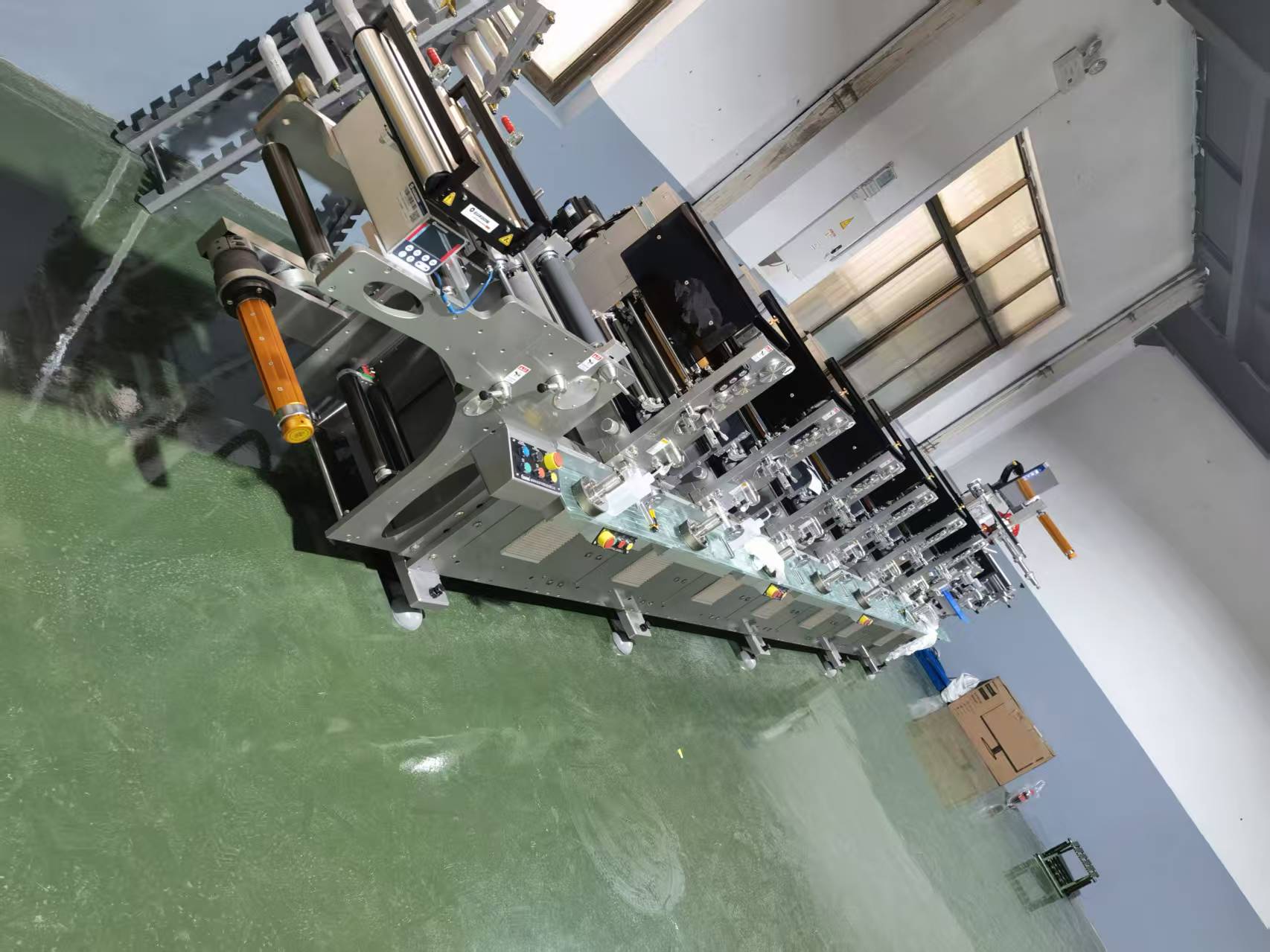
Print quality is what buyers remember from a demonstration, but die-cutting is what decides whether the machine earns money on Monday morning. Every label on a roll has to be cut to shape, often stripped and frequently slit; if the cutting step cannot keep pace with the printing step, the press runs below its own capability regardless of how many print stations it carries.
The difference between the three paths is mechanical before it is commercial. A flatbed die-cutting station presses a flat die plate against the web on each reciprocating stroke, so the cut is made impression by impression. A rotary die-cutting station turns a cylindrical die with the web, so the cut is continuous while the material moves. Neither method is superior in the abstract. They differ in what a job costs to set up, how much die inventory you carry, and how much of the working week disappears into changeover.
That is why the model family matters more than the option list. On the CS-220, flatbed die-cutting is the cutting method. On the CS-300/320, flatbed and rotary die-cutting are combined so one line can serve both a short plate job and a long rotary job. On the CS-350/370/380, rotary die-cutting is the cutting method and the combination refers to the converting stations arranged around it. Choosing between the families is therefore a decision about your job book, not about a feature you might use occasionally.
Industry background: demand, trade classification and conformity
The commercial backdrop is steady rather than explosive. Mordor Intelligence estimates the global print label market at USD 57.05 billion in 2026, growing at a 3.28% CAGR to USD 67.02 billion by 2031. That figure measures printed label output, not label press sales, so it should be read as a demand indicator for converters rather than as a market size for machinery — the two are different layers of the value chain and should not be combined into one number. A slowly growing label market pushes competitive pressure onto job mix, lead time and waste, which is precisely where the die-cutting decision sits.
Two documentation points matter early for cross-border buyers. Flexographic printing machinery is classified under HS code 844316, which importers and freight forwarders will need on the commercial invoice. For the EU, CAISHENG holds a Machinery Directive Attestation of Conformity, certificate M.2025.206.C124100 issued by UDEM, citing EN ISO 12100:2010 and EN 60204-1:2018, issued on 8 November 2025 and valid until 8 October 2030, with CS-300, CS-220 and CS-350 named in its scope.
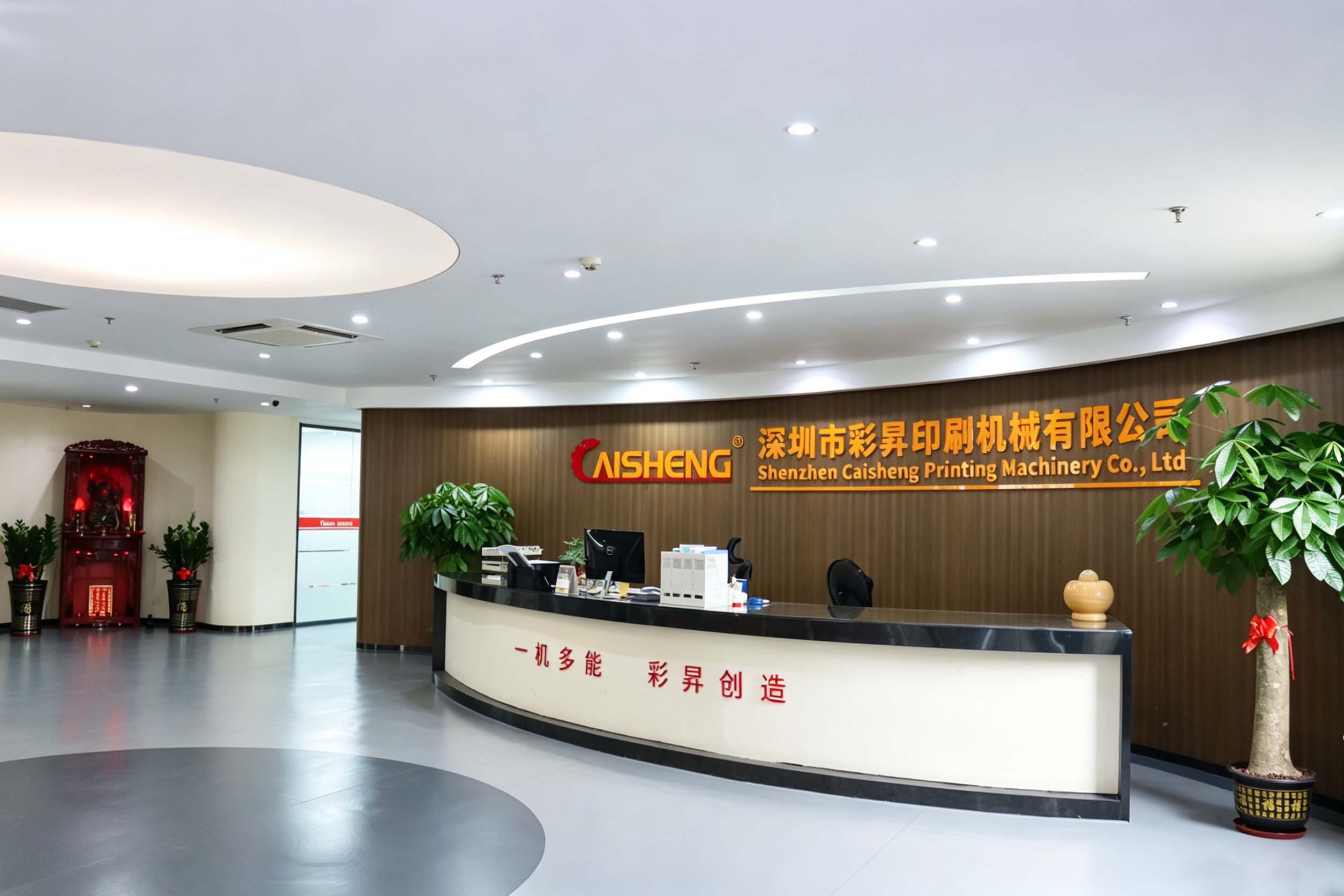
The company behind these models, Shenzhen Caisheng Printing Machinery Co., Ltd. (CAISHENG), was founded in 2011 and operates a 6,000 m² facility with 65 employees and a team of eight engineers. It reports annual output of 200 units, with roughly 50% exported to Southeast Asia, Europe, the Middle East and the United States. Those numbers describe capacity and market reach; they do not by themselves prove that a given model suits your jobs, which is why the rest of this comparison works model family by model family.
The three die-cutting paths, defined
CS-220: flatbed die-cutting as the only cutting path
The CS-220 family covers the models CAISHENG documents as the CS-220-4C intermittent label press and the CS-220-5C stickers printing machine. Both are built on flatbed die-cutting: the die is a flat plate mounted at a flatbed station, and the cut happens once per machine cycle. The CS-220 is the family to examine when flatbed is not a compromise but the correct answer for the work.
Flatbed logic suits converters whose month is made of many short and medium runs in different die shapes — sample work, private-label batches, seasonal sticker sets, short promotional reprints. Because the die is a plate, a new artwork usually means a new plate rather than a new cylinder, and changeover is a plate change. What you give up is the second cutting method: every job, long or short, runs on the flatbed rhythm, so a repeat order that would justify a rotary die has nowhere else to go on the same machine.
Registration is a number to test rather than accept. CAISHENG's published specification for the CS-220-4C intermittent rotary letterpress states ±0.025 mm registration precision; that is a company-reported figure, and the only meaningful confirmation is a trial on your own stock at your own running conditions. If your labels carry tight tolerances around a printed image, that trial belongs in the acceptance criteria, not in the brochure file.
CS-300/320: the flatbed plus rotary combination
The CS-300/320 family is the flatbed-plus-rotary combination: the same line carries a flatbed die-cutting station and a rotary die-cutting station. The documented models span several printing architectures — CS-300-5C self-adhesive label press, CS-300-6C rotation label machine, CS-320-6C semi-rotary label printing machine and CS-320-7C rotary label press — so the family already covers both intermittent and rotary printing platforms before die-cutting is considered.
The commercial point of the combination is routing. A converter with a mixed order book can place short, plate-based jobs on the flatbed station and move repeat long-run work to the rotary station without buying a second press or declining work it cannot schedule. Die inventory becomes a mixed set — plates for short jobs, cylinders for repeat jobs — and production planning turns into a question of which station a job belongs on, rather than whether the machine can accept it at all.
Two installations are recorded by CAISHENG. A CS-300 series machine has been in label production for three years at a US commercial printing group identified in the case record as R.R. Donnelley & Sons (RRD), with recorded highlights of stable registration accuracy, print quality and reliable equipment performance, and reported improvements in production efficiency and product quality. A second installation — one unit at a printing company in Taiwan supplying high-quality label work — is recorded with highlights of printing precision, stable production performance and flexible process expansion. Both are supplier-recorded customer recognitions rather than independent benchmark tests, but they point at the same buyer profile: a converter whose work is not uniform.

CS-350/370/380: rotary die-cutting combination
The CS-350/370/380 family is built on rotary die-cutting as the cutting method, with the combination referring to the converting modules arranged around the rotary die station. Documented models include the CS-JQ350G-6C high-speed label printing machine, the CS-JQ350-7C semi-rotary and full-rotary label press machine and the CS-JQ350G-10C full-rotary label press. CAISHENG also lists flexographic models under CS-J380F, CS-Q370F and CS-370F; the die-cutting configuration of a specific flexo model should be confirmed on the quotation, because model naming alone does not define the finishing stack.
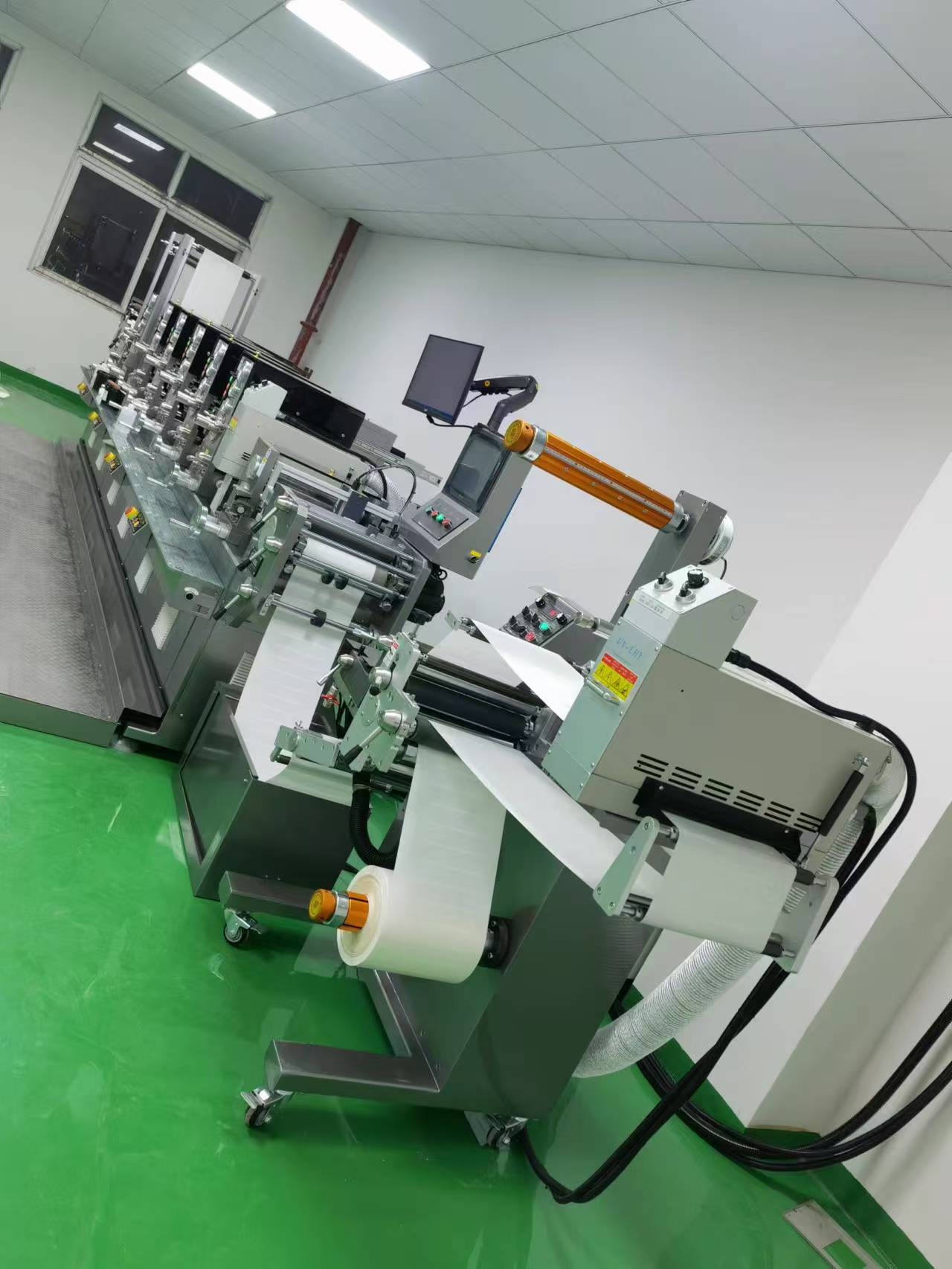
A rotary die turns with the web, so the cutting action does not stop and restart the material for every label. That is what makes the family a preference for long repeat runs and stable, recurring SKUs, where the die cost is spread across a large order rather than across a sample sheet. The same architecture supports process-heavy labels: extra stations can sit in sequence so the label is printed, finished and cut in one pass instead of being re-handled between machines.
The evaluation trap is buying rotary capacity for a job book that is mostly short. A rotary die cylinder is committed to one repeat length, so when order shapes and sizes change every few days the die cost and changeover land on every job. The CS-350/370/380 family rewards predictability: fewer SKUs, longer runs, more processes per label.
Six criteria that actually change between the paths
- Die inventory and tooling commitment. A flatbed path carries plates; a rotary path carries cylinders tied to a repeat length; a combination carries both. Count how many live die sets you would own in each scenario before you compare machine prices.
- Changeover frequency. Estimate die changes per shift from your own order history. High changeover favours the flatbed station; low changeover with long repeats favours rotary.
- Module stack beyond the die station. CAISHENG's customization list covers colour stamping, glue-side printing frames, cold foil stamping, lamination, offline or online UV varnishing, flatbed die-cutting, rotary die-cutting, sheet cutting, slitting, corona treating, dust cleaning, static elimination, full-rotary screen printing, hot foil stamping and embossing. Both die-cutting methods appear on that list, which is consistent with the combination approach; the version that matters is the one written into your quotation.
- Registration requirement. Translate your tightest tolerance into a test condition, then check whether the demonstrated result matches the published company-reported specification on your material.
- Conformity document per model. The CAISHENG CE attestation names CS-300, CS-220 and CS-350 in scope. If your configuration falls outside that named scope, request the conformity documentation that applies to the exact model and configuration.
- Service and supply. CAISHENG states remote support and a one-year warranty on major components, a minimum order of one unit, monthly capacity of 18 units and a lead time of 45 to 60 days. ODM customization is offered, so the schedule should be confirmed against the final module stack.
Step by step: how to evaluate the three paths in order
Run the sequence below before requesting quotations, otherwise every supplier will quote a different machine and the comparison will collapse into price.
- Sort your last twelve months of orders by run length. Split them into short, medium and long bands using your own definition, then calculate what share of revenue each band produces.
- Count die shapes and artwork changes per month. This predicts die inventory and changeover far more accurately than a production manager's impression.
- List the finishing operations your customers actually buy. Glue-side printing, cold foil, lamination, UV varnish, slitting, sheet cutting, screen printing, hot foil or embossing each add a station and change the machine architecture.
- Convert your tolerance requirement into a trial protocol. Specify substrate, die shape, running condition and acceptance threshold, and ask for the result rather than the specification.
- Check the paperwork against the exact model. Match the certificate number, named models and validity dates to the quotation, and keep the document with the purchase file.
- Confirm tooling supply and schedule. Ask how die plates or rotary cylinders are sourced, what the lead time is on a new die, and how the 45 to 60 day machine lead time interacts with your first order commitments.
Which path fits which production profile
The preference below is a fit statement by job profile, not a ranking of quality. Two converters buying the same model can get opposite results if their order books differ.
| Production profile | Preferred die-cutting path | Reason it fits |
|---|---|---|
| High SKU count, short and medium runs, frequent artwork changes, sample work | CS-220 — flatbed die-cutting | One cutting method, plate-based tooling, and no second station to schedule or maintain |
| Mixed order book with both short and long runs, plus glue-side, foil or varnish work | CS-300/320 — flatbed plus rotary combination | Both cutting methods on one line, so jobs can be routed by run length instead of being declined |
| Long repeat runs, stable SKUs, multi-process labels | CS-350/370/380 — rotary die-cutting combination | Rotary cutting runs with the web, and added stations allow print, finish and cut in one pass |
Model-level comparison table
| Evaluation point | CS-220 family | CS-300/320 family | CS-350/370/380 family |
|---|---|---|---|
| Die-cutting architecture | Flatbed die-cutting | Flatbed plus rotary die-cutting combination | Rotary die-cutting combination |
| Models named in CAISHENG documentation | CS-220-4C intermittent label press; CS-220-5C stickers printing machine | CS-300-5C self-adhesive label press; CS-300-6C rotation label machine; CS-320-6C semi-rotary label printing machine; CS-320-7C rotary label press | CS-JQ350G-6C high-speed label printing machine; CS-JQ350-7C semi-rotary and full-rotary label press machine; CS-JQ350G-10C full-rotary label press |
| Cutting logic | Flat die plate, cut on each reciprocating stroke | Short runs to the flatbed station, long runs to the rotary station | Rotary die turns with the web; converting stations inline |
| Die inventory | Flatbed plates | Plates and rotary cylinders | Rotary cylinders |
| Preferred job profile | Frequent SKUs, short runs, samples | Mixed book across both run lengths | Long repeat runs, multi-process labels |
| CE certificate M.2025.206.C124100 | CS-220 named in scope | CS-300 named in scope | CS-350 named in scope |
| Ask before ordering | Die plate supply and plate change routine | How jobs will be split between the two stations | Rotary die lead time and module sequence |
What this comparison does not establish
No throughput, uptime or cost-per-thousand figure appears in this guide because none is supplied for these models, and estimating one would be invention rather than analysis. The registered precision figure for the CS-220-4C is company-reported. The two installation cases are supplier-recorded customer recognitions, not independently audited performance tests, and they should be treated as evidence that the equipment has run in production rather than as a forecast of your results.
The CE attestation names CS-300, CS-220 and CS-350; it is not a blanket statement covering every configuration sold under those families, and no claim is made here about conformity for models outside that named scope. Likewise, the module list describes what CAISHENG offers to configure, not what is fitted to any particular machine. Every point in the tables above should be re-confirmed against a written quotation and, where registration or cutting quality is critical, against a trial on your own material.
Frequently asked questions
Which models are covered by CAISHENG's CE documentation?
The Machinery Directive Attestation of Conformity held by CAISHENG, certificate M.2025.206.C124100 issued by UDEM, names CS-300, CS-220 and CS-350 in its scope and cites EN ISO 12100:2010 and EN 60204-1:2018. It was issued on 8 November 2025 and runs to 8 October 2030. If your quotation is for a model outside that named scope — for example a CS-320, CS-370 or CS-380 configuration — ask for the conformity document that applies to the exact model and configuration you are buying, and keep it with the purchase file.
Can one label printing machine do both flatbed and rotary die-cutting?
Yes, in the CS-300/320 family. Those models combine flatbed and rotary die-cutting on one line, so a converter can route short, plate-based jobs to the flatbed station and long repeat jobs to the rotary station. The CS-220 family uses flatbed die-cutting only, and the CS-350/370/380 family is built around rotary die-cutting combined with inline converting. CAISHENG's customization list includes both flatbed die-cutting and rotary die-cutting, which is consistent with the combination approach, but the configuration of a specific machine should be confirmed on the quotation.
What drives the cost difference between flatbed and rotary die-cutting?
Three cost drivers separate the paths. The first is tooling: a flatbed job needs a die plate, while a rotary job needs a die cylinder committed to a repeat length. The second is die inventory: a mixed job book on a combined line means plates and cylinders both in stock. The third is the module stack — glue-side printing frames, cold foil, lamination, UV varnishing, slitting, sheet cutting, screen printing, hot foil or embossing all add stations and change the machine price. CAISHENG quotes per configuration and accepts a minimum order of one unit, so the honest comparison is a configured quotation against your own job list rather than a headline machine price.
How can we test die-cutting on our own label jobs before ordering?
Test on your own material and your own die shape, and write the result into the acceptance criteria. CAISHENG states 100% testing as its quality-control method, together with remote support and a one-year warranty on major components after delivery; job-specific validation — registration behaviour, cutting quality, stripping and slitting — should be agreed with the sales team before the order is confirmed. For a registration claim such as the ±0.025 mm figure published for the CS-220-4C, treat the trial run, not the specification sheet, as the decision point.
What are the lead time, capacity and minimum order?
CAISHENG states a minimum order of one unit, monthly capacity of 18 units and a lead time of 45 to 60 days. ODM customization is offered, covering options such as glue-side printing frames, cold foil stamping, lamination, offline or online UV varnishing, flatbed and rotary die-cutting, sheet cutting, slitting, corona treating, dust cleaning, static elimination, full-rotary screen printing, hot foil stamping and embossing. Lead time is quoted per configuration, so confirm the schedule for the exact module stack before promising a delivery date to your own customers.
Which die-cutting path should a converter with mixed short and long runs shortlist?
Start with the CS-300/320 combination. It is the only family in this comparison where flatbed and rotary die-cutting sit on the same line, so a mixed order book does not force a choice between one cutting method and the other. If the job book is genuinely short-run and plate-driven, the CS-220 is the cleaner fit; if it is long-run and process-heavy, the CS-350/370/380 rotary combination is the fit. Sending CAISHENG a job list with run lengths, die shapes and required finishing modules is the fastest way to get a configured recommendation.
Conclusion: choose the cutting method first, the model second
The three CAISHENG families are not three grades of the same machine; they are three answers to three different order books. CS-220 converts flatbed die-cutting into a dedicated, plate-based workflow. CS-300/320 keeps both flatbed and rotary die-cutting on one line so a mixed job book never has to be turned away. CS-350/370/380 commits to rotary die-cutting and builds converting capacity around it for long, repeat, process-heavy work.
For an evaluation-stage buyer, the productive move is to sort twelve months of orders by run length and artwork changes, list the finishing operations customers actually pay for, and only then ask for quotations. That sequence also makes the compliance check straightforward: match the certificate scope and validity to the exact model, and match the trial result on your own material to the registration requirement your customers impose on you.
Next step for evaluation-stage buyers
Send a job list with run lengths, die shapes and required finishing modules, and ask for a configured comparison of the CS-220, CS-300/320 and CS-350/370/380 paths against your own work. The full model overview is available in the CAISHENG product brochure (PDF), and general company information is on caishengmachinery.com.
Have Questions or Need More Details?
Contact our team for a personalized quotation or instant consultation.
Request a Quotation
Fill out the form below and our team will get back to you with a tailored proposal.
WhatsApp Direct Chat
Prefer to chat in real-time? Message us on WhatsApp for instant assistance & quick answers.
- Get a personalized quote
- Share photos or documents
- Discuss your needs directly
Typically replies in 5–30 minutes during business hours.