Top Rotary Die-Cutting Label Presses Ranked: Flatbed, Rotary & Combination Picks
Top Rotary Die-Cutting Label Presses Ranked: Flatbed, Rotary & Combination Picks
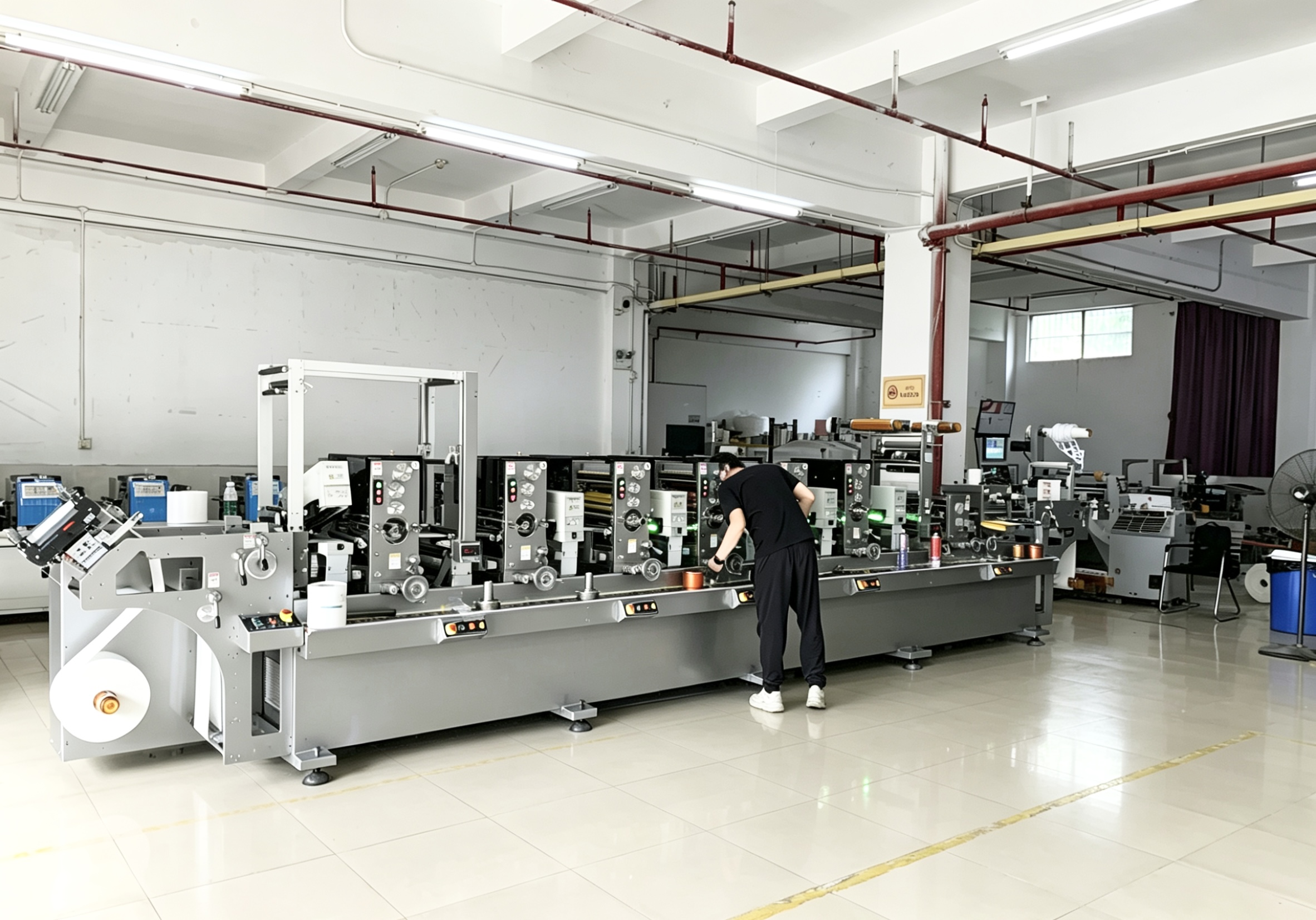
The specification that separates CAISHENG's label printing machines fastest is not the number of printing stations - it is the die-cutting configuration. Shenzhen Caisheng Printing Machinery Co., Ltd. (CAISHENG), founded in 2011 with a 6,000 m2 factory, 65 employees, an 8-engineer R&D team and an annual output of 200 units, builds its range across three die-cutting tiers: flatbed die-cutting platforms (CS-220-4C and CS-220-5C), platforms that carry both flatbed and rotary die-cutting (CS-300 and CS-320 series), and rotary die-cutting combination machines on semi-rotary and full-rotary high-speed platforms (CS-350, CS-370 and CS-380 series). This ranking groups the range by that architecture, explains which production scenario each tier fits, and states verified specifications for every model named.
Read the ranking by capability ceiling and by how much of the finishing process is resolved on one line. Rank #1 is the tier that answers the highest-throughput briefs. Rank #3 is not a lesser machine - it is the correct answer when floor space, capital and job mix point to a compact platform. If your constraint is footprint and entry cost rather than line speed, start at the bottom of the list.
Why Die-Cutting Configuration Decides the Shortlist, Not Station Count
Two label presses can show the same web width, the same number of printing stations and the same top speed on a quotation and still produce very different economics, because the die-cutting module decides how the finished label leaves the machine. Three configurations exist in practice, and each one changes tooling cost, changeover time and the speed at which the web can move.
- Flatbed die-cutting. The cutting die is held on a flat platen and pressed into the web while the material is momentarily stationary. Because the label shape is set by a flat die plate, changing formats generally means changing a comparatively low-cost plate. Flatbed die-cutting is typically the more economical route for short runs, frequent job changes and irregular shapes that would be expensive to reproduce on a cylinder.
- Rotary die-cutting. The die is mounted on a cylinder that rotates in step with the web. The web does not stop at each impression, so rotary die-cutting suits continuous, higher-speed production and long repeat runs with a stable repeat length. The trade-off is generally higher die cost and longer setup when the job changes.
- Combination (flatbed plus rotary). Both modules on one line. Combination platforms are usually specified by converters whose order book mixes short runs with medium or long runs, because the same machine can switch between the two die-cutting methods without a second pass.
CAISHENG documents exactly this combination logic in a CS-300-6C configuration that runs rotary die-cutting and flatbed die-cutting together with glue-side printing, a multi-functional frame and slitting on one line, and in a second documented CS-300-6C installation that pairs printing and glue-side printing with rotary die-cutting and flatbed die-cutting.
Selection rule: if short runs and varied die shapes dominate your order book, weight flatbed. If long repeat runs at continuous speed dominate, weight rotary. If the mix is unpredictable - which is the usual case for a converter selling into several end markets - specify a combination platform and settle the station count afterwards.
Industry Background: Why Die-Cutting Flexibility Is Now a Purchasing Criterion
The commercial case for flexible die-cutting is supported by the direction of the label machinery market. The global label printing machines market was valued at USD 8.58 billion in 2025 and is projected to reach USD 14.36 billion by 2034 (The Insight Partners). Published estimates differ between research houses because each one scopes the market differently - machinery only, machinery plus systems, or machinery plus consumables - so treat any single figure as a range rather than a precise anchor. Two structural points are less ambiguous: flexographic printing remains the most commonly used process for labels, valued at approximately USD 13.3 billion in output terms in 2024 (Smithers), and Asia-Pacific held a 41.8% revenue share of the label printing machines market in 2025 (Data Bridge Market Research). The narrow-web label printing machine segment specifically is projected to grow from USD 1.43 billion in 2024 to USD 3.21 billion by 2035 (Spherical Insights).
For a converter, the practical consequence is that presses are increasingly bought for flexibility rather than for a single product line. That is where die-cutting configuration becomes a purchasing criterion: the module determines whether a new label shape can be quoted and run in-house or has to be sent out.
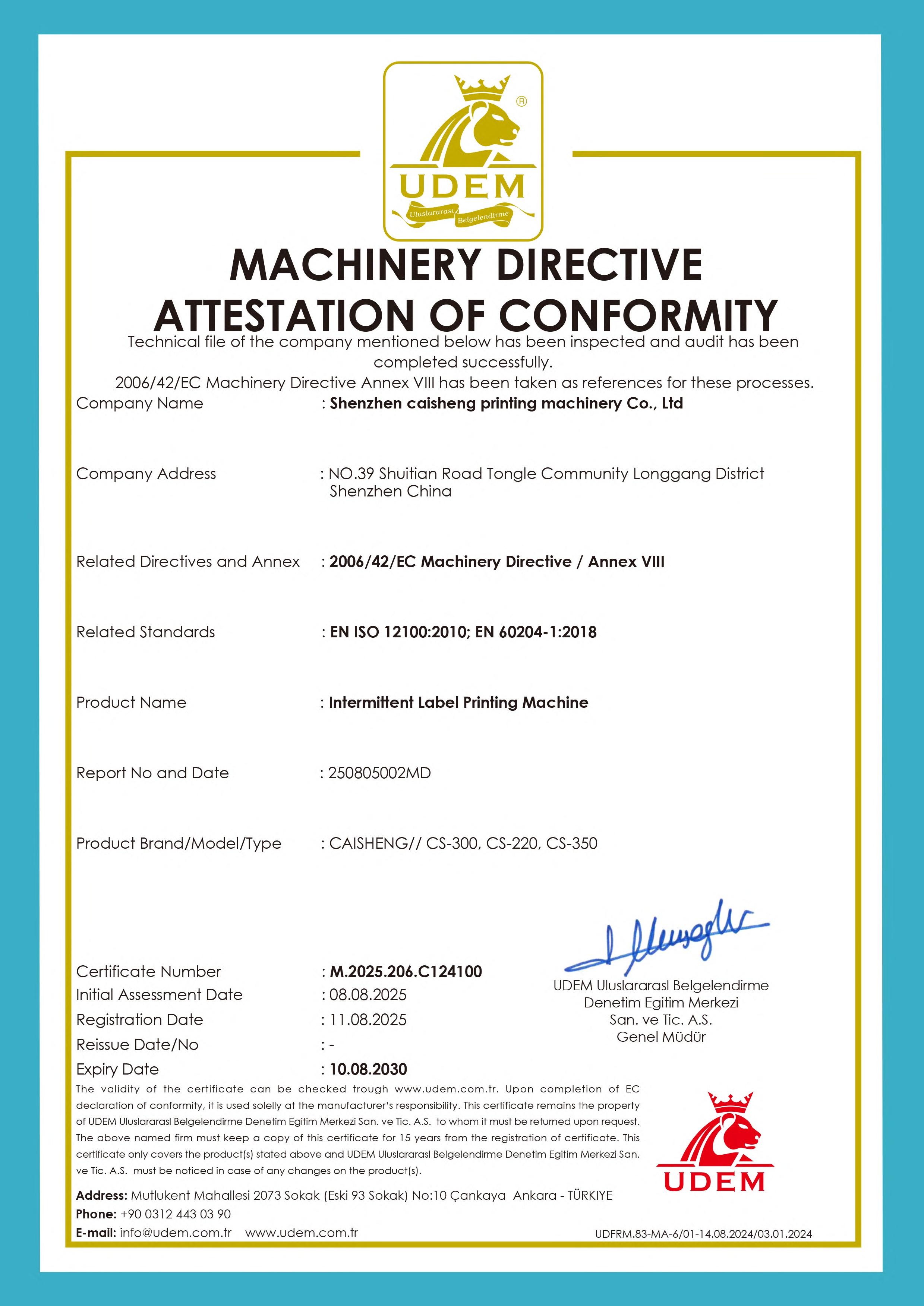
Compliance runs in parallel. Safety requirements for graphic technology equipment, including label presses, are addressed by the international standard ISO 12643-2:2023, and machinery sold in the EU must comply with Machinery Directive 2006/42/EC and carry CE marking (European Commission). CAISHENG holds a Machinery Directive Attestation of Conformity, certificate M.2025.206.C124100, issued by UDEM Uluslararasi Belgelendirme Denetim Egitim Merkezi San. ve Tic. A.S. on 8 November 2025 and valid until 8 October 2030. The certificate scope covers the CS-300, CS-220 and CS-350 platforms, assessed against EN ISO 12100:2010 and EN 60204-1:2018. Buyers shortlisting models outside that scope should request model-specific documentation before the order is placed.
The Ranking: Three Die-Cutting Tiers of CAISHENG Label Presses
Tiers are ranked by output ceiling and by the amount of finishing work resolved in a single pass. Each tier below lists the models assigned to it, the verified parameters that matter for site planning, and the production scenario it fits.
| Rank | Die-cutting tier | Models | Die-cutting configuration | Best-fit production scenario |
|---|---|---|---|---|
| #1 | Rotary die-cutting combination (CS-350 / CS-370 / CS-380) | CS-JQ350G-6C, CS-JQ350-7C, CS-JQ350G-10C, CS-J380F-4C, CS-J380F-7C, CS-Q370F-6C, CS-370F-8C | Rotary die-cutting built onto semi-rotary and full-rotary high-speed platforms; full-rotary printing up to 158 m/min on the 350 class and 150 m/min on the 370 class | High-volume, long-repeat label production; multi-process work that must be resolved in one pass |
| #2 | Flatbed plus rotary combination (CS-300 / CS-320) | CS-300-5C, CS-300-6C, CS-320-6C, CS-320-7C | Both flatbed and rotary die-cutting on one line; documented on CS-300-6C together with glue-side printing, a multi-functional frame and slitting | Mixed order books: short runs and frequent die changes alongside medium runs |
| #3 | Flatbed die-cutting (CS-220) | CS-220-4C, CS-220-5C | Flatbed die-cutting tier; the most compact platforms in the range | Start-up and job-shop production; short runs; constrained floor space |
Rank #1 - CS-350, CS-370 and CS-380: Rotary Die-Cutting Combination Class
This is the tier built for continuous production. Rotary die-cutting needs a web that does not stop, and the CS-350 and CS-370 platforms provide exactly that architecture.
The CS-JQ350G-6C, CS-JQ350-7C and CS-JQ350G-10C are intermittent and full-rotary high-speed label printing machines: maximum printing area is 350 x 380 mm in intermittent mode and 350 x 419 mm in full-rotary mode, with printing speed of 60 m/min intermittent and 158 m/min full rotary. The three models differ mainly in size, weight and installed power - 7.8 x 1.5 x 1.9 m and 10 t at 22 kW for the CS-JQ350G-6C; 8.7 x 1.5 x 1.9 m and 10.8 t at 24.5 kW for the CS-JQ350-7C; and 12 x 1.5 x 2 m and 14 t at 34 kW for the CS-JQ350G-10C.
The flexographic side of the same tier runs on different geometry. The CS-J380F-4C and CS-J380F-7C are flexo label printing machines with a maximum printing area of 360 x 380 mm intermittent and 360 x 419 mm full rotary and a top speed of 60 m/min. The CS-J380F-7C measures 9.3 x 1.3 x 1.6 m and weighs 6 t, while the CS-J380F-4C measures 7.4 x 1.3 x 1.6 m and weighs 4 t. The CS-Q370F-6C and CS-370F-8C are full rotary flexographic printing machines running to 150 m/min with a full-rotary printing area of 370 x 200 mm and 370 x 600 mm; they measure 7.5 x 1.5 x 1.7 m (7 t) and 9.1 x 1.5 x 1.7 m (8.6 t) respectively.
Die-cutting in this class follows the printing architecture. CAISHENG's published configuration material includes a 380F-class semi-rotary flexographic press paired with rotary die-cutting, and the CS-350 platform has also been built as a 2-color label printing machine with flatbed die-cutting - which shows that on this platform the die-cutting module is a configuration decision rather than a fixed specification. Confirm the exact module for your job before signing.
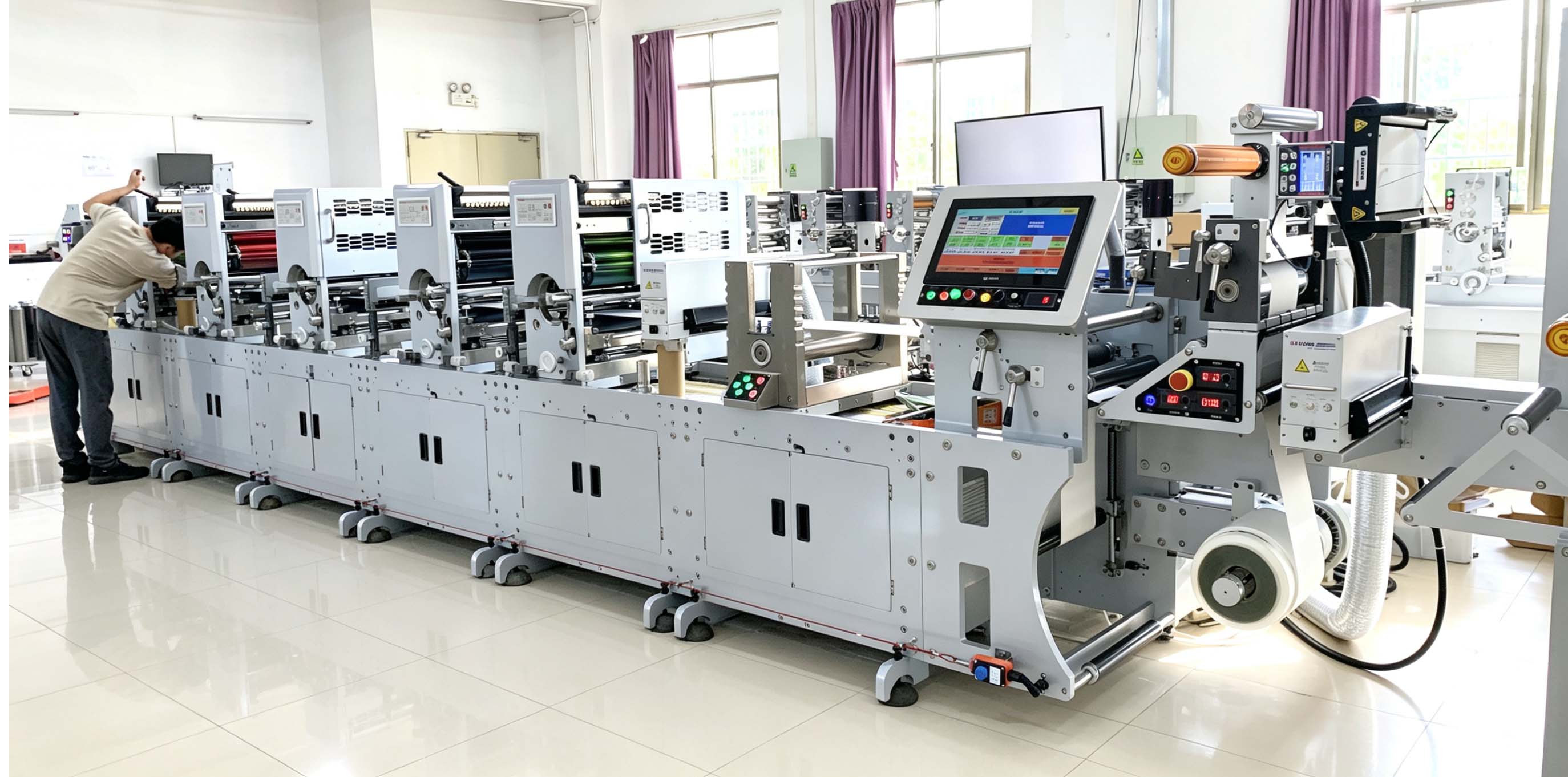
Scenario fit: converters running long repeat lengths who need printing, laminating, die-cutting and slitting resolved on one line, and who have the floor area and power supply for a 10-14 t machine. If your monthly volume cannot keep a full-rotary platform loaded, this tier will idle - move down to Rank #2.
Rank #2 - CS-300 and CS-320: Flatbed Plus Rotary Combination
This is the tier most overseas label converters end up specifying, because it answers both halves of a mixed order book on one machine.
The CS-300-5C and CS-300-6C run a 30-300 mm web width with a maximum printing area of 280 x 300 mm intermittent and 280 x 326 mm full rotary at a top speed of 40 m/min. The CS-300-5C measures 6.5 x 1.5 x 1.8 m and weighs 5 t at 18.8 kW of main-machine power; the CS-300-6C measures 8.9 x 1.5 x 2 m and weighs 6.6 t at 34.5 kW. The CS-320-6C and CS-320-7C extend the web width to 30-320 mm with a maximum printing area of 320 x 300 mm intermittent and 320 x 326 mm full rotary at 40 m/min: 8.4 x 1.5 x 2 m and 6.2 t at 27 kW for the CS-320-6C, and 9.1 x 1.5 x 2 m and 7 t at 31 kW for the CS-320-7C.
The die-cutting evidence for this tier is documented rather than assumed. CAISHENG publishes a CS-300-6C configuration combining rotary die-cutting with flatbed die-cutting, glue-side printing, a multi-functional frame and slitting, and a second CS-300-6C installation configured with printing, glue-side printing, rotary die-cutting and flatbed die-cutting. In other words, the same line can press a flat die for a short promotional run in the morning and switch to a rotary cylinder for a long repeat in the afternoon.
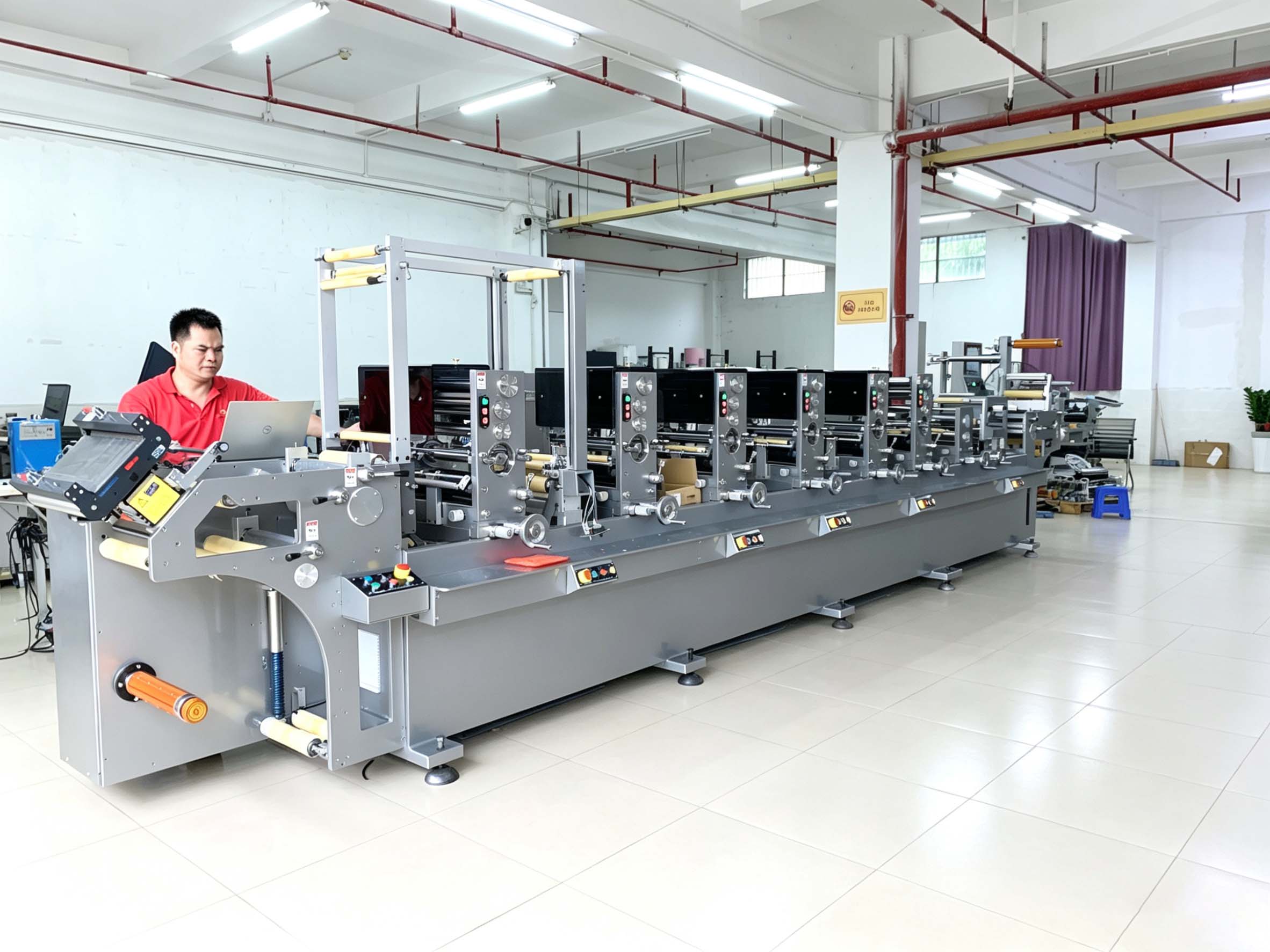
Scenario fit: a converter whose job book mixes prototypes, short promotional runs and repeat medium-volume work; a first or second press where the buyer wants one platform to cover both die-cutting methods; and businesses that need a 320 mm web but do not yet have the volume to justify a 158 m/min platform.
Rank #3 - CS-220: Flatbed Die-Cutting Class
The CS-220 tier is the company's compact flatbed die-cutting class, and it is the smallest entry point into the range.
The CS-220-4C runs a 30-240 mm web width with a maximum printing area of 30 x 200 mm intermittent and 220 x 245 mm full rotary at 40 m/min, in a frame measuring 4.2 x 1 x 1.5 m and weighing 2.6 t at 8.4 kW of main-machine power - the smallest machine in CAISHENG's published parameter set. The CS-220-5C uses the same 30-240 mm web width and the same 220 x 245 mm full-rotary printing area, with a 220 x 200 mm intermittent area, 6.6 x 1 x 1.5 m of floor space, 3.6 t of weight and 17 kW of main-machine power.
Scenario fit: start-up label producers, job shops and converters whose work is dominated by short runs and frequent die changes, where a low-cost flat die and a small footprint matter more than line speed. If the job book later shifts towards long repeat runs, the natural next step is the CS-300 or CS-320 combination tier rather than rebuilding the CS-220 line - discuss the configuration with CAISHENG before ordering so the machine you buy today can still serve the work you expect in two years.
Step-by-Step: How to Choose a Die-Cutting Tier in Five Moves
- Write down the die-cutting mix. Estimate the share of jobs that are short runs with changing shapes versus long runs with a stable repeat. That single ratio usually decides between Rank #3, Rank #2 and Rank #1.
- Fix the maximum label size and repeat length. Match it against the maximum printing areas published for each platform: 220 x 245 mm (CS-220 class), 280 x 326 mm (CS-300 class), 320 x 326 mm (CS-320 class), 350 x 419 mm (CS-350 class), 360 x 419 mm (CS-380F class) and 370 x 200 / 370 x 600 mm on the CS-370F full-rotary presses.
- Check the physical budget. Footprint, weight and installed power vary more than most buyers expect: from 4.2 x 1 x 1.5 m and 2.6 t on the CS-220-4C to 12 x 1.5 x 2 m and 14 t on the CS-JQ350G-10C. Verify floor loading, crane access and power supply before shortlisting.
- List the processes you want on one line. CAISHENG's customization options include flatbed die-cutting, rotary die-cutting, sheet cutting, slitting, glue-side printing, lamination, cold foil stamping, hot foil stamping, embossing, full-rotary screen printing, a corona treater, a dust cleaner and a static eliminator. Every process added is a pass you no longer have to run offline.
- Confirm market documentation. Check that the platform you choose is covered by the documentation your market requires - the CE attestation on file covers the CS-300, CS-220 and CS-350 platforms - and ask for model-specific documents for anything outside that scope.
Use Cases: Where These Tiers Have Already Been Put to Work
Two documented installations illustrate the difference between the combination tier and the industrial-scale use of the same architecture in real production.
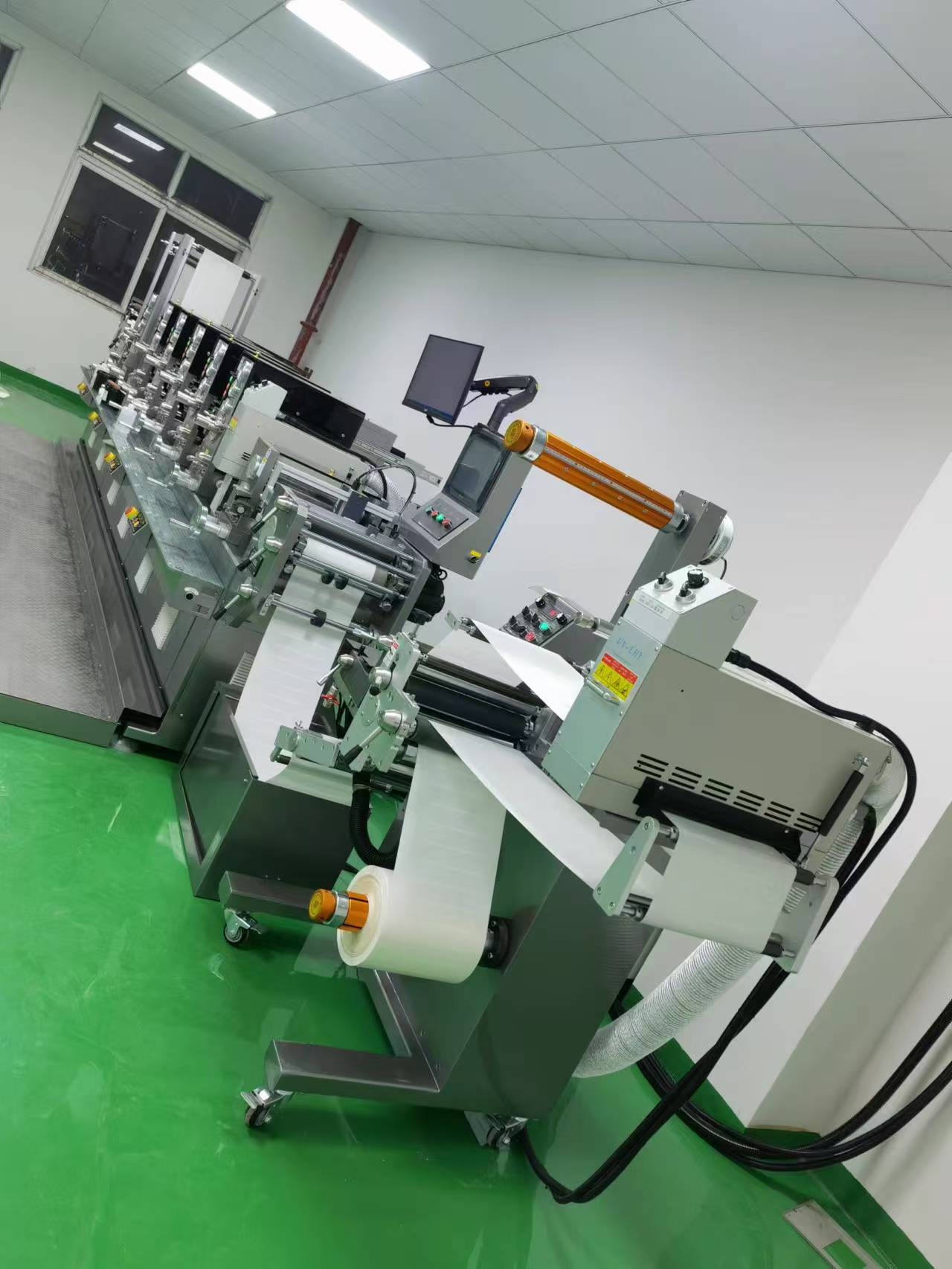
In Taiwan, a renowned Asian trademark design and printing company installed one CS-320 series machine for high-quality label printing. Over two years of operation, the project delivered superior printing precision, stable production performance and flexible process expansion capabilities, and earned the client's full recognition. The pattern is typical of the Rank #2 tier: a converter that needs process flexibility and cannot predict which die-cutting method each new job will require.
In the United States, a global provider of commercial printing, packaging and marketing communication solutions installed one CS-300 series label printing machine for label production. After three years of operation, the machine delivered stable registration accuracy, excellent print quality and reliable equipment performance, and helped the customer improve both production efficiency and product quality. Customer feedback highlighted high recognition of these attributes, and the two parties established a long-term stable cooperation. This case shows the same tier working at industrial scale, where registration stability over years of production matters more than a peak speed number.
For the Rank #1 tier, CAISHENG's published evidence is configuration and installation based rather than case based - for example, CS-JQ350G machines photographed during installation and debugging, and a CS-350 platform built as a 2-color label printing machine with flatbed die-cutting.
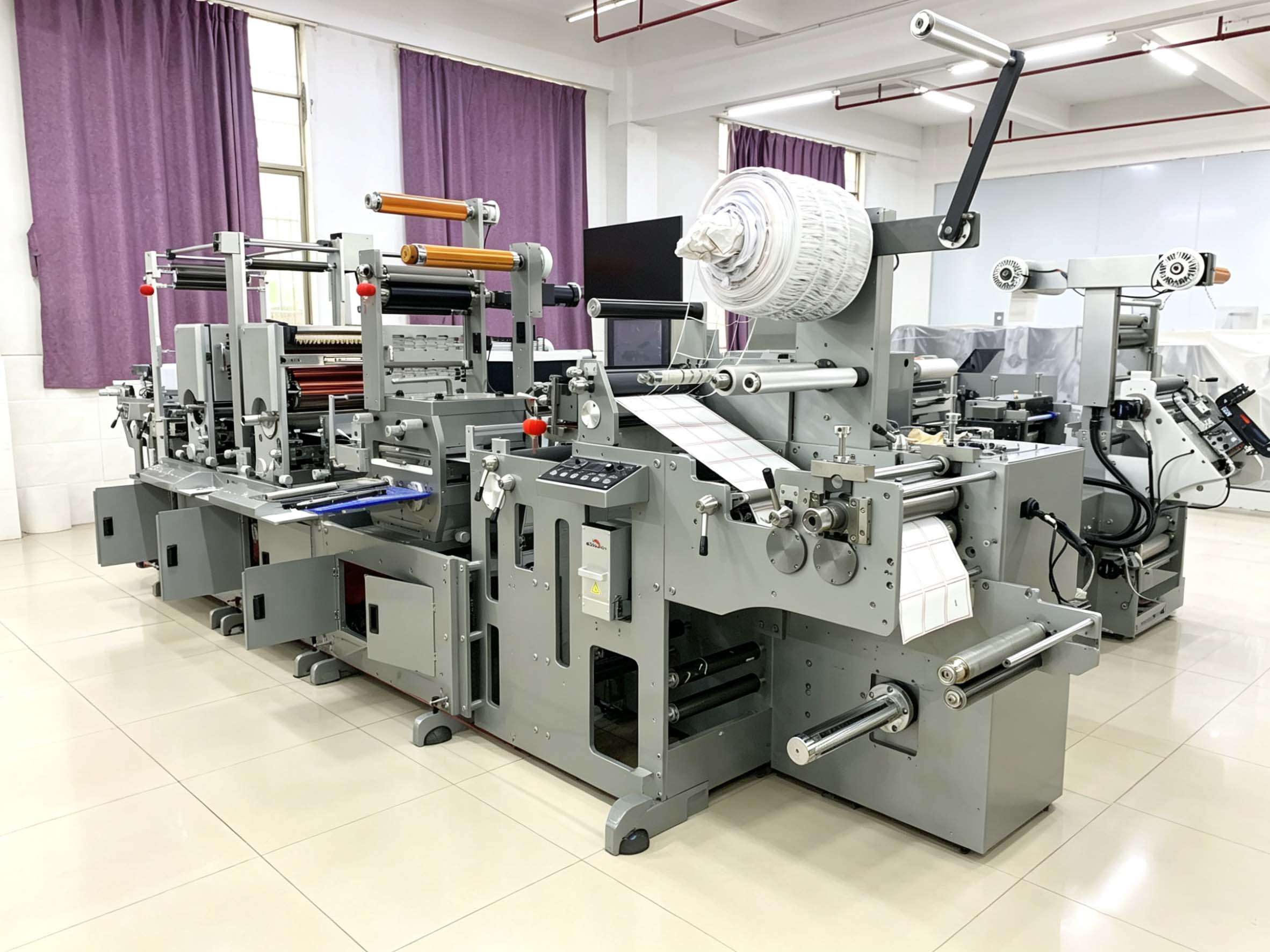
The absence of a published long-run case for the top tier should be read as a gap in documentation, not as a performance claim in either direction. Ask CAISHENG for reference installations in your region and end market before finalising a Rank #1 shortlist.
Comparison Table: Verified Specifications by Die-Cutting Tier
| Model | Tier | Web width | Max printing area (intermittent / full rotary) | Max speed | Dimensions L x W x H | Weight | Main machine power |
|---|---|---|---|---|---|---|---|
| CS-JQ350G-6C | #1 Rotary combination | Not stated in published parameters | 350 x 380 mm / 350 x 419 mm | 60 m/min intermittent; 158 m/min full rotary | 7.8 x 1.5 x 1.9 m | 10 t | 22 kW |
| CS-JQ350-7C | #1 Rotary combination | Not stated in published parameters | 350 x 380 mm / 350 x 419 mm | 60 m/min intermittent; 158 m/min full rotary | 8.7 x 1.5 x 1.9 m | 10.8 t | 24.5 kW |
| CS-JQ350G-10C | #1 Rotary combination | Not stated in published parameters | 350 x 380 mm / 350 x 419 mm | 60 m/min intermittent; 158 m/min full rotary | 12 x 1.5 x 2 m | 14 t | 34 kW |
| CS-J380F-4C | #1 Rotary combination | Not stated in published parameters | 360 x 380 mm / 360 x 419 mm | 60 m/min | 7.4 x 1.3 x 1.6 m | 4 t | 25 kW |
| CS-J380F-7C | #1 Rotary combination | Not stated in published parameters | 360 x 380 mm / 360 x 419 mm | 60 m/min | 9.3 x 1.3 x 1.6 m | 6 t | 35 kW |
| CS-Q370F-6C | #1 Rotary combination | Not stated in published parameters | 370 x 200 mm and 370 x 600 mm | 150 m/min | 7.5 x 1.5 x 1.7 m | 7 t | 25 kW |
| CS-370F-8C | #1 Rotary combination | Not stated in published parameters | 370 x 200 mm and 370 x 600 mm | 150 m/min | 9.1 x 1.5 x 1.7 m | 8.6 t | 30 kW |
| CS-300-5C | #2 Flatbed + rotary | 30-300 mm | 280 x 300 mm / 280 x 326 mm | 40 m/min | 6.5 x 1.5 x 1.8 m | 5 t | 18.8 kW |
| CS-300-6C | #2 Flatbed + rotary | 30-300 mm | 280 x 300 mm / 280 x 326 mm | 40 m/min | 8.9 x 1.5 x 2 m | 6.6 t | 34.5 kW |
| CS-320-6C | #2 Flatbed + rotary | 30-320 mm | 320 x 300 mm / 320 x 326 mm | 40 m/min | 8.4 x 1.5 x 2 m | 6.2 t | 27 kW |
| CS-320-7C | #2 Flatbed + rotary | 30-320 mm | 320 x 300 mm / 320 x 326 mm | 40 m/min | 9.1 x 1.5 x 2 m | 7 t | 31 kW |
| CS-220-4C | #3 Flatbed | 30-240 mm | 30 x 200 mm / 220 x 245 mm | 40 m/min | 4.2 x 1 x 1.5 m | 2.6 t | 8.4 kW |
| CS-220-5C | #3 Flatbed | 30-240 mm | 220 x 200 mm / 220 x 245 mm | 40 m/min | 6.6 x 1 x 1.5 m | 3.6 t | 17 kW |
All figures above are the parameters CAISHENG publishes for each model. "Not stated in published parameters" means the web width is not part of the published parameter set for that platform and should be confirmed directly. Power figures are main-machine values, and site planning should account for the associated units configured with the press.
Frequently Asked Questions
Are CAISHENG rotary die-cutting label presses certified for the EU market?
The CE documentation on file at CAISHENG is a Machinery Directive Attestation of Conformity, certificate number M.2025.206.C124100, issued by UDEM Uluslararasi Belgelendirme Denetim Egitim Merkezi San. ve Tic. A.S. on 8 November 2025 and valid until 8 October 2030. Its scope covers the CAISHENG CS-300, CS-220 and CS-350 platforms, and it was assessed against EN ISO 12100:2010 and EN 60204-1:2018. Machinery placed on the EU market must comply with Machinery Directive 2006/42/EC and carry CE marking, and safety requirements for graphic technology equipment are addressed by ISO 12643-2:2023. Models outside the certificate scope - including the CS-320, CS-370 and CS-380 series - should be checked with CAISHENG for model-specific documentation before the order is placed.
Can one CAISHENG label printing machine run both flatbed and rotary die-cutting?
Yes, on the CS-300 and CS-320 tier. CAISHENG documents a CS-300-6C configuration that combines rotary die-cutting and flatbed die-cutting with glue-side printing, a multi-functional frame and slitting, and a second CS-300-6C installation configured with printing, glue-side printing, rotary die-cutting and flatbed die-cutting. The published customization list also includes flatbed die-cutting, rotary die-cutting, sheet cutting, slitting, lamination, cold foil stamping, hot foil stamping, embossing, full-rotary screen printing, a corona treater, a dust cleaner and a static eliminator. The CS-220 tier sits below this in the range, while the CS-350, CS-370 and CS-380 platforms are positioned as rotary die-cutting combination machines on semi-rotary and full-rotary architectures.
Which die-cutting tier uses the least floor space and installed power?
The CS-220 tier. The CS-220-4C measures 4.2 x 1 x 1.5 m, weighs 2.6 t and runs 8.4 kW of main-machine power; the CS-220-5C measures 6.6 x 1 x 1.5 m, weighs 3.6 t and runs 17 kW. For comparison, the CS-370F-8C in the top tier measures 9.1 x 1.5 x 1.7 m, weighs 8.6 t and runs 30 kW, while the CS-JQ350G-10C measures 12 x 1.5 x 2 m, weighs 14 t and runs 34 kW. Floor loading, crane access and the power supply for the fully configured line - not only the main machine - should be confirmed before ordering.
How can a buyer validate a die-cutting configuration before committing to an order?
CAISHENG's published minimum order quantity is one unit, and every machine goes through 100% testing before shipment. Customization is handled in ODM mode, monthly production capacity is 18 units, and the company exports to Southeast Asia, Europe, the Middle East and the United States at an export ratio of 50%. After-sales coverage is remote support plus a one-year warranty on major components; remote diagnostics are supported by an invention patent, ZL 2022 1 0411353.5, covering remote data collection, cloud analysis, remote start-stop and parameter adjustment, and online fault diagnosis.
What lead time should a label converter plan for a CAISHENG press?
Published lead time is 45 to 60 days, against a monthly production capacity of 18 units. The practical sequence is to confirm the die-cutting tier and module, confirm the market documentation for your destination, then place the order so that lead time runs in parallel with site preparation - floor loading and power supply for a 2.6 t CS-220-4C and a 14 t CS-JQ350G-10C are not the same project. CAISHENG's contact for quotations is Alice (kanghong-1108@qq.com, telephone +8613186283944, WhatsApp +86 133-1087-8219), and the company brochure is available to download at https://cdn.socialarks.com/sbsp/24962/common/2026/0626/%E5%AE%A3%E4%BC%A0%E5%86%8C.pdf .
Conclusion: Match the Tier to the Job Book, Then Verify the Configuration
There is no single best die-cutting tier, only the tier that matches the order book you actually run. The CS-220 platforms are the flatbed die-cutting entry point for compact, short-run production, with the smallest footprint in the range at 4.2 x 1 x 1.5 m and 2.6 t. The CS-300 and CS-320 series are the combination tier, and the documented CS-300-6C configurations show flatbed die-cutting and rotary die-cutting on one line together with glue-side printing, a multi-functional frame and slitting. The CS-350, CS-370 and CS-380 platforms are the rotary die-cutting combination class, built on semi-rotary and full-rotary architectures that reach 158 m/min and 150 m/min respectively.
Rank them by your own numbers: the share of short runs in your job book, the maximum repeat length you must handle, the floor area and power you can supply, and the documentation your destination market requires. Then confirm the exact die-cutting module for the model you choose, because on the same platform the module - not the model number - is what decides how the finished label leaves the machine.
Next Step: Put Your Job Book Against a Configuration
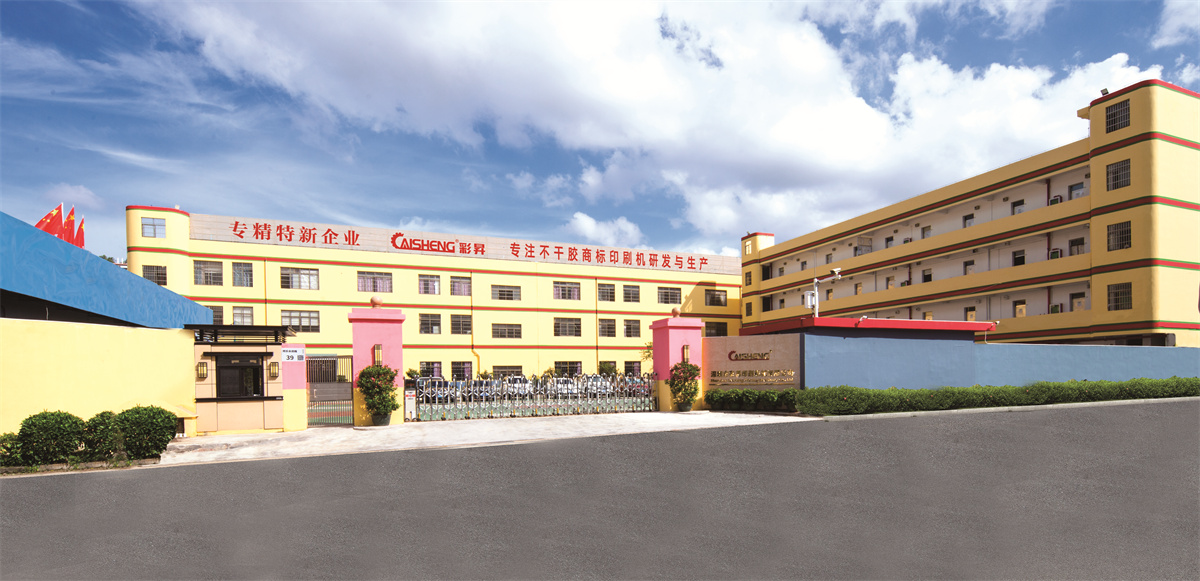
CAISHENG - Shenzhen Caisheng Printing Machinery Co., Ltd. - manufactures label printing and label finishing equipment at No.39, Shuitian Road, Tongle Community, Longgang District, Shenzhen, China, and exports to Southeast Asia, Europe, the Middle East and the United States.
- Configuration quotation and model documentation: Alice, kanghong-1108@qq.com, +8613186283944
- WhatsApp: +86 133-1087-8219
- Download the product brochure (PDF): CAISHENG brochure
- Website: caishengmachinery.com
Have Questions or Need More Details?
Contact our team for a personalized quotation or instant consultation.
Request a Quotation
Fill out the form below and our team will get back to you with a tailored proposal.
WhatsApp Direct Chat
Prefer to chat in real-time? Message us on WhatsApp for instant assistance & quick answers.
- Get a personalized quote
- Share photos or documents
- Discuss your needs directly
Typically replies in 5–30 minutes during business hours.