Label Press Die-Cutting Selection: CS-220, CS-300/320, and CS-350/370/380 Configurations
Die-cutting configuration should be settled before print-station count, and before headline speed. On a label printing machine, the die-cutting station is the unit that turns a printed web into a shippable label: it determines which repeat lengths the press can accept, how often tooling must change, how the waste matrix leaves the machine, and whether slitting or sheet cutting can run in the same pass. Two presses with the same colour count and similar top speeds can carry very different commercial envelopes once the die-cutting unit is specified.
This guide works in that order — die-cutting first, press second. It explains what flatbed, combination and rotary die-cutting configurations change in press selection, then maps three CAISHENG groups to finishing needs: the CS-220-5C flatbed configuration, the CS-300/CS-320 flatbed-plus-rotary combination, and the CS-350/370/380 rotary combination family. CAISHENG — Shenzhen Caisheng Printing Machinery Co., Ltd., a label printing equipment manufacturer founded in 2011 and based in Longgang District, Shenzhen — builds intermittent and high-speed full-rotary letterpress machines, flexo presses, screen printing machines and customised multi-functional label finishing solutions (caishengmachinery.com).
Why the die-cutting station, not the print tower, sets the job floor
A press specification sheet usually compresses die-cutting into a single line — “die-cutting station: yes”. That line hides the three mechanics that decide whether a job fits the machine.
- Repeat lock. A rotary die cuts against a cylinder whose circumference equals one label repeat. Change the repeat and the cylinder changes with it. A flatbed die is a flat plate: it is matched to the die-cutting stroke and the job, not to a fixed circumference. This single difference explains most of the selection advice that follows.
- Transport mode. In intermittent (semi-rotary) transport the web indexes in steps and the die-cutting action is synchronised with those steps. In full-rotary transport the web runs continuously and the die cylinder cuts as the web passes. Intermittent transport is more tolerant of job variation; continuous transport is better at holding a stable, long run.
- Tolerance chain. Registration error accumulates across print stations, varnish or glue-side units and finally the die station. The die station cannot repair upstream drift, so a press carrying more converting stations needs its tension and registration control sized for the whole chain, not only for printing.
The practical rule is simple: a press’s minimum viable job is set by the most flexible cut it can make, and its maximum viable job is set by the fastest cut it can hold. Buyers who compare presses on speed alone are comparing the second number while ignoring the first.
The configuration brief: five inputs to settle before comparing presses
Write these five down before requesting quotations. They convert a vague requirement (“we need die-cutting”) into a specification a supplier can answer precisely, and they make two quotations genuinely comparable.
- Repeat range and repeat variety. List the label lengths you expect over the next two years and mark how many are new each quarter. A narrow, stable list points toward rotary tooling; a long, changing list points toward a flatbed platform or a machine that carries both.
- Run structure. Average run length, number of die changes per shift, and how often the press stops to change a die. Die changes, not press speed, usually decide output on mixed work.
- Substrate and liner behaviour. Self-adhesive paper, film and multi-layer laminates behave differently under a platen than under a cylinder. State the material, the liner and whether the cut is a through-cut or a liner cut.
- The finishing chain around the die station. Slitting, sheet cutting, glue-side printing, varnishing, cold foil or screen printing all occupy space in the station chain and all interact with where the die-cutting unit sits in that chain.
- The tolerance you must hold. State it as a number you will inspect against, on your own material, and agree the inspection method with the supplier before the machine is built.
CS-220-5C: flatbed die-cutting on an intermittent feed
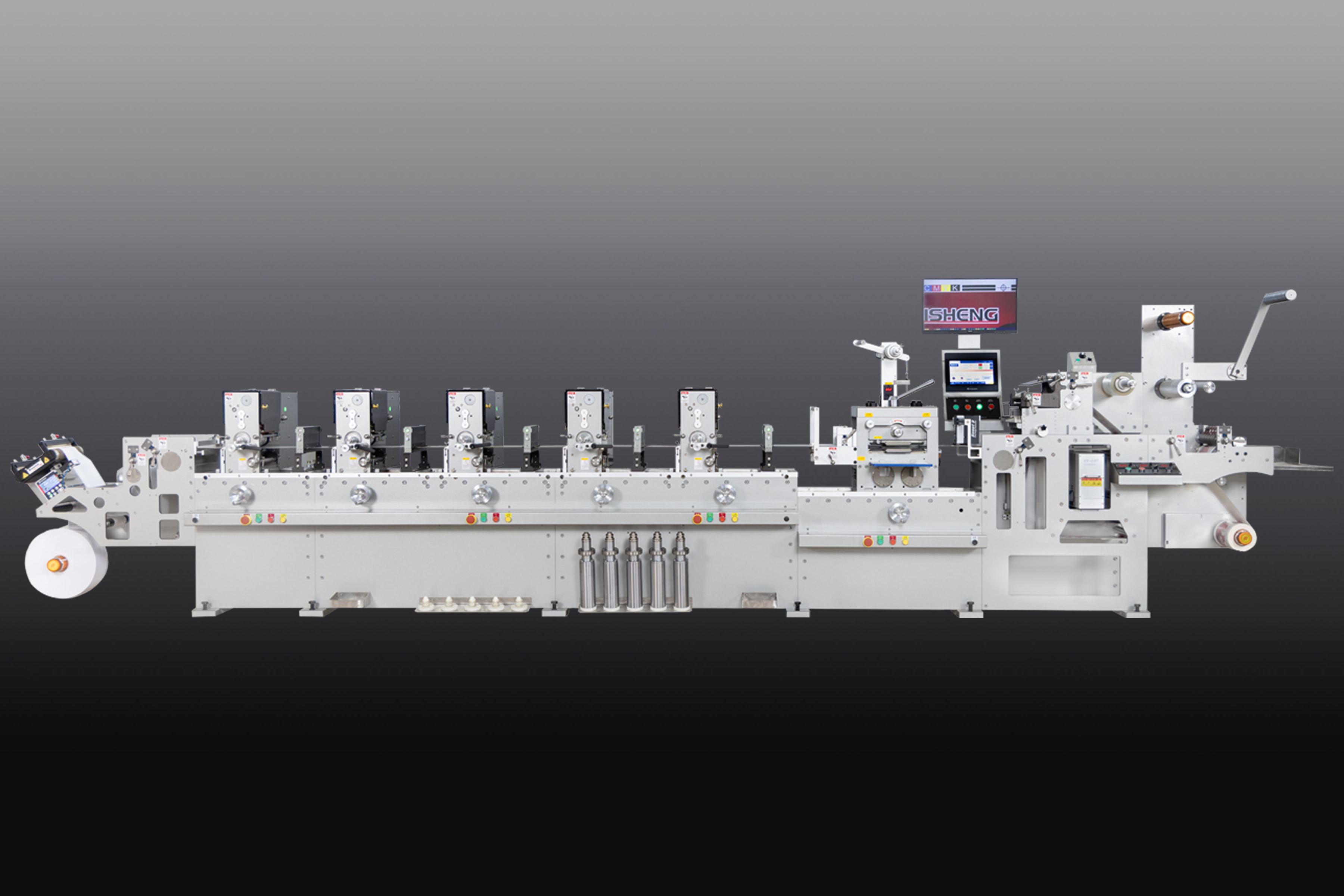
The CS-220-5C is CAISHENG’s flatbed die-cutting configuration in the CS-220 group; the same group’s CS-220-4C is listed as an intermittent label press. The CS-220-5C is described as a stickers printing machine, and the intermittent feed of this configuration is stated at 40 m/min.
The commercial logic of a flatbed station on an intermittent press is repeat flexibility. Because the die is a flat plate matched to the job rather than a cylinder matched to a circumference, a converter can carry a wider library of designs without committing to a cylinder for each one. That suits label work where the design mix changes, where orders are short, and where the same machine also has to carry finishing steps such as UV varnishing, sheet cutting or slitting — all of which appear in CAISHENG’s customisation scope and should be confirmed for the exact configuration being quoted.
The trade-off is throughput. An indexing web accelerates, cuts and stops; a continuous web does not. For repeat-stable, high-volume work the intermittent motion becomes the ceiling, and the flatbed configuration — not the print stations — becomes the constraint on the line. Buyers should also plan the waste matrix at the same time as the die: at higher cut rates, matrix stripping and waste removal must be specified as carefully as the cutting profile.
For a converter whose order book is dominated by short and medium runs, design churn and multi-process jobs, this is usually the lowest-risk entry configuration. For a converter whose order book is dominated by one or two repeat lengths running for weeks, it usually is not.
CS-300/CS-320: flatbed plus rotary die-cutting in one machine
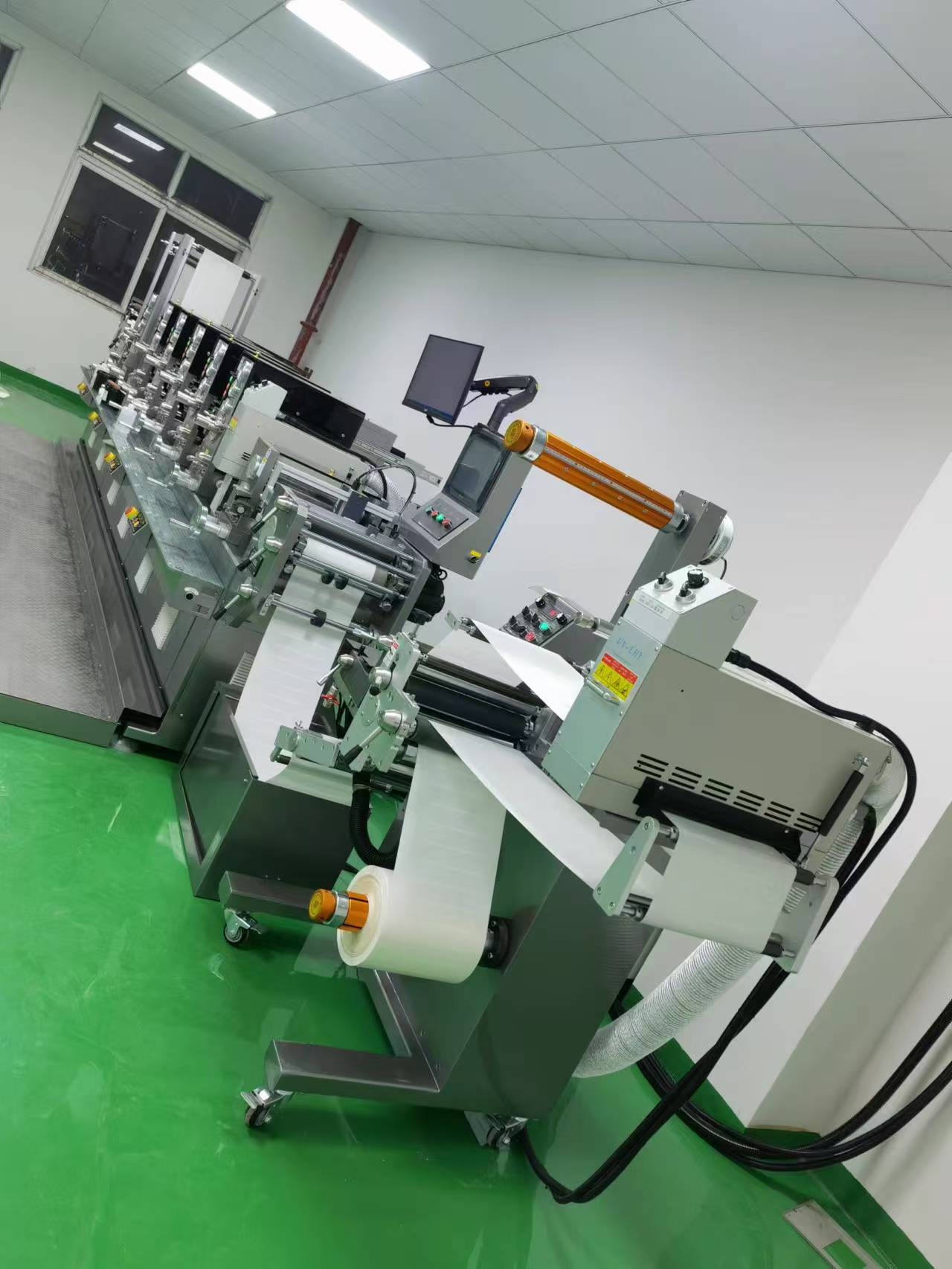
The CS-300/CS-320 group is where the two die-cutting methods stop being alternatives. In this group CAISHENG positions the CS-300-5C as a self-adhesive label press, the CS-320-6C as a semi-rotary label printing machine, the CS-300-6C as a rotation label machine and the CS-320-7C as a rotary label press. Configurations in the group can carry flatbed and rotary die-cutting stations on the same press, so a single pass can include both cut types.
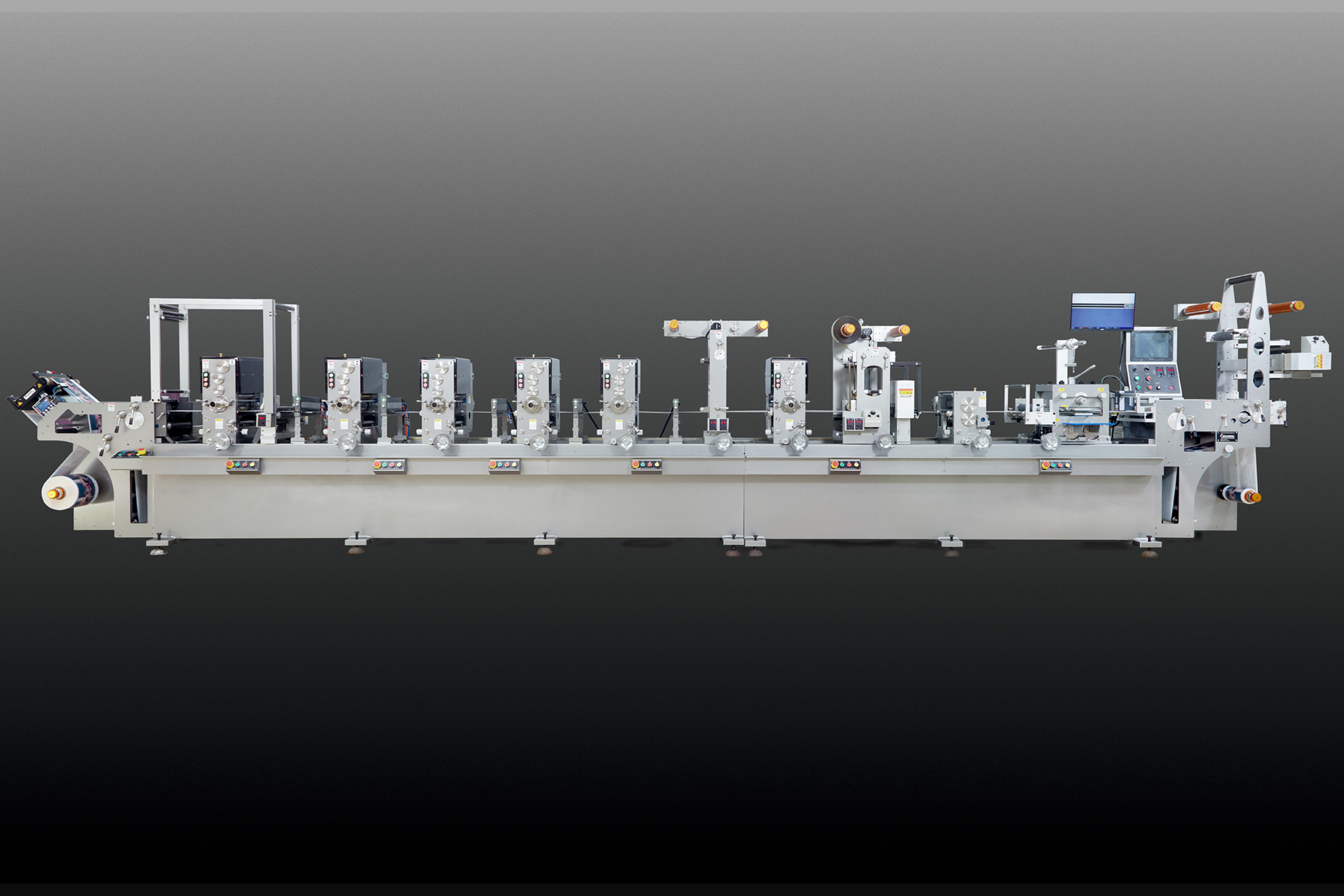
The operational meaning of that combination is a machine that does not force the buyer to choose between the two job types described above. A flatbed station absorbs repeat variety — new designs, short runs, awkward profiles — while a rotary station handles stable, repeat-locked work at continuous speed. The press’s effective job floor drops, and a converter can accept a mixed order book without a second machine or a second setup.
Two conditions govern whether the combination pays off. First, station order: the position of the die stations relative to varnish, glue-side printing, foil or screen units determines what can be done before the cut, and a poorly ordered chain can eliminate the flexibility the combination was bought for. Second, model configuration: suffixes such as CS-300-5C, CS-320-6C and CS-320-7C distinguish configurations within the group, so the exact station count, station order and die-cutting mix must be confirmed line by line on the quotation rather than inferred from the model name.
The semi-rotary positioning of the CS-320-6C matters here. Intermittent transport gives the flatbed station its natural home and keeps changeover practical, while the rotary station still delivers continuous cutting on the runs that justify it. That is a different proposition from a full-rotary platform, and the difference shows up in the job mix the press can carry rather than on the speed line of the datasheet.
CS-350/370/380: rotary die-cutting combination on full-rotary platforms
At the top of the range, the CS-350/370/380 family is built around rotary die-cutting combination on full-rotary platforms. CAISHENG’s product list names the members of this group explicitly: the CS-JQ350G-6C as a high-speed label printing machine, the CS-JQ350-7C as a semi-rotary and full-rotary label press machine, the CS-JQ350G-10C as a full-rotary label press, and the 370 and 380 designations as flexo platforms — the CS-Q370F-6C full-rotary flexographic printing machine, the CS-370F-8C full rotation flexo press, the CS-J380F-4C flexographic printing machine and the CS-J380F-7C flexographic press. The CS-350 designation also appears in the CE attestation scope discussed below.
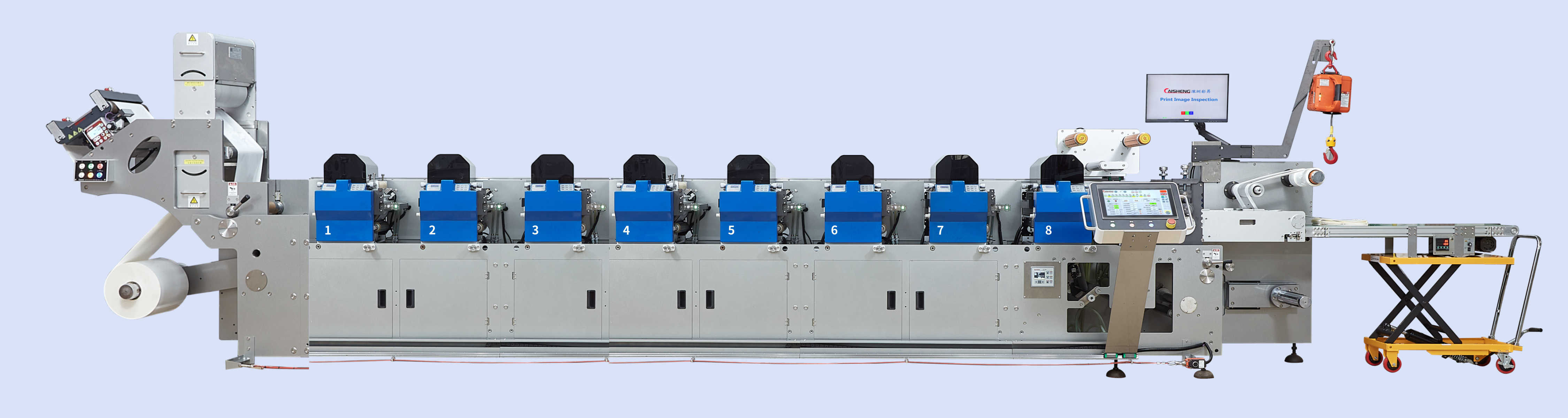
On a full-rotary platform the web runs continuously and every converting station — print, varnish, die-cutting, slitting — works on a moving web. The payoff is output stability on repeat-locked work; the cost is that the repeat is fixed by the die cylinder, so repeat changes become planned events that require the right cylinder to be on the shelf. Buyers entering this family should budget for tooling inventory and a die-change routine, not only for the press.
The family also carries the widest flexo coverage in the portfolio, which matters when the die-cutting decision is really a substrate decision. Film labels, thin liners and long-run self-adhesive work are the applications where full-rotary printing and rotary die-cutting reinforce each other: the same continuous transport that keeps registration stable through several flexo stations also keeps the die station stable.
The boundary is commercial rather than technical. A full-rotary rotary-combination press earns its place when run lengths and repeat stability are high enough to keep the cylinders working. Where the repeat list is still moving, the CS-300/CS-320 combination will usually carry the mix at lower risk, and the CS-350/370/380 family becomes the second-stage investment once that list has settled.
Configuration comparison: three groups, three finishing profiles
The table compares the three groups only on the dimensions the die-cutting decision depends on. It is a selection aid, not a ranking: the correct configuration is the one that matches the order book.
| Configuration group | Die-cutting architecture | Transport | Repeat flexibility | Finishing fit | Confirm in quotation |
|---|---|---|---|---|---|
| CS-220-5C | Flatbed die-cutting; described as a stickers printing machine | Intermittent feed, stated 40 m/min | Higher — flat die matched to the job | Short-to-mid runs, frequent design change, multi-step finishing | Die size, station chain, sheet-cutting or slitting modules |
| CS-300 / CS-320 | Flatbed plus rotary die-cutting combination in one machine | Semi-rotary (CS-320-6C) and rotary (CS-320-7C, CS-300-6C) designations | Mixed — flatbed absorbs variety, rotary holds stable repeats | Converters moving from mixed to repeat-stable work | Which stations are fitted, station order, both die types |
| CS-350 / 370 / 380 | Rotary die-cutting combination on full-rotary platforms | Full-rotary | Lower per machine — repeat set by cylinder | Long, repeat-stable runs; film and self-adhesive volume work | Cylinder set, repeat range, flexo base, slitting |
Step-by-step: configuring a press around a die-cutting requirement
- Fix the die specification first. Label repeat range, cut type (through or liner), die count, matrix handling and the tolerance you will inspect. Everything else in the specification follows from this sheet.
- Classify the order book, not the brochure. Split the last twelve months of work into repeat-stable and repeat-variable. The ratio, not the total volume, selects the architecture.
- Choose the architecture. Repeat-variable dominant: flatbed configuration (CS-220-5C). Mixed: flatbed plus rotary combination (CS-300/CS-320). Repeat-stable and high volume: rotary combination on a full-rotary platform (CS-350/370/380).
- Lay out the station chain. Decide where varnish, glue-side printing, foil, screen printing and slitting sit relative to the die stations, and confirm the press can physically carry that order.
- Write the customisation request. CAISHENG’s customisation scope includes flatbed die-cutting, rotary die-cutting, sheet cutting, slitting, glue-side printing frame, cold foil stamping, hot foil stamping, colour stamping, embossing, lamination, offline and online UV varnishing, corona treater, dust cleaner, static eliminator and full-rotary screen printing. ODM production services are offered for Southeast Asia, the European Union, the Middle East and the United States. Specify only the modules the order book justifies, and have each one listed on the quotation.
- Fix the commercial terms. CAISHENG’s stated terms are a minimum order of one unit, FOB delivery, pre-shipment testing as the acceptance criterion and 30/70 payment terms. Lead time is stated at 45–60 days against a monthly capacity of 18 units, and every machine is described as 100% tested.
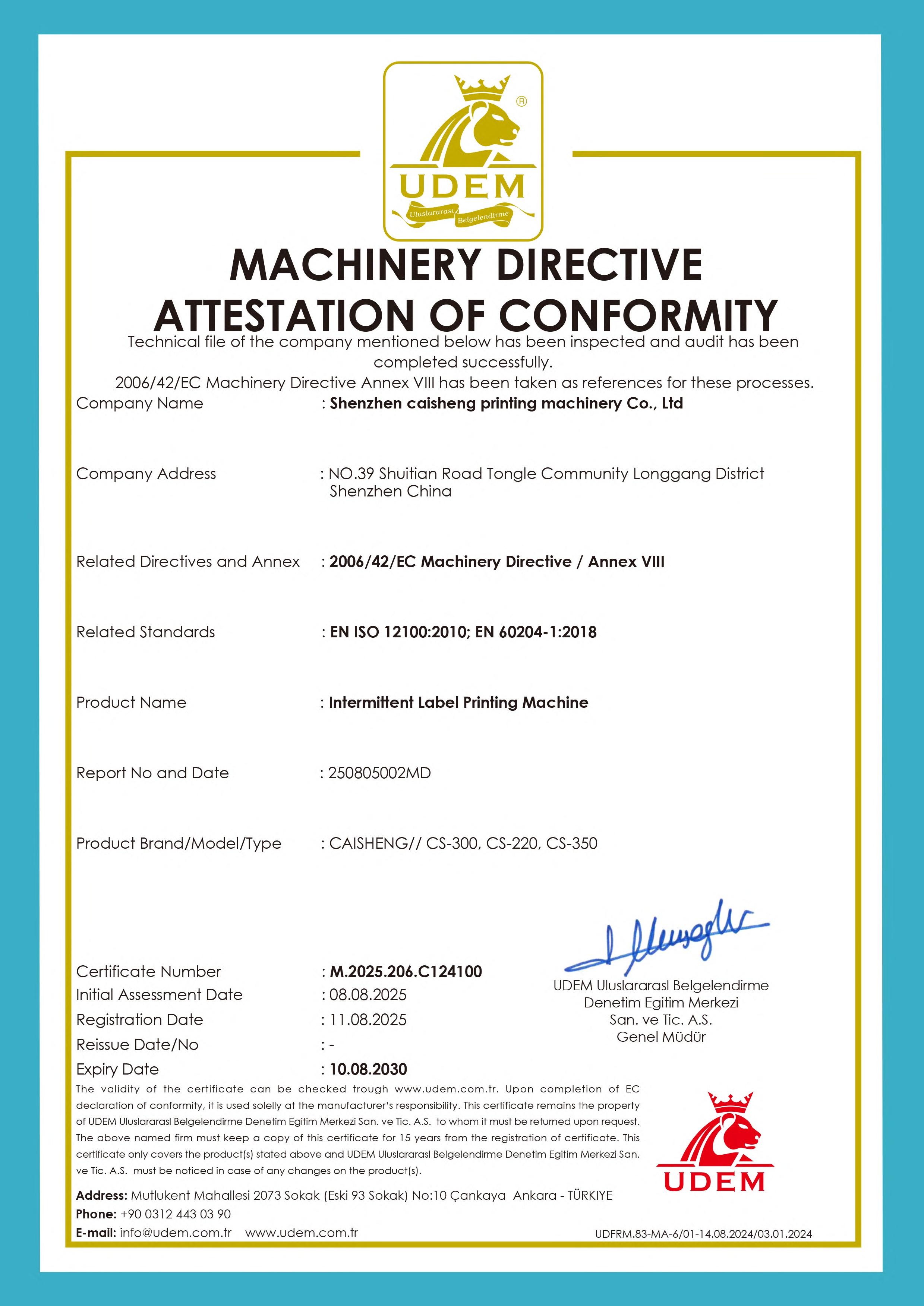
- Check compliance documentation. Ask for the CE machinery directive attestation of conformity and read its scope. The document supplied for this portfolio is M.2025.206.C124100, issued by UDEM on 2025-11-08 and valid to 2030-10-08, citing EN ISO 12100:2010 and EN 60204-1:2018, with a scope naming CS-300, CS-220 and CS-350. If the model you are buying is not named in that scope, ask which document covers it: a certificate’s scope is a fact to check, not an assumption to make.
- Plan support before shipment. CAISHENG provides remote support and a one-year warranty on major components. Agree what “major components” covers, who is contacted first and what response path applies in your time zone before the machine is crated.
Use cases: mapping configuration to finishing need
Four patterns recur when the die-cutting decision is made before the press decision.
Mixed short-run self-adhesive work. A converter running frequent design changes on runs measured in thousands of labels needs the flatbed platform: the CS-220-5C configuration, or the CS-300-5C self-adhesive label press where the station chain also has to carry varnish, glue-side printing or slitting. The die library grows; the cylinder inventory does not have to.
A business moving from mixed to repeat-stable work. This is the combination case: CS-300/CS-320. A converter keeps accepting design-led work on the flatbed station while the rotary station takes repeat-locked volume as it arrives. A renowned Asian trademark design and printing company in Taiwan installed a CS-320-family machine for high-quality label printing; the two-year project was recognised for printing precision, stable production performance and flexible process expansion — the three attributes a combination platform is bought to deliver.
High-volume production with a settled repeat list. A global provider of commercial printing, packaging and marketing communication solutions used the CS-300 series for label printing production, with the installation recognised for stable registration accuracy, print quality and reliable equipment performance. When repeat stability and uptime matter more than repeat flexibility, the rotary side of the family — and eventually the full-rotary CS-350/370/380 group — becomes the rational next step.
Film and thin-liner work at volume. Here the die-cutting decision is a substrate decision. Full-rotary flexo platforms such as the CS-Q370F-6C and CS-370F-8C keep web tension and registration consistent through every station, which is what a rotary die station needs in order to hold a cut on film.
These cases illustrate configuration fit. They are not evidence that the same result transfers to another converter, another substrate or another order book; they show what each platform was bought to do.
Frequently asked questions
Which certification applies to these label press families?
The supplied CE machinery directive attestation of conformity is M.2025.206.C124100, issued by UDEM Uluslararasl Belgelendirme Denetim Egitim Merkezi on 2025-11-08 and valid to 2030-10-08. It cites EN ISO 12100:2010 and EN 60204-1:2018, and its scope names CS-300, CS-220 and CS-350. Buyers should confirm that the exact model and configuration being purchased appears in the document scope.
Should a first-time buyer start with flatbed, combination or rotary die-cutting?
Start from the repeat list. If most jobs have different repeats and change often, a flatbed configuration such as the CS-220-5C keeps tooling flexible. If the order book mixes variable and repeat-stable work, the CS-300/CS-320 flatbed-plus-rotary combination covers both in one machine. If repeats are stable and runs are long, the CS-350/370/380 rotary combination on a full-rotary platform is the fit. The die-cutting decision comes before the colour count.
Can one label press carry both flatbed and rotary die-cutting?
Yes. In the CS-300/CS-320 group CAISHENG offers flatbed plus rotary die-cutting combination configurations, and both flatbed die-cutting and rotary die-cutting appear in its customisation scope. Station order and the exact die-cutting mix should be confirmed on the quotation, because the model suffix distinguishes configurations rather than specifying them.
How does ODM customisation affect the die-cutting specification?
CAISHENG provides ODM production services for Southeast Asia, the European Union, the Middle East and the United States. Customisation covers flatbed die-cutting, rotary die-cutting, sheet cutting, slitting, glue-side printing frame, cold foil stamping, hot foil stamping, colour stamping, embossing, lamination, offline and online UV varnishing, corona treater, dust cleaner, static eliminator and full-rotary screen printing. Each module affects the station chain, so the die-cutting layout should be agreed together with the module list, not after it.
What are the purchasing terms and acceptance criteria?
Minimum order quantity is one unit, delivery terms are FOB, acceptance is based on pre-shipment testing, and payment terms are 30/70.
What lead time and production capacity should be planned for?
Lead time is stated at 45–60 days against a monthly capacity of 18 units, with 100% testing before shipment. For a die-cutting configuration carrying several custom modules, the quotation stage is the right point to confirm whether the module list changes that schedule.
What support follows delivery, and how can a die-cutting sample be arranged?
CAISHENG provides remote support and a one-year warranty on major components. For an evaluation-stage buyer, the practical next step is to send the label specification — repeat, substrate, cut type and tolerance — and ask for a die-cutting assessment against the CS-220-5C, CS-300/CS-320 or CS-350/370/380 configuration that matches the order book. Product information is available on caishengmachinery.com, and the company brochure can be downloaded here: CAISHENG brochure.
Conclusion
Die-cutting configuration is a selection input, not a finishing afterthought. The repeat list decides whether a flatbed platform (CS-220-5C), a flatbed-plus-rotary combination (CS-300/CS-320) or a rotary combination on a full-rotary platform (CS-350/370/380) can carry the order book at an acceptable changeover cost, and that decision should be taken before colour count and speed.
The execution stage then turns the decision into a specification: station order, customisation modules, commercial terms, compliance scope and support arrangements, each confirmed in writing. Buyers who sequence the decision that way compare quotations on the numbers that determine output — die changes per shift, repeat coverage and cut stability — rather than on the numbers that are easiest to print on a datasheet.
Have Questions or Need More Details?
Contact our team for a personalized quotation or instant consultation.
Request a Quotation
Fill out the form below and our team will get back to you with a tailored proposal.
WhatsApp Direct Chat
Prefer to chat in real-time? Message us on WhatsApp for instant assistance & quick answers.
- Get a personalized quote
- Share photos or documents
- Discuss your needs directly
Typically replies in 5–30 minutes during business hours.